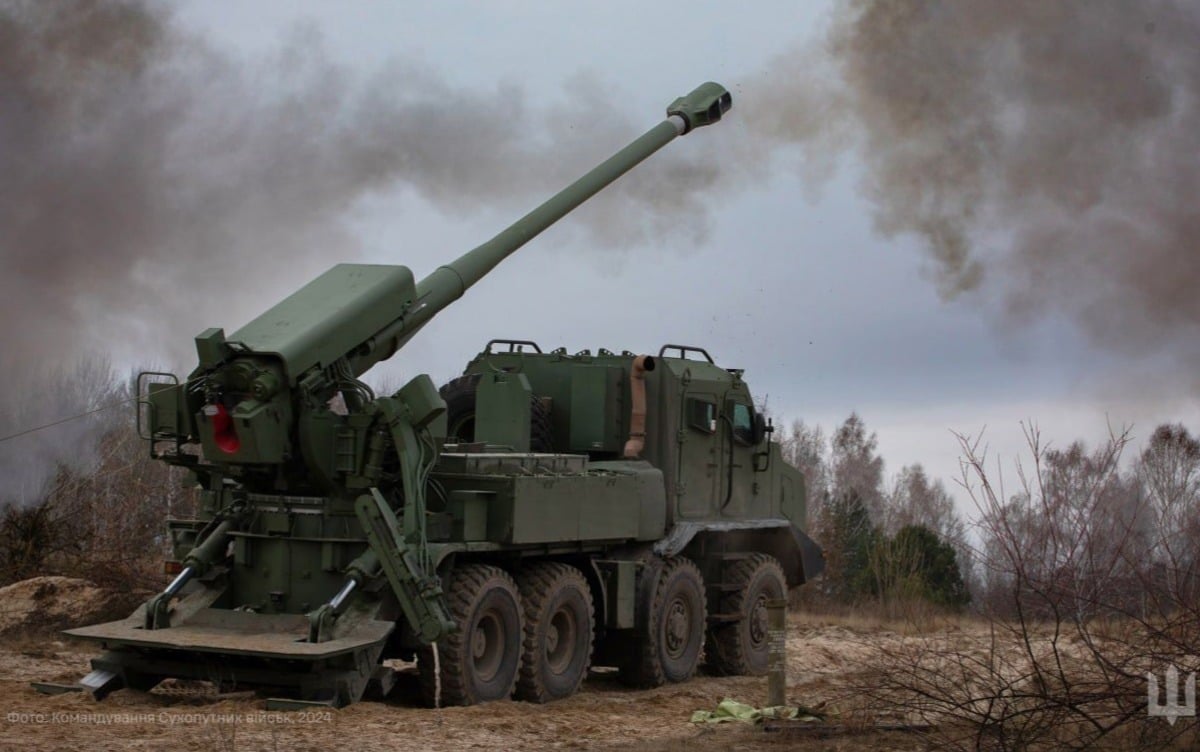
Military analysts love to obsess over maximum firing range. They look at spreadsheets, compare maximum distances, and assume that longer is always better. When news broke that the Ukrainian defense forces started testing a new domestic 155mm towed howitzer named the Marta, the armchair generals immediately pointed out its flaw. The weapon features a 39-caliber barrel. That is significantly shorter than the 52-caliber barrel found on Ukraine's flagship self-propelled artillery system, the Bohdana.
A shorter barrel means a shorter firing range. On paper, it looks like a step backward. Why would a military locked in a high-stakes artillery duel build a weapon that cannot shoot as far as its existing systems?
The reality on the ground dictates a completely different set of priorities. Out in the mud, survival depends on things spreadsheets ignore. Weight matters. Camouflage matters. The specific types of ammunition sitting in your supply depots matter more than theoretical maximums. The Marta howitzer is not a step backward. It is a highly practical, combat-driven answer to the brutal realities of modern trench warfare.
The Real Reason Ukraine Wants Smaller Towed Guns
You cannot understand the Marta without understanding the shift in how artillery operates today. Drone-dominated skies mean that if you stay in one place for too long, you die. Large, heavy artillery pieces take too much time to dig in, too much time to pack up, and are incredibly difficult to hide from overhead surveillance.
The Bohdana-BG, which is a towed system using a massive 52-caliber barrel, has proven its accuracy and power in frontline units like the 147th Separate Artillery Brigade. Gun crews call it a sniper rifle. It hits targets out to 41 kilometers with standard shells. But that performance comes with a massive physical footprint. It stretches 13.5 meters in its transport configuration. Moving something that size through tree lines and ruined villages is a logistical nightmare.
That is where the Marta steps into the picture. By shrinking the barrel to 39 calibers, Ukrainian engineers radically reduced the weapon's overall size and weight.
A lighter gun changes everything. It means you do not need a massive, specialized heavy prime mover just to drag the weapon into position. Smaller vehicles can handle the towing job. This opens up a wider variety of deployment options. When a gun crew needs to shift positions under fire, every second saved during the hook-up process translates directly into lives saved.
Smaller dimensions also make the gun vastly easier to hide. In a war where cheap thermal-imaging drones hunt for artillery around the clock, effective camouflage is your primary armor. A compact gun can tuck into smaller tree lines. It requires less netting. It blends into the broken terrain much faster than a massive 52-caliber monster. Speed and concealment are the new metrics for artillery survival.
Unpacking the Engineering Behind the 39 Caliber Marta
The engineering choices behind the Marta reveal a deep understanding of the global ammunition supply. People often assume that NATO standard 155mm ammunition is all the same. It is not.
The most common 155mm projectile in the world today is the aging M107 shell. These rounds entered mass production decades ago. Millions of them sit in Western stockpiles, and they comprise a huge portion of the military aid flowing into Ukraine. Here is the catch. The M107 was specifically designed to reach its peak ballistic efficiency when fired from a 39-caliber barrel.
When you shove an old M107 shell into a modern 52-caliber system like the Bohdana or a French Caesar, you do not get the massive range boost you might expect. Long 52-caliber barrels feature much larger powder chambers. They require massive, high-pressure propellant charges to get the projectile moving fast enough to utilize that extra barrel length. If you use standard or smaller charges meant for older shells, the oversized chamber actually hurts performance. You end up wasting energy.
The Marta matches the weapon to the available logistics. It is optimized for the exact shells Ukraine receives in the highest volumes.
- It maximizes the velocity of older stockpiled ammunition without stressing the barrel.
- It uses smaller, more readily available propellant charges.
- It reduces internal wear and tear, extending the operational life of the weapon.
- It simplifies the manufacturing process for domestic barrel production.
Colonel Andriy Zhuravlev, a senior figure in the Rocket Forces and Artillery Command, confirmed that the Marta is undergoing active testing. Military planners are also eyeing a shorter 39-caliber variant for the self-propelled Bohdana system. Standardizing these barrels across both towed and wheeled platforms will drive down maintenance costs. It makes spare parts interchangeable. If a barrel gets damaged by counter-battery fire or worn out from rapid firing, swapping it out becomes a straightforward logistics task rather than an engineering crisis.
How the Zetros Truck Supply Reshapes Frontline Mobility
A towed howitzer is only as mobile as the truck pulling it. For a long time, Ukrainian artillery relied heavily on aging Soviet-era KrAZ trucks or tracked MT-LB vehicles to move heavy guns. These legacy vehicles are loud, prone to breaking down, and hard to find spare parts for.
The entire mobility equation changed as Germany accelerated its delivery of specialized tactical vehicles. The Mercedes-Benz Zetros truck has become the backbone of Ukrainian frontline logistics. Built specifically for brutal off-road conditions, these trucks offer the mechanical reliability that frantic combat operations demand.
Look at the numbers coming out of the defense ministries. Germany funded a massive 750 million euro project to supply Ukraine with 200 Bohdana self-propelled artillery units mounted directly onto these rugged Zetros chassis. Alongside those systems, well over 300 Zetros logistics trucks, fuel tankers, and recovery vehicles have entered active service, with hundreds more on order.
While the self-propelled Bohdana units occupy the high-end, highly automated tier of the army, the towed Marta howitzers benefit immensely from this same fleet. A Zetros 4x4 or 6x6 truck provides the perfect towing platform for a lightweight, 39-caliber gun.
These trucks handle deep mud, trenches, and ruined roads without throwing tracks or burning through transmissions. They feature central tire inflation systems, letting drivers drop tire pressure on the fly to cross soft soil without getting stuck. When a Marta crew needs to execute a shoot-and-scoot mission, the combination of a lighter gun and a high-performance German truck allows them to drop into action, fire their rounds, hook up, and vanish before Russian radar can calculate their position.
The Economics of Repurposing Soviet Gun Carriages
Building an entirely new artillery system from scratch is incredibly expensive. It takes years to design, test, and mass-produce carriages, recoil mechanisms, and hydraulic jacks. Ukraine does not have years. It needs solutions right now.
To solve this problem, Ukrainian defense engineers mastered the art of Franken-weapons. They take the best parts of broken or outdated systems and combine them into something entirely new. We saw this with the Bohdana-BG, which mounts a modern 155mm barrel onto the durable carriages of old Soviet 152mm 2A36 Giatsint-B guns.
The Marta follows this exact playbook, but it scales the concept down. By opting for a lighter 39-caliber barrel, engineers can mount the gun onto even lighter legacy carriages. Think of the Soviet-era 152mm D-20 gun-howitzer or the 2A65 Msta-B.
Ukraine holds significant numbers of these older carriages in reserve, or has units sitting in repair depots with worn-out barrels. The original Soviet 152mm barrels are frequently burned out from high rates of fire, and finding new 152mm ammunition is becoming harder as the domestic industry standardizes around NATO 155mm sizes.
Replacing those old barrels with a fresh, domestically produced 155mm 39-caliber Marta barrel instantly resurrects a dead asset. You get a modern, standard-compliant artillery piece at a fraction of the cost of buying a new Western system. It completely bypasses the need to manufacture complex steel trails and wheel assemblies from scratch. You pull an old D-20 carriage out of storage, strip the useless 152mm barrel, bolt on the new 155mm Marta barrel with its upgraded recoil system, and send it to the front.
Why the European Defense Market Is Watching This Experiment
The development of the Marta is not just an internal Ukrainian affair. It represents a major shift that could disrupt the broader European defense market. For the last three decades, Western European militaries completely turned their backs on towed artillery. They focused almost exclusively on highly complex, heavily armored self-propelled systems like the German PzH 2000 or the wheeled French Caesar.
This left a massive gap in the market. Many European countries, including Greece, Finland, Spain, and Romania, still keep significant numbers of towed guns in their active inventories. They use them because they are cheap to maintain, easy to store in reserve depots, and don't require complex electronic maintenance. The problem is that Western defense primes stopped making simple, cost-effective towed 155mm guns. If a country wants to buy towed artillery today, its options are extremely limited.
The United Kingdom is working on local production of the American M777, but that system is notoriously expensive and uses complex titanium components that are hard to manufacture quickly.
Ukraine is positioning itself to fill this exact market gap. Once the immediate pressures of the war ease, the domestic defense industry will possess massive serial production capacities for artillery barrels. With the 52-caliber Bohdana-B occupying the long-range segment, the 39-caliber Marta offers an ideal, budget-friendly alternative for export.
Foreign buyers looking to modernize their artillery regiments will face a simple choice. They can spend tens of millions on hyper-complex automated vehicles, or they can purchase batches of simple, combat-proven Marta howitzers that work reliably with basic, widely available global ammunition stocks.
Moving From Prototype to Frontline Reality
Testing a weapon is one thing. Scaling production to a level that impacts a theater-wide war is another challenge entirely. The true measure of the Marta will be how fast the Kramatorsk Heavy Duty Machine Tool Plant and its partners can churn out these shortened barrels.
We already know Ukraine ramped up its production of self-propelled artillery significantly, building dozens of Bohdana systems every single month. Adding the Marta to the production mix should, in theory, run smoothly because the manufacturing steps for a shorter 39-caliber barrel are less demanding than those for the longer 52-caliber variants.
For commanders in the field, the tactical next steps are clear. They need to identify which artillery brigades are burning through their legacy Soviet ammunition the fastest. Those units should be prioritized for conversion to the Marta platform. Instead of waiting for scarce, high-end Western self-propelled systems to arrive from foreign donors, regional maintenance depots can begin swapping out legacy barrels right near the front lines.
Streamlining this process will allow Ukraine to phase out the old 152mm caliber entirely, unifying its logistics under a single 155mm supply line. It keeps the artillery branch sustainable, flexible, and deadlier than ever.