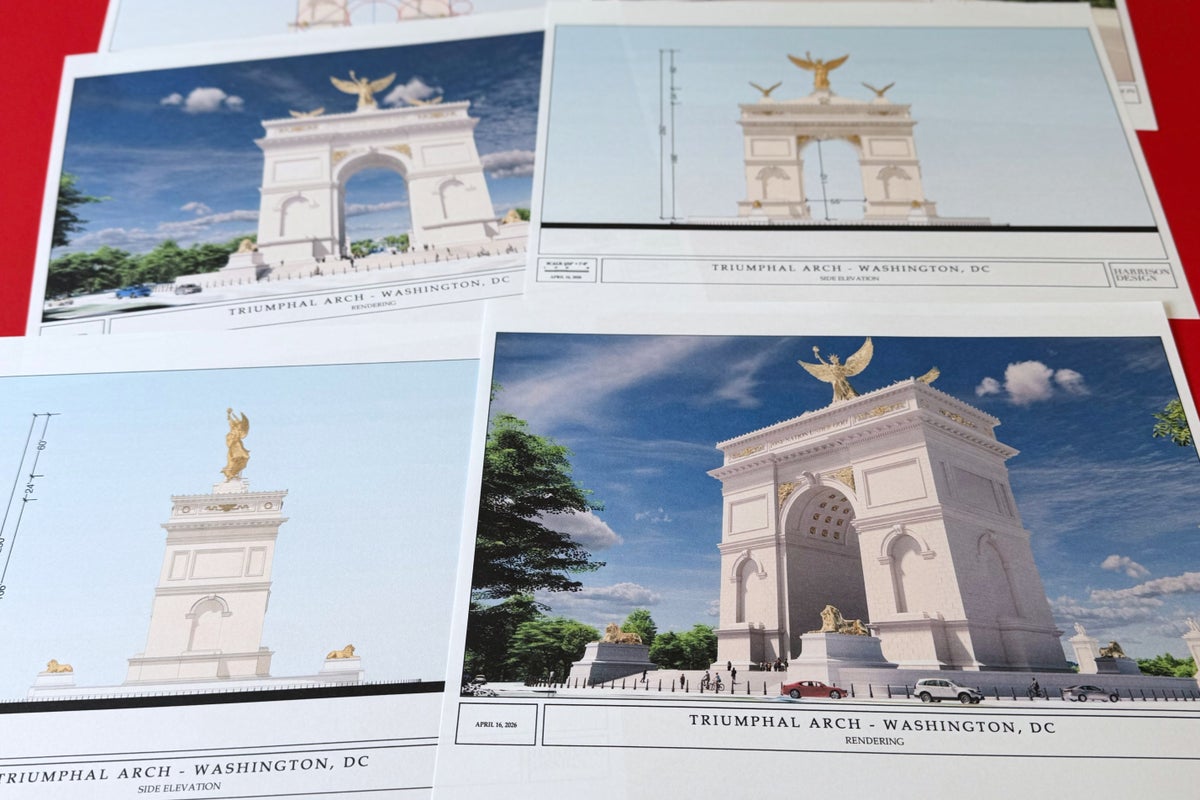
Washington D.C. has a height limit for a reason. It’s supposed to keep the monuments to our ideals taller than the buildings where we work. But a new proposal is currently shaking up the capital's skyline, and it isn't another office block. President Trump wants to drop a 250-foot Triumphal Arch right on the Potomac.
To put that in perspective, the Lincoln Memorial stands at 99 feet. This arch would be two and a half times taller than Lincoln. It would be nearly half the height of the Washington Monument. If you think that sounds like a massive shift in the city's visual DNA, you're right. It’s a move that’s as much about architectural dominance as it is about celebrating the nation’s 250th birthday in 2026.
The Design of the Arc de Trump
The official name might be the "Independence Arch," but everyone in the District is already calling it the "Arc de Trump." This isn't just a simple stone gateway. According to the 12-page plan recently approved by the U.S. Commission of Fine Arts, this thing is going to be loud.
We’re talking about a structure topped with a winged, Lady Liberty-style figure holding a torch. She’ll be flanked by two massive eagles. At the base, four gilded lions will stand guard. If that sounds a bit "imperial Rome meets Mar-a-Lago," that's because it's exactly the vibe they're going for. The inscriptions will be finished in gold lettering, featuring the phrases "One Nation Under God" and "Liberty and Justice for All."
Interior Secretary Doug Burgum has been the one pitching this to the public. He argues that Washington is the only major Western capital without a triumphal arch. He’s not technically wrong—Paris has the Arc de Triomphe, London has Marble Arch, and Berlin has the Brandenburg Gate. But those cities grew over centuries of monarchies and empires. D.C. was designed as a horizontal city, a "city of magnificent distances" where the sky belongs to the people, not a single monument.
Where Exactly Is This Going
The planned location is Columbia Island. If you’ve ever driven from D.C. into Northern Virginia via the Memorial Bridge, you know the spot. It’s basically a giant, grassy traffic circle currently managed by the National Park Service.
Right now, it’s a bit of a "no-man's land." Burgum called it a "barren" patch of grass that needs "adornment." But critics and historians are already pointing out a major problem. The island sits directly on the sightline between the Lincoln Memorial and Arlington House at Arlington National Cemetery.
Adding a 250-foot tower of gold and stone right in the middle of that axis doesn't just "adorn" the space. It fundamentally severs the symbolic link between the Great Emancipator and the hallowed ground of the fallen. A group of veterans has already filed a federal lawsuit to stop the project, arguing that the arch would "disrupt the solemnity" of the landscape.
Why 250 Feet Matters
The number isn't random. 2026 marks the Semiquincentennial—the 250th anniversary of the signing of the Declaration of Independence. The height is a literal 1-foot-per-year tribute to American history.
It’s part of a much larger push by the administration to "Make Federal Architecture Beautiful Again." This involves a strict preference for classical styles—columns, pediments, and marble—over the "ugly" concrete of Brutalism or the weird angles of Deconstructivist buildings.
But there's a practical hurdle. Modern architects are scratching their heads over the timeline. Building a 250-foot masonry and bronze structure in under two years is a massive lift. Then there's the cost. While $40 million has been earmarked in the "One Big Beautiful Bill," some experts say the price tag for the gilded statues alone could eat through that budget.
More Than Just an Arch
The arch is the crown jewel, but it’s not the only change coming to the capital. Trump’s second-term architectural vision includes several other "legacy" projects:
- Painting the EEOB: The Eisenhower Executive Office Building—that massive gray granite wedding cake next to the White House—is slated for a white paint job to match the White House.
- The National Garden of American Heroes: A park featuring 250 statues of "the greatest Americans," including everyone from George Washington to Kobe Bryant.
- The Great American State Fair: A year-long festival on the National Mall planned for 2026.
Critics see this as an attempt to "rebrand" the federal city in a single image. Supporters see it as a long-overdue return to the grandeur that the Founding Fathers supposedly envisioned. Honestly, both can be true.
The Battle of Style and Scale
One of the weirdest debates surrounding the arch is about the lions. During a Commission of Fine Arts meeting, Vice Chairman James McCrery II—an architect who actually likes classical style—objected to the lions. Why? Because lions aren't "natural to the North American continent." He suggested the arch would be better (and much shorter) if they just removed the figure and the eagles on top, which would shave about 80 feet off the height.
The administration isn't budging. They want the height. They want the gold. They want the spectacle.
For the average tourist, the arch would offer something the Lincoln Memorial doesn't: a 360-degree observation deck. You’d be able to see across the Potomac into the heart of the city from a vantage point that currently doesn't exist. To get people there, the plan includes an underground pedestrian tunnel, bypassing the chaotic traffic of the circle.
What Happens Next
The project is currently moving through the approval phases, but the legal challenges are the real "Final Boss" here. Between the lawsuits from veterans and the pushback from historical preservationists, the "Arc de Trump" is facing a steep climb.
If you're planning to visit D.C. for the 250th anniversary in 2026, don't expect a finished monument just yet. Even if they break ground tomorrow, the complexity of a 250-foot tower with gilded bronze eagles is a multi-year endeavor.
For now, the best way to track the progress is to keep an eye on the U.S. Commission of Fine Arts meeting notes and the federal court dockets. If the lawsuits fail and the funding holds, the D.C. skyline you know today is about to look very, very different. Basically, get your "before" photos of the Lincoln Memorial sightline while you still can.