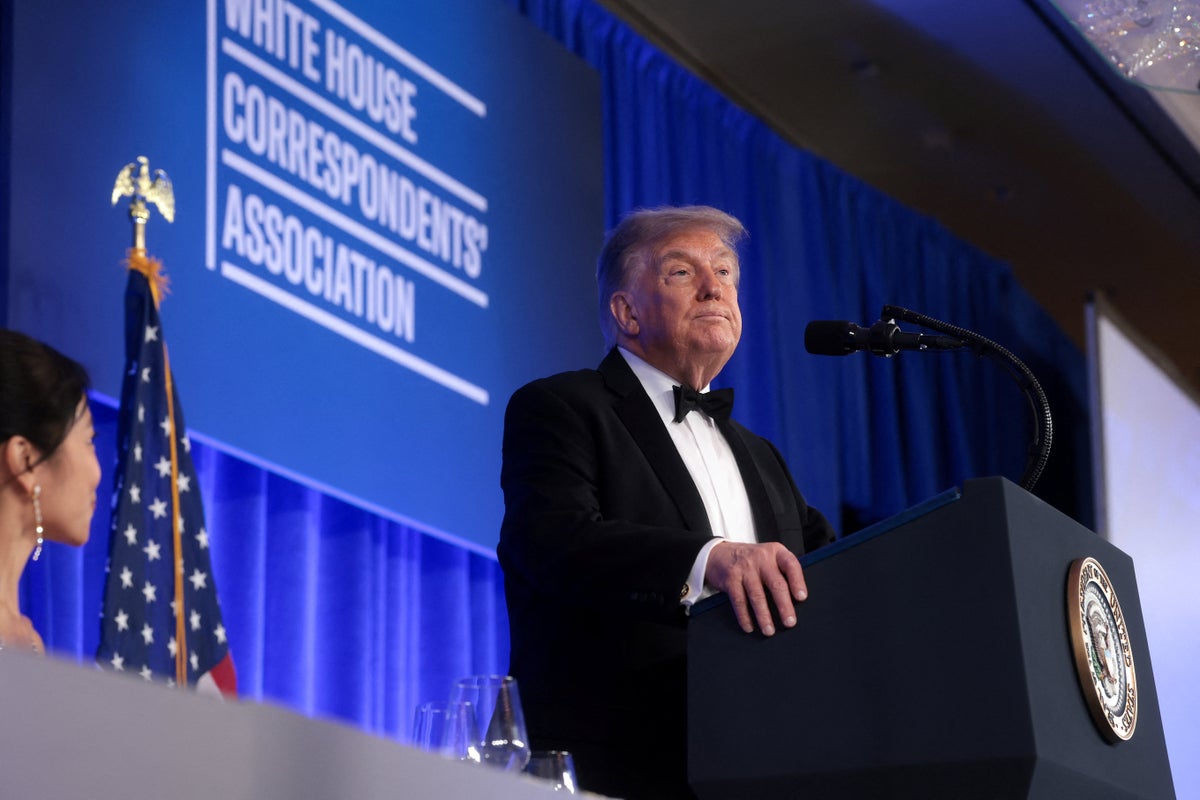
Every political commentator in Washington is currently high on their own supply. They sat through the White House Correspondents' Dinner, watched Donald Trump deliver a speech that conventional wisdom immediately branded as a total disaster, and collectively breathed a sigh of relief. The lazy consensus hit the airwaves within seconds: He’s lost his touch. The fastball is gone. He’s rambling, unfocused, and totally out of his depth in a room that doesn't belong to him.
It is a comforting bedtime story for people who desperately want reality to match their preferences. It is also completely wrong.
I have spent decades watching political communication professionals misread the room because they judge modern media through an outdated, analog lens. When elite pundits look at a speech and see a lack of discipline, they are evaluating an artifact from 1995. They are grading a heavyweight prize fighter by the rules of a classical ballet. Trump does not care about the ballroom applause lines that make beltway insiders swoon. He cares about the cut-and-paste ecosystem of modern attention economics.
To understand why calling him washed-up is a catastrophic misread of current political dynamics, we have to dismantle the entire framework of how establishment media evaluates political performance.
The Trap Of Elite Approval
Let us look at how the press evaluates public speaking. For decades, the gold standard was Ronald Reagan's smooth delivery, Barack Obama's rhythmic cadences, or George Clinton’s practiced folksiness. The underlying assumption has always been that a successful speech must unify the room, respect institutional norms, and win over the neutral observers in the middle.
That model died years ago, and yet mainstream analysts keep exhuming its corpse.
When critics complain that a speech is rough around the edges, they are treating politics like a corporate board presentation. They assume that if you alienate the people sitting right in front of you, you are failing. But modern populist politics operates on an entirely different vector of gravity. The people in the room at the White House Correspondents' Dinner are not the target audience. They never were. They are the backdrop. They are the props in a theatrical performance designed to generate friction.
Political communication in the current era is not about persuasion through charm; it is about dominance through contrast.
When a speaker walks into a hostile room and refuses to bend the knee, the establishment interprets it as social awkwardness or cognitive decline. The base interprets it as defiance. And in a polarized media landscape, defiance is currency. Every time an anchor on cable news clutches their pearls over a supposedly "freaking stupid" line, they are simply mailing a check to the campaign.
The Mechanics Of Weaponized Chaos
Let us define what is actually happening when a speech gets labeled as erratic.
Traditional speechwriting is linear. It moves from a premise to an argument to a soaring conclusion. It respects grammar, chronology, and thematic unity. Trump’s style, by contrast, is associative and modular. It functions like a jazz solo or a continuous live-streamed monologue.
Critics call it undisciplined. Strategists should call it algorithmic armor.
When you speak in tidy, predictable paragraphs, you give your opponents clean soundbites to clip and contextualize. You give fact-checkers neat little boxes to tick. Modular, unstructured discourse breaks that machinery. It offers too many moving parts. By the time a mainstream fact-checker or commentator isolates one "gaffe" to weaponize, the speaker has already pivoted through three other topics, completely exhausting the news cycle's capacity for sustained outrage.
I have watched corporate executives try to sanitize this exact communication style in their own leaders, forcing them into rehearsed, boring bullet points that immediately cause audience engagement to flatline. The moment you sanitize a communicator to make the press corps comfortable, you strip them of the very friction that makes them interesting.
Consider the data on attention spans. Long gone are the days when a voter sat through a twenty-minute policy exposition. People consume politics in micro-doses through social media platforms where tone matters infinitely more than text. A speech that feels messy, unscripted, and combative cuts through the noise of produced corporate media precisely because it looks human—even if it is a calculated, aggressive brand of humanity.
The Comfort Of Complacency
Why do sophisticated political analysts keep making the same mistake? Why do they continually predict his political demise based on metrics that haven't mattered in a decade?
It is psychological self-defense.
If you admit that the old rules of decorum, institutional respect, and polished rhetoric are completely obsolete, you have to admit that your entire skillset is obsolete. If a candidate can ignore every traditional playbook, insult the gatekeepers to their faces, and still command the center of gravity in national politics, then the gatekeepers are no longer gatekeepers. They are just spectators screaming from the cheap seats.
This brings us to the core delusion behind the "lost his edge" narrative. The critics are confusing their fatigue with the public's rejection.
The media elite are exhausted. They have covered the same cast of characters for years. They want a return to normal, where politicians speak in dulcet tones about bipartisan infrastructure packages and everyone goes home by nine o'clock. Because they want that reality so badly, they project it onto the electorate. Every time a speech doesn't fit their nostalgia for the nineties, they declare the era over.
It is wishful thinking disguised as analysis.
What Winning Actually Looks Like Now
If you want to know whether a political performance worked, stop asking journalists how they felt about it. Stop measuring applause lines in a ballroom filled with lobbyists and reporters.
Look instead at the distribution map of attention. Look at search velocity. Look at engagement metrics across alternative media ecosystems where voters actually spend their time. By those metrics, a controversial, abrasive appearance that outrages the establishment isn't a failure—it's a masterclass in market dominance.
The mistake competitors make is thinking politics is still a debate club. It is a war for mental real estate.
When you define the terms of the conversation, when you force your enemies to spend forty-eight hours dissecting every adjective you used, you haven't lost your edge. You have completely weaponized their obsession with you.
Stop waiting for the old world to come back. It isn't coming. The sooner political observers realize that the disruption is the strategy, the sooner they will stop embarrassing themselves with premature obituaries.



