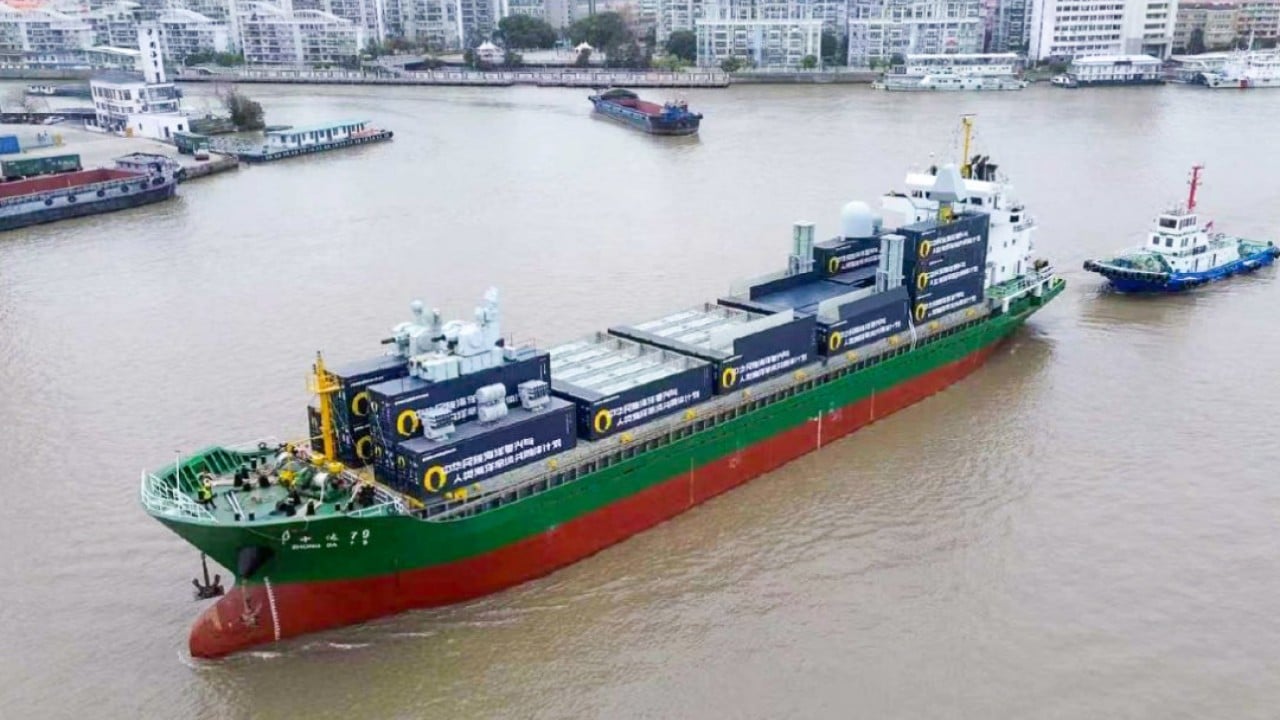
Zhang stands on the deck of the Chang He, a massive Roll-on/Roll-off (RO-RO) ferry, watching the salt spray kick up against the hull. He is not a soldier. He is a merchant mariner, a man who knows the weight of sedans and the rhythm of logistics better than the mechanics of a rifle. But today, the vehicles lined up in the cavernous belly beneath his feet aren't destined for a showroom in Fuzhou. They are heavy, olive-drab, and armored.
The steel beneath him vibrates with a different kind of tension. In a standard conflict, you look for the gray hulls of destroyers or the sleek silhouettes of submarines. You look for the "teeth." But the real danger in the narrow, choppy waters of the Taiwan Strait might just be the "tail"—the logistical backbone that looks like a common civilian commuter. For another perspective, check out: this related article.
The Steel Shell of a Civilian Giant
For years, military analysts focused on the "Million Man Swim," the seemingly impossible task of China moving enough troops across 100 miles of water to actually hold ground. The math didn't add up. China lacked the dedicated amphibious assault ships to make it happen. Or so we thought.
While the world watched Beijing build aircraft carriers, the People’s Liberation Army (PLA) was quietly integrating the nation’s massive civilian merchant fleet into its command structure. This isn't a theory. It is a legal mandate. Under the 2017 National Defense Transportation Law, every civilian ship is required to support military operations when called upon. Similar analysis on this matter has been shared by Al Jazeera.
The RO-RO ferry is the crown jewel of this strategy. These are ships designed to move thousands of cars or trucks quickly. They have massive ramps that drop down, allowing vehicles to drive off onto a pier in minutes. To the casual observer, the Bang Chui Dao is just a ferry. To a military planner, it is a high-capacity troop and tank transport hiding in plain sight.
The scale is staggering. China is currently the world's largest shipbuilder. They aren't just building ships; they are building "dual-use" infrastructure. Many of these ferries are being constructed with reinforced decks and modified ramps capable of launching heavy Main Battle Tanks directly into the surf or onto makeshift piers.
A Logistics Problem Solved by Stealth
Imagine the logistical nightmare of a traditional invasion. You need to secure a port. You need cranes. You need days of uninterrupted work to offload a single division. If the enemy blows up the cranes, your invasion stops before it begins.
Beijing’s solution is more elegant and far more terrifying. By using a fleet of hundreds of "civilian" ships, they create a target saturation problem. If you are a defender on the coast of Taiwan, how do you decide which ship to fire your precious few Harpoon missiles at? Do you hit the destroyer bristling with missiles, or the three-block-long ferry that might be carrying 2,000 soldiers and 50 tanks?
By the time you decide, the ramp is already down.
Consider the sheer volume of this "shadow fleet." China’s COSCO Shipping and other state-owned enterprises operate thousands of vessels. In a period of heightened tension, these ships don't need to change their paint or fly a different flag. They simply deviate from their trade routes. One day they are carrying BYD electric cars to Europe; the next, they are the second wave of an amphibious assault.
The Invisible Stakes of Grey Zone Warfare
The beauty of this strategy—if you can call it that—is its ambiguity. It sits in the "Grey Zone," the space between peace and total war. It’s a psychological game as much as a physical one.
When a Chinese RO-RO ferry conducts a "civilian exercise" near the median line of the Taiwan Strait, it forces a reaction. Taiwan must scramble jets, ready its coastal batteries, and put its people on high alert. Do this ten times, twenty times, a hundred times. The soldiers get tired. The public gets desensitized. The "boy who cried wolf" effect is a potent weapon in Beijing’s arsenal.
Then comes the day when it isn't an exercise.
The transition from merchant mariner to auxiliary combatant is a blurred line. Zhang, our hypothetical sailor, represents thousands of real workers who are increasingly being trained in military drills. They aren't just sailors anymore; they are the logistical vanguard of a superpower.
This creates a moral and legal quagmire for the West. If the U.S. or Taiwan sinks a "civilian" ship, the propaganda victory for Beijing is immediate and massive. "The aggressors are sinking ferries full of workers!" they will scream. The RO-RO fleet is a shield as much as it is a sword.
The Weakness in the Armor
But this strategy isn't foolproof. The very thing that makes these ships useful—their size and civilian design—makes them incredibly vulnerable.
A RO-RO ferry is essentially a giant, hollow box. It has no armor. It has no point-defense systems to shoot down incoming missiles. If a single torpedo hits a ferry, it doesn't just damage the ship; it kills everyone on board and sends an entire battalion's worth of equipment to the bottom of the ocean. It is a high-risk, high-reward gamble.
Furthermore, these ships require deep-water ports or specialized "portable" piers to offload. They can't just run up onto a sandy beach like a traditional landing craft. This limits where they can go. The defenders know exactly where these ports are. Every inch of those piers is zeroed in by Taiwanese artillery.
The "weaponized cargo ship" is a solution to a capacity problem, but it creates a vulnerability problem. It assumes that the sheer volume of ships will overwhelm the defenses. It assumes that the defender will hesitate to fire on a merchant vessel.
Beyond the Horizon
The shift in naval power we are witnessing isn't just about who has the most missiles. It is about who can dominate the mundane, the boring, and the commercial. Beijing has realized that a globalized economy provides the perfect camouflage for a regional war.
We often talk about "de-risking" or "de-coupling" in terms of microchips and sneakers. But the strategic reality is much deeper. The global supply chain is the battlefield. Every container ship, every oil tanker, and every car ferry is a piece on a board that we are only just beginning to understand.
As Zhang looks out over the water, he sees the lights of Taiwan flickering on the horizon. To the tourists on the shore, the ship he sails is just a speck on the ocean, a symbol of commerce and connection. They don't see the tanks in the hold. They don't see the military orders tucked into the captain’s log.
They only see the sunset.
The tragedy of modern conflict is that by the time you see the threat for what it truly is, the ramp has already touched the shore. The silence of the Strait is not peace; it is the held breath of a giant that has learned how to hide in plain sight.