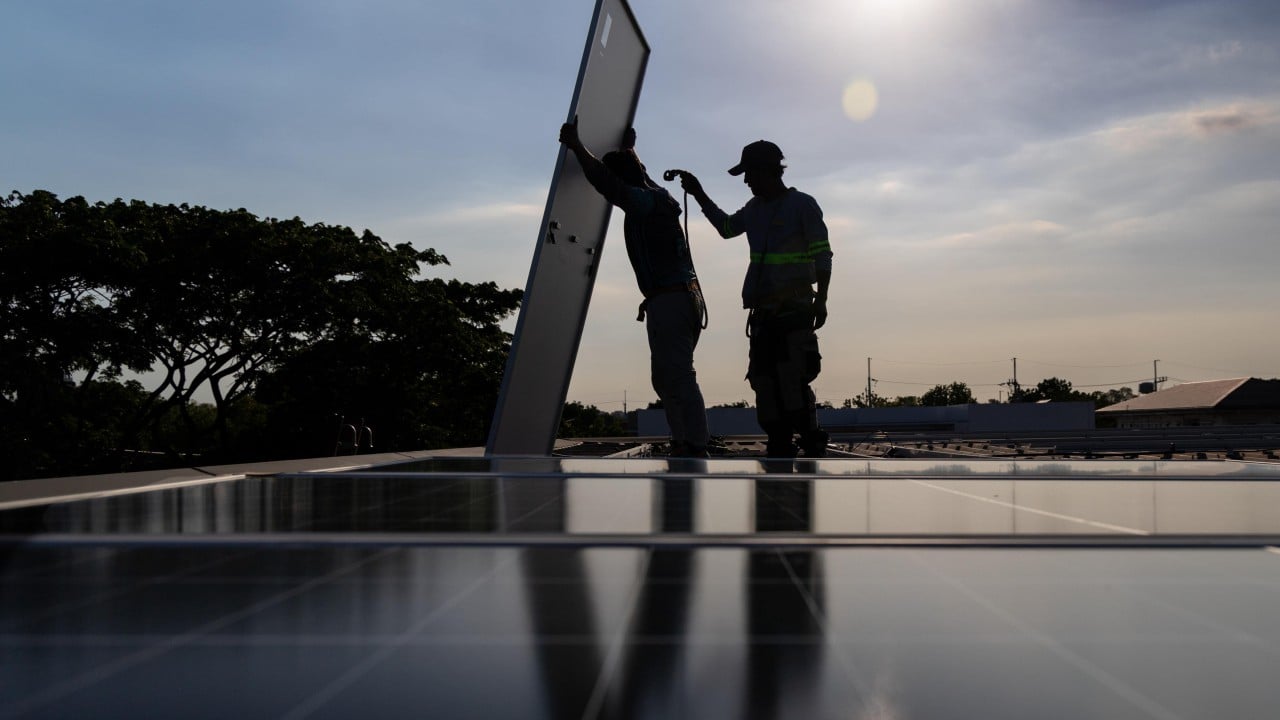
Mainstream financial media is currently tripping over itself to celebrate the Philippines as the undisputed king of clean energy investment. The narrative is neat, comforting, and fundamentally flawed. According to the prevailing consensus, a sudden surge in solar capital expenditure—catalyzed by geopolitical volatility in the Middle East—is a masterstroke of economic foresight.
It is nothing of the sort.
What the spreadsheets at global development banks call a "historic transition" is actually an aggressive misallocation of capital that risks crippling the archipelago's grid infrastructure. The narrative assumes that throwing billions of dollars at photovoltaic modules automatically translates to cheap, reliable electrons. Having spent fifteen years analyzing emerging market grid mechanics and watching utilities sink capital into unbacked generation assets, I can tell you the reality is far more brutal. The Philippines is not leading a revolution; it is building a massive, intermittent house of cards on top of a transmission system designed for the twentieth century.
The Fatal Flaw of the "Top Spender" Metric
Measuring energy progress by how much money you spend is like measuring fitness by how much you spend on gym memberships. It is a vanity metric.
The competitor press is fixated on the raw dollar amount entering the country. They ignore where those dollars are going. Buying millions of solar panels and shipping them across the South China Sea does not magically solve an energy crisis. In fact, without concurrent, massive investments in grid stabilization and storage, over-indexing on solar utility-scale projects is a recipe for systemic blackouts.
Consider the baseline mechanics of the Philippine power grid. The country operates on three distinct grids—Luzon, Visayas, and Mindanao—connected by limited high-voltage direct current (HVDC) submarine cables.
[Solar Generation Peaks at Noon] ──> [Local Substation Overload] ──> [HVDC Bottleneck] ──> [Grid Instability/Curtailment]
When you dump gigawatts of variable solar energy into a system with severe transmission bottlenecks, you do not get cheap power. You get curtailment—the forced shutting down of power plants because the wires physically cannot handle the load. I have watched developers in Negros Occidental lose significant chunks of their projected revenue because they built clean generation in regions where the National Grid Corporation of the Philippines (NGCP) simply lacked the capacity to move the power to high-demand hubs like Metro Manila.
The current capital influx ignores this entirely. Investors are racing to secure feed-in tariffs or power purchase agreements based on nameplate capacity ($MW$), completely ignoring the operational reality of capacity factors. Solar in the Philippines operates at an average capacity factor of just 15% to 20% due to intense tropical cloud cover and monsoon seasons. You are spending maximum capital for a resource that sits idle 80% of the time.
Dismantling the Middle East Catalyst Myth
The argument that the Middle East energy crisis is forcing this shift is a lazy correlation passed off as causation. The assumption is that high oil prices make domestic solar an immediate economic savior.
Let's look at the actual power mix. The Philippines does not generate the bulk of its electricity from crude oil. The power sector is anchored by coal and domestic natural gas (though Malampaya is depleting). High global oil prices heavily impact transportation and logistics, but their direct pressure on the baseload power tariff is vastly overstated by casual observers.
By framing solar as a direct shield against Middle East oil shocks, analysts cheat the public out of understanding the real crisis: baseload economics.
Solar cannot replace coal or gas baseload during peak consumption hours in the Philippines, which routinely occur between 6:00 PM and 9:00 PM—long after the sun has set. To prevent the grid from collapsing when solar drops off a cliff at 6:00 PM, utilities must maintain spinning reserves. These are thermal plants burning coal or diesel, running hot and wasting fuel just waiting to catch the system when the sun goes down.
The Hidden Cost: Running spinning reserves to back up intermittent solar actually drives up the net emissions and fuel costs per kilowatt-hour generated. The consumer ends up paying twice: once for the subsidized solar infrastructure, and again for the inefficiently managed thermal backup.
People Also Ask: Dismantling the Clean Energy Premise
"Won't competitive solar auctions drive down electricity prices for Philippine consumers?"
This is the ultimate industry delusion. On paper, solar developers offer incredibly low bids per kilowatt-hour during green energy auctions. What they don't include in that bid is the systemic integration cost.
Who pays for the synchronous condensers needed to maintain grid frequency when solar generation fluctuates? Who pays for the thousands of kilometers of new high-voltage transmission lines required to connect remote solar farms to the urban load centers? Under the current regulatory framework, these costs are socialized through transmission wheeling charges or reflected in the system loss charges on your monthly bill. The generation cost looks cheap; your total electricity bill remains among the highest in Asia.
"Can't utility-scale battery storage solve the intermittency problem?"
Imagine a scenario where a developer builds a 500-megawatt solar farm and pairs it with a massive lithium-ion battery energy storage system (BESS). It sounds perfect on a pitch deck.
In reality, the levelized cost of storage (LCOS) for utility-scale batteries in tropical environments is astronomical. High ambient temperatures accelerate battery degradation, requiring massive, energy-intensive HVAC systems just to keep the cells from thermal runaway. To provide true baseload capability—say, 12 hours of continuous discharge during a protracted monsoon week—the required battery array would cost more than the solar installation itself. The economics collapse under their own weight.
The Real Winner: Capital Extraction, Not Energy Independence
If this massive spending spree isn't actually fixing the Philippine grid, who benefits? Follow the money.
The current framework is designed for international equipment manufacturers and foreign private equity firms looking to park ESG-mandated capital. They secure dollar-denominated returns, utilize sovereign guarantees, and leave local distribution utilities holding the operational bag.
International Capital ──> Equipment Purchases (Offshore) ──> Sovereign-Backed PPA ──> Local Grid Risk (Domestic)
The equipment—the panels, the inverters, the specialized tracking software—is almost entirely imported. Very little of that "top spending" status translates into high-value domestic manufacturing or long-term structural employment. Once the construction crews pack up, a 100 MW solar farm requires fewer than two dozen full-time technicians to manage.
The downside of my contrarian stance is clear: stopping the solar gold rush risks slowing down the immediate influx of foreign direct investment. It looks bad on a government press release. But continuing down this path without a total moratorium on unbacked solar installations guarantees a fractured grid within the decade.
Fix the Foundation Before Buying the Roof
The solution is not to stop building renewable energy entirely. The solution is to immediately halt the unchecked expansion of utility-scale solar until the underlying infrastructure can support it.
Instead of chasing headline-grabbing investment totals, capital must be redirected by regulatory mandate toward three unglamorous, highly critical areas:
- Subsea Grid Interconnection: Upgrading the transfer capacity between Luzon, Visayas, and Mindanao to allow excess power to move fluidly across regions.
- Pumped Hydro Storage: Prioritizing long-duration mechanical storage over short-lived chemical batteries. The topography of the Philippines is uniquely suited for pumped hydro, which offers true grid-scale stabilization.
- Decentralized Rooftop Microgrids: Shifting the model away from massive rural solar installations that require miles of transmission lines, and focusing instead on commercial and industrial rooftop solar paired with localized smart-grid controls. This reduces line losses and places generation directly at the point of consumption.
Until the Department of Energy shifts its metrics from "dollars attracted" to "grid resilience achieved," every billion spent on solar is just another liability waiting to disrupt the system. Stop celebrating the spending. Start worrying about the bill.