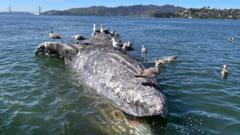
A massive gray whale washes up on a San Francisco beach and the first thing you notice is the smell. It’s a heavy, cloying scent of decay that hangs in the salty air. Local residents stop their morning jogs to stare. Scientists from the Marine Mammal Center arrive in yellow waterproof gear, knives in hand, ready to perform a necropsy. This isn't a rare event anymore. It's becoming a grim routine.
Gray whales are dying in San Francisco’s waters at an alarming rate, and the reasons why are more complicated than a single smoking gun. If you think it’s just "pollution," you’re missing the bigger picture. We’re witnessing a collision between an ancient migration route and a modern industrial shipping hub. If you found value in this article, you might want to look at: this related article.
The Unusual Mortality Event Explained
Since 2019, the National Oceanic and Atmospheric Administration (NOAA) has declared an Unusual Mortality Event (UME) for the Eastern North Pacific gray whale population. This isn't just a fancy government label. It’s a formal recognition that something is fundamentally broken in the ecosystem.
The numbers tell a brutal story. The population peaked at about 27,000 whales in 2016. By 2023, researchers estimated that number had plummeted to roughly 14,500. That’s nearly half the population gone in less than a decade. When these whales enter the San Francisco Bay, they’re often at their most vulnerable. They’ve traveled thousands of miles from the warm lagoons of Baja California, Mexico, heading toward their feeding grounds in the Arctic. For another look on this story, refer to the latest update from NPR.
By the time they reach the Golden Gate, many are running on empty. They’re literally starving.
Why Starvation is the Silent Killer
The most common thing scientists find when they cut into these whales? Empty stomachs. Or worse, stomachs filled with nothing but kelp or a few stray bits of plastic. Gray whales are "bottom feeders." They dive to the ocean floor, scoop up mouthfuls of sediment, and filter out tiny shrimp-like creatures called amphipods through their baleen plates.
Climate change is wrecking the buffet. As Arctic ice melts earlier and the water warms, the sea floor community changes. The fatty, nutrient-dense amphipods are disappearing, replaced by less nutritious species. Imagine trying to run a marathon while eating only celery. That’s the reality for these whales.
When a whale is malnourished, it makes bad decisions. A healthy whale stays on the coastal "highway" outside the Bay. A starving whale wanders into the San Francisco Bay looking for a quick snack. They’re desperate. They take risks. This brings them directly into the path of massive container ships.
Ship Strikes and the Golden Gate Bottleneck
San Francisco Bay is one of the busiest ports on the West Coast. It’s a nightmare for a slow-moving, exhausted whale.
I’ve seen the results of ship strikes. They aren't pretty. Massive blunt-force trauma, broken jaws, and severed spines are common findings at the Marine Mammal Center’s necropsies. Sometimes the whale is sliced by a propeller. Other times, the impact is so internal you don't see the damage until the skin is pulled back.
Ships are getting bigger and faster. A whale resting near the surface or a mother teaching her calf how to navigate can’t get out of the way in time.
- Speed kills: Ships traveling over 10 knots are much more likely to kill a whale upon impact.
- Noise pollution: The underwater roar of engines can mask the sound of an approaching vessel.
- The "Wall" effect: Modern hulls are so large that a whale might not even feel the pressure wave of the ship until it’s too late.
Entanglement is a Slow Death
It isn't just the ships. Fishing gear is a constant threat. While San Francisco’s Dungeness crab fishery has made strides in moving their season to avoid whale migrations, "ghost gear"—abandoned nets and lines—still litters the ocean floor.
An entangled whale doesn't usually die instantly. It’s a slow, agonizing process. The heavy ropes cut into their flippers or get lodged in their mouths. This makes it impossible for them to feed or swim efficiently. They drag hundreds of pounds of gear for months until they simply give up.
The Toxic Soup of San Francisco Bay
While starvation and ship strikes are the primary killers, we can't ignore the chemical load. Whales are long-lived mammals. They act like sponges for every toxin we dump into the ocean.
When a whale starves, its body starts burning through its blubber. This is where most toxins—like PCBs and DDT—are stored. As the fat melts, these chemicals are released into the whale’s bloodstream, hitting their immune system when they’re already weak. It’s a double whammy. They aren't just hungry; they’re being poisoned from the inside out by their own fat stores.
What Scientists are Doing Right Now
The team at the Marine Mammal Center and the California Academy of Sciences are the front-line detectives. Every time a carcass is reported, they coordinate a massive effort to get to the site before the tide pulls the body back out.
They take samples of everything. Blubber for toxin testing. Eyeballs to determine age. Muscle tissue for DNA. They’re looking for trends. Is it mostly juveniles? Mothers?
The data they collect is used to push for policy changes. For instance, NOAA has implemented voluntary vessel speed reduction zones. When you see those "Slow Down" signs for ships entering the Bay, that’s a direct result of whale necropsy data.
The Good News Nobody Mentions
It feels bleak, but there’s a silver lining. Gray whales are incredibly resilient. They’ve survived UMEs before. In the late 90s, the population took a similar hit and bounced back.
We’re starting to see some signs of recovery in the 2024-2026 data. Calving rates in Mexico are slightly up. More whales are appearing "robust" rather than "skinny" during their northbound trek.
The whales are doing their part by trying to adapt. We have to do ours by giving them space.
How to Help from the Shoreline
You don't need a biology degree to help. Most of the data scientists use comes from everyday people.
- Report sightings: If you see a whale in the Bay, report it to the Marine Mammal Center or use apps like WhaleAlert.
- Support speed limits: Advocate for mandatory vessel speed reductions in shipping lanes. Voluntary measures aren't enough when profit is on the line.
- Watch from a distance: If you’re on a boat or a jet ski, stay at least 100 yards away. Don’t be that person who stresses out a mother and calf for a TikTok video.
- Reduce plastic use: It sounds cliché, but whales do ingest plastic debris found in the Bay's sediment.
The next time you walk along Ocean Beach or the Marin Headlands and see a spout in the distance, remember that whale is on a 12,000-mile round trip. It’s one of the greatest migrations on Earth. It’s our job to make sure the San Francisco stretch of that journey isn't their last.
Stop looking at these deaths as isolated accidents. They're symptoms of a changing ocean. If we want the gray whales to stay, we have to change how we use the water they call home. Pay attention to the local news for necropsy reports and stay informed on shipping lane regulations. Support the organizations doing the dirty, smelly, vital work on our beaches. They're the only ones telling the whales' side of the story.