The breaking point didn’t happen behind the heavy closed doors of a Vatican congregation. It happened in an open meadow in Écône, Switzerland.
On July 1, 2026, the traditionalist Society of St. Pius X (SSPX) threw down the ultimate gauntlet. They ordained four new bishops without the permission of Pope Leo XIV. It’s an act of open defiance that has triggered immediate, automatic excommunications under Catholic canon law and pushed the Church into its most severe structural crisis in decades.
If this sounds like history repeating itself, that's because it is. Thirty-eight years ago, the group's founder, Archbishop Marcel Lefebvre, did the exact same thing. Back then, Pope John Paul II declared a formal schism. History just recycled itself, but this time, the stakes feel wildly different. The global Catholic landscape is more polarized than it was in 1988, and the modern internet has turned a localized theological rebellion into a highly funded, borderless digital movement.
Let’s get past the dense canon law jargon and look at what’s actually happening here. This isn't just a quirky dispute over whether Mass should be said in Latin or English. It’s a raw, public battle over who holds final authority in the world's largest Christian church.
The Meadow in Écône and the Defiance of Rome
The atmosphere in Switzerland mixed absolute solemnity with bizarre modern marketing. Thousands of the traditionalist faithful showed up hours early, many wearing traditional veils, straw hats, and carrying folding chairs. The SSPX even sold a commemorative box of wine for 75 Swiss francs—about $92—labeled "Cuvée des Sacres." Each bottle featured the face of one of the new bishops.
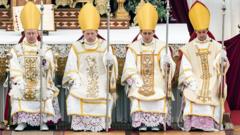
The ceremony itself was led by two surviving bishops from the original 1988 illicit consecrations, including Bishop Alfonso de Galarreta. He laid his hands on the heads of the four new men: Swiss Father Pascal Schreiber, American Father Michael Goldade, and French Fathers Michel Poinsinet de Sivry and Marc Hanappier. By doing so, they claim to pass down the apostolic succession.
But according to Rome, they just passed down an administrative death sentence.
The whole thing took place despite a direct, heartfelt, last-minute plea from Pope Leo XIV. Just a day earlier, on June 30, the Vatican published a letter from the pontiff addressed to Father Davide Pagliarani, the superior general of the SSPX. The Pope didn't mince words. He called the planned ordinations a "sin of extreme gravity" that would "tear the seamless garment of Christ." He begged them with a simple phrase: "Please turn back!"
They didn't. Instead, as the ceremony started, a priest read a statement framing the ordinations as a "sacred duty toward Holy Mother Church" to preserve tradition against what they view as a compromised modern Vatican. Pagliarani told the new bishops to act like serpents to perceive the duplicity of the world, boldly declaring, "God now asks us to be treated as rebels."
Why This Fracture Is Radically Different in 2026
To understand why this is a massive headache for the Vatican, you have to look at how much the ground has shifted since the 1980s. The SSPX isn't a tiny, isolated pocket of disgruntled French royalists anymore. They've grown into a highly organized global operation with nearly 1,500 priests, seminarians, and vocational members. They claim to serve over half a million faithful worldwide.
Their biggest, most influential stronghold? The United States.
With a massive operations base running out of Kansas, the American wing of this movement is fueled by deep-pocketed donors and a highly aggressive media apparatus. The traditionalist movement online has exploded. Go to YouTube, TikTok, or X, and you'll find a massive ecosystem of young, media-savvy traditionalists who view the modern Vatican with outright suspicion.
The crowd on the ground in Switzerland also highlighted the messy political cross-currents fueling this religious split. Spotted in the audience were members of Italian neofascist and far-right political groups, underlining a reality that church historians have pointed out for years: theological traditionalism often bleeds directly into hard-right nationalist politics.
The technicalities of the split are fascinatingly hypocritical. During the rite, the four candidates took an oath in Latin, promising to "fight against schismatic heretics." The paradox of saying that while actively undergoing a ceremony that Rome classifies as a schismatic act didn’t seem to bother anyone in the meadow.
The Paradox of Validity vs. Legality
The real confusion for everyday Catholics centers on how the Church defines a bishop. Catholic theology makes a sharp distinction between a sacrament being "valid" and it being "licit" (legal).
Because the SSPX bishops possess valid holy orders traced back through historical lines, the ordinations they perform are considered real by the Vatican. The new men are bishops. They can ordain real priests who can consecrate real hosts. But because they lack a papal mandate, their ministry is entirely illegal. They have zero canonical jurisdiction.
The pastoral fallout from this is going to be incredibly messy. During the papacies of Benedict XVI and Francis, the Vatican tried to build bridges. Pope Francis actually granted SSPX priests special faculties to legally hear confessions and witness marriages. It was a pastoral olive branch meant to keep the faithful connected to Rome.
Now? Those concessions are on the chopping block. If the Vatican follows through with a formal declaration of schism, those faculties will likely be revoked. Everyday people who attend SSPX chapels because they prefer the Latin Mass will find themselves standing on the wrong side of a hard line, potentially cut off from what Rome considers lawful sacraments.
Where Does Pope Leo XIV Go From Here?
This is the first major crisis for Pope Leo XIV, who was elected just a little over a year ago in May 2025. As the first North American pope, he made healing the rifts with traditionalists a core priority of his early papacy, trying to mend the deep ideological gashes left behind during the years of Pope Francis.
He tried the diplomatic route. Cardinal Víctor Manuel Fernández, the head of the Vatican's doctrine office, met with the SSPX leadership back in February, offering a path of continued dialogue if they suspended the ordinations. The SSPX flatly swatted the offer away, stating that full communion was "impracticable due to doctrinal divergences."
They fundamentally reject the core reforms of the Second Vatican Council (1962–1965), including the mass being said in local languages and the Church's modern stances on religious liberty and ecumenism. They view those changes not as evolution, but as heresy.
So what's the next step? Expect the Vatican to issue a formal declaration confirming the automatic excommunications of the six bishops involved—the two who ordained them and the four who were raised to the episcopacy. The bigger question is how the Vatican will handle the thousands of laypeople who attend their chapels.
If you are a practicing Catholic navigating these traditionalist spaces, or simply someone trying to understand the dividing lines, the practical reality is clear. The gray area is gone. The SSPX has chosen to operate entirely outside the structure of the Roman Catholic Church, creating a parallel hierarchy that answers only to itself. If you continue to support or financially contribute to these communities via their remote live streams and QR-code donation setups, you are willfully participating in an organization that has formally broken its communion with Rome. The bridge back to the Vatican just burned to the ground in a Swiss meadow.