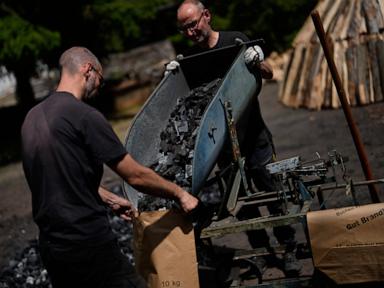
Charcoal production represents a primitive yet remarkably persistent application of pyrolytic conversion. While industrial chemical processing relies on tightly monitored, oxygen-starved retorts with automated thermal profiles, traditional earth-mound charcoal burning depends entirely on empiricism, manual airflow management, and sensory feedback. Examining this practice through an operational and thermodynamic lens reveals why a pre-industrial manufacturing method survives in a modern economy, governed by strict input costs, energy density yields, and labor efficiency constraints.
The Thermodynamic Mechanics of Traditional Pyrolysis
Charcoal burning is not combustion in the traditional sense. It is controlled carbonization. When wood undergoes thermal degradation in an oxygen-depleted environment, moisture evaporates first, followed by the breakdown of hemicellulose, cellulose, and lignin. Discover more on a related topic: this related article.
The process operates across specific temperature bands:
- Between 200°C and 260°C, endothermic reactions dominate as moisture leaves the cellular structure.
- Between 280°C and 500°C, exothermic reactions trigger spontaneous decomposition, releasing volatile gases, tar, and pyrolytic liquids while leaving behind a carbon skeleton.
In a modern retort, these volatile gases are captured and re-injected to fuel the process, maximizing thermal efficiency. In an earth-mound system, the methodology relies on a controlled partial burn. The operator covers a stacked timber stack with soil and turf, ignites a central core, and regulates ambient air entry through precisely placed vent holes. Additional reporting by Forbes delves into similar perspectives on this issue.
This creates a moving reaction front. The heat required to drive off moisture and volatile components in unburnt wood is supplied by the partial combustion of adjacent timber within the mound. The operator acts as a manual thermodynamic valve. By opening or sealing vents, they dictate the local oxygen concentration, preventing the wood from reducing completely to ash while ensuring the temperature stays high enough to drive out impurities.
The Operational Cost Structure and Labor Bottlenecks
Traditional charcoal production is structurally constrained by low labor productivity and high physical variance. Unlike automated manufacturing, where variable costs scale predictably with volume, earth-mound production features a high ratio of skilled labor input per unit of output.
The lifecycle of a single production cycle breaks down into distinct operational phases:
- Harvesting and Sizing: Selecting hardwood species of high density, such as beech or oak, and cutting timber to uniform lengths to ensure even packing density inside the mound.
- Mound Construction: Stacking heavy logs vertically and horizontally around a central chimney to establish structural integrity and predictable internal draft patterns.
- The Burn Monitoring Phase: Continuous presence required over a 48 to 96-hour window. The operator must interpret the color of the smoke, the settlement of the earth covering, and the heat radiating through the soil to diagnose internal anomalies.
- Quenching and Sorting: Sealing the mound entirely to extinguish the fire, followed by manual excavation, grading by lump size, and bagging.
The economic viability of this model does not stem from cost parity with industrial extruded charcoal briquettes. Instead, value extraction relies on niche positioning. Artisanal charcoal commands a premium in specific markets, such as high-end culinary sectors and metallurgy, where buyers pay for the chemical purity, lack of petroleum-based accelerants, and specific thermal profiles characteristic of slow-cooked hardwood lump charcoal.
Yield Ratios and Conversion Inefficiencies
From a mass-balance perspective, earth-mound systems are inefficient compared to engineered kilns.
The mass conversion ratio of dry wood to charcoal in a traditional mound typically hovers between 15% and 25% by weight. This means processing 100 kilograms of seasoned hardwood yields roughly 15 to 25 kilograms of usable charcoal. The remaining 75% to 85% of mass is lost to the atmosphere as water vapor, carbon dioxide, methane, acetic acid, and complex tar aerosols.
This low yield introduces significant opportunity costs. The financial return is bound directly to timber acquisition costs and the time investment of the operator. Because the process cannot be easily scaled without losing the micro-control required to prevent the mound from collapsing into ash, output remains rigidly capped by human bandwidth. A single practitioner can manage only a finite number of concurrent burns before the risk of thermal runaway and total loss spikes past acceptable thresholds.
The Micro-Economics of Niche Craft Preservation
When an industrial process survives long after technological obsolescence, it typically occupies a protected economic niche defined by regulatory arbitrage, cultural preservation subsidies, or a distinct consumer preference for non-standardized attributes.
Traditional charcoal burning persists because its outputs possess properties that automated, high-speed production lines cannot replicate. Industrial briquettes often utilize pulverized wood waste bound together with starch, limestone, or accelerants, pressed into uniform shapes for predictable ignition. In contrast, artisanal lump charcoal retains the structural grain of the original hardwood branch or trunk. This results in irregular burn rates, higher peak temperatures, and zero chemical contamination, attributes highly valued by specialist users.
However, this survival mechanism creates a fragile economic ecosystem. The profession relies on tacit knowledge—skills transferred through decades of tactile experience rather than codified engineering manuals. As the demographic cohort of traditional operators ages, the barrier to entry rises. Younger workers face a high physical labor toll combined with low initial financial returns during the steep learning curve required to master smoke reading and vent management.
Strategic Capital Allocation for Low-Yield Craft Industries
To secure long-term operational continuity without compromising the core value proposition, traditional producers must navigate a narrow strategic corridor. Scaling via industrial automation destroys the artisanal differentiation that justifies the premium price point. Conversely, maintaining pure manual isolation limits revenue generation to local, fragmented markets vulnerable to labor fatigue.
The optimal operational adjustment involves targeted hybridization. Practitioners can modernize the pre-processing and post-processing logistics—utilizing mechanized log splitters and automated grading screens—while preserving the core pyrolytic earth-mound burn phase intact. This preserves the sensory-driven carbonization process that yields the desired chemical profile while eliminating the physical bottlenecks of timber preparation and packaging.
Concurrently, producers must leverage traceability and verified sustainability metrics. Because raw wood sourcing directly impacts end-product quality and regulatory compliance, documenting the ecological provenance of harvested hardwood transforms a traditional commodity into a certified luxury consumable. The enterprise transitions from competing on volume against multinational fuel distributors to capturing margin through absolute supply chain transparency and verifiable material integrity.