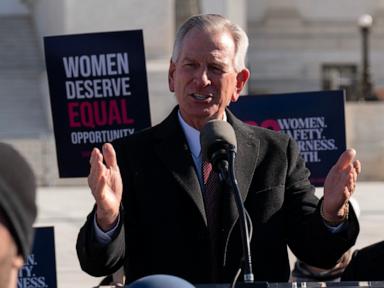
Tommy Tuberville is staying on the ballot. If you expected anything else from the Alabama Republican Party, you haven't been paying attention to modern politics.
The 21-member ALGOP steering committee met behind closed doors at a law office in Birmingham. They emerged with a unanimous decision. They threw out the formal residency challenge filed against the sitting U.S. Senator. The challenge came from Ken McFeeters, the guy Tuberville absolutely crushed in the May primary election. McFeeters claimed "Coach" hasn't lived in the state long enough to run for governor. The party establishment disagreed. They basically told McFeeters he didn't bring enough proof to the table.
This whole mess centers on a strict law in the Alabama Constitution. It says gubernatorial candidates must be resident citizens of the state for at least seven years right before the election. Tuberville's critics say he is actually a Florida man who just drops by Alabama to campaign. His allies say that is complete nonsense. The party elite just slammed the door on the debate, clearing Tuberville for a massive November rematch against Democrat Doug Jones.
The Paper Trail That Saved Coach Tuberville
You can't win a legal residency battle with just good vibes. Tuberville's legal team showed up to the private hearing packed with documents. They handed over heavily redacted Alabama income tax returns covering 2018 through 2024. Those tax forms list an Auburn address. They show the Tuberville family technically moved back to the state in August 2018.
The committee also looked at a 2019 Alabama driver's license, property records, and his local voter registration. Under Alabama law, your legal domicile is largely about intent and where you keep your primary records. The steering committee released a seven-page document explaining their choice. They noted that courts view voter registration as a massive factor in deciding where someone actually lives.
McFeeters tried to counter with travel logs. He pointed out that Tuberville's Senate travel records show constant trips down to the Florida Panhandle. He also noted that Tuberville actually cast a ballot in Florida in November 2018 before registering to vote in Alabama in March 2019. But the committee ruled that McFeeters failed to carry the burden of proof. In politics, a bad timeline isn't always enough to disqualify a heavyweight.
Why The Florida Man Label Won't Die
Let's look at the actual real estate. Tuberville and his wife own a stunning beach house in Santa Rosa Beach, Florida. It is valued at roughly $5.6 million. Meanwhile, his primary Alabama residence is a modest 1,551-square-foot house in Auburn worth around $291,780. His wife and son bought that Auburn property back in 2017. Tuberville's name wasn't even on the deed until 2024.
This isn't the first time opponents tried to use the Sunshine State against him. Back in the 2020 Senate primary, former Attorney General Jeff Sessions ran attack ads explicitly calling Tuberville a Florida man. Tuberville ignored the noise, won 61% of the primary runoff vote, and easily took the seat.
Tuberville knows exactly how to play this to his base. He immediately called the challenge a ridiculous residency hoax and a media witch-hunt. He even claimed he was getting the same unfair treatment as Donald Trump. In deep-red Alabama, framing a administrative challenge as a partisan hit job is a winning strategy. It completely neutralizes the actual factual questions about his driver's license and voting dates.
The Messy Reality of Domicile Laws
The real problem here is that Alabama's constitutional residency rule is incredibly vague. It says the governor must be a resident citizen "at least seven years next before the date of their election."
What does that actually mean? Does it mean you have to sleep in an Alabama bed every single night? No state court has ever defined it that strictly. If you maintain a home, pay local taxes, and keep your voter registration active, the state generally considers you a resident. Tuberville lived out of state for years coaching football at Texas Tech and Cincinnati. He also worked for ESPN. But his team argued his deep ties to Auburn, where he coached from 1999 to 2008, never truly vanished.
The ALGOP decision makes it clear that the party has no desire to litigate these grey areas. Party Chair Scott Stadthagen told the press that the committee based its decision on clarity and common sense. They told members to set aside raw politics. Of course, keeping your highly popular primary winner on the ballot is also just good electoral strategy. Knocking Tuberville off would have thrown the entire state party into utter chaos right before the general election.
What This Means For November
The path is completely clear now. Tuberville grabbed over 421,000 votes in the primary. That was roughly 85% of the total vote. McFeeters was a total afterthought with less than 10%. The voters already made their choice, and the party steering committee simply validated it.
Now we get a sequel to the 2020 Senate race. Tuberville is facing off against Doug Jones again, this time for the highest office in the state. Jones will absolutely try to keep the Florida narrative alive. Expect the state Democrats to hammer the contrast between a multi-million dollar Florida beach mansion and the reality of working-class Alabamians.
But if history tells us anything, it is that paper-trail scandals rarely move the needle in Alabama if the candidate has the backing of the party machine and a Trump endorsement. Tuberville has both. The residency fight is officially dead inside the GOP. If Democrats want to beat him, they will have to do it on policy, not property records.
If you want to track how this legal precedent affects future state challenges, keep an eye on the local circuit court filings. McFeeters already tried to sue in county court earlier this year before that case got thrown out for lack of jurisdiction. The party machinery has spoken, and the boardroom doors are locked tight.