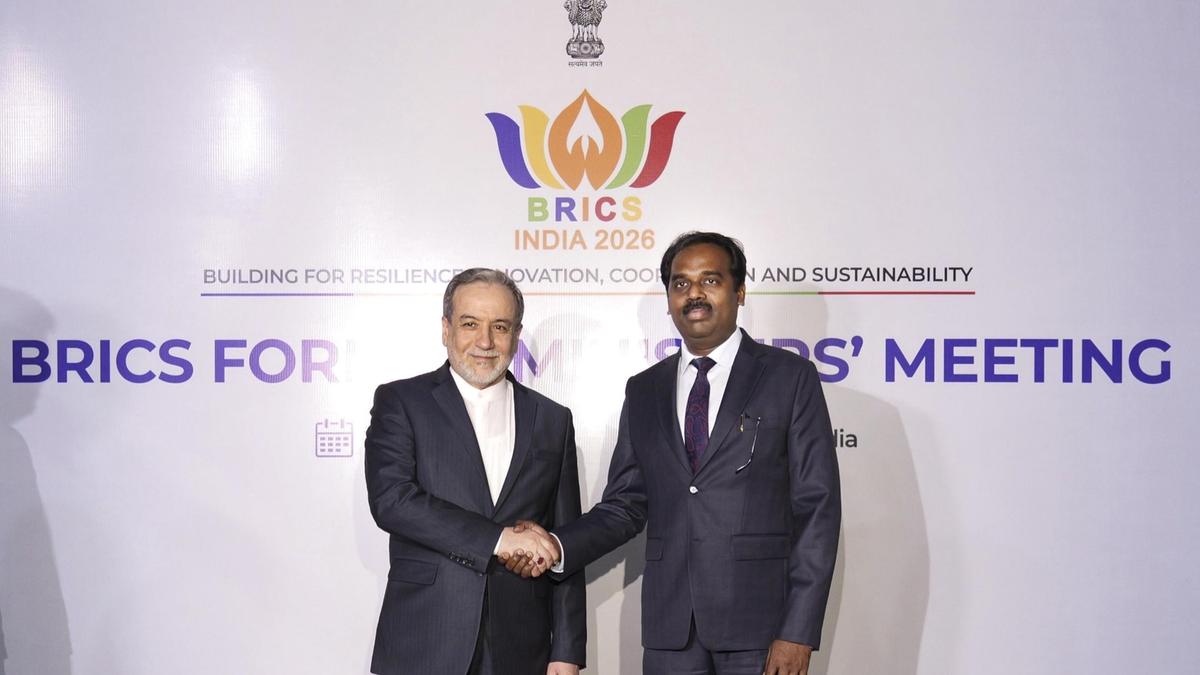
The air in New Delhi has a specific weight in mid-May. It is a thick, humid press of atmosphere that makes every movement feel deliberate, almost ceremonial. As the wheels of a private jet touched down on the tarmac this Wednesday, the shimmering heat waves rising from the runway did more than just distort the view of the hangars. They blurred the lines of a world order that has spent the last decade trying to decide who is allowed to sit at the table.
Abbas Araghchi stepped out into that heat.
The Iranian Foreign Minister did not come to India for a vacation. He arrived for the BRICS Foreign Ministers' meeting, a gathering that carries a name sounding like a construction firm but functions like a tectonic shift. To the casual observer, it is a photo op. To the people living in the bazaars of Tehran or the tech hubs of Bangalore, it is the sound of a door being unlocked.
Consider a small shop owner in Isfahan. Let’s call him Reza. For years, Reza has watched the value of his currency dance a frantic, downward spiral. He deals in carpets and spices, ancient trades that should, by all rights, be immune to the digital flickers of Wall Street. Yet, when a bank in a country he has never visited decides to flip a switch, Reza’s ability to send money to a supplier in Mumbai vanishes. He is a ghost in the global financial system.
Araghchi’s presence in Delhi is an attempt to turn the lights back on for men like Reza.
The BRICS collective—Brazil, Russia, India, China, and South Africa, now expanded to include Iran and others—is no longer a theoretical club for "emerging economies." It has become a lifeboat. India and Iran share a history that predates the very concept of a "foreign policy." They share linguistic roots, architectural DNA, and a mutual understanding that the world is much older than the institutions currently running it.
When Araghchi meets his Indian counterpart, S. Jaishankar, they aren't just discussing trade quotas. They are discussing the North-South Transport Corridor. This is a sprawling web of rails and ships designed to bypass the traditional chokepoints of global trade. It is a physical manifestation of a desire to move goods without asking for permission from a third party.
India occupies a fascinating, often exhausting, middle ground. Delhi is a city that speaks the language of the West fluently but thinks in the long-term cycles of the East. It wants to be a partner to Washington while remaining a brother to Tehran. This isn't double-dealing; it is survival. India needs energy. Iran has oceans of it. India needs a gateway to Central Asia. Iran holds the keys to the Port of Chabahar.
The stakes are invisible until they aren't.
We often talk about "geopolitics" as if it were a game of Risk played by giants in windowless rooms. The reality is far more intimate. It is about whether a student in Delhi can afford the petrol to get to university. It is about whether a hospital in Shiraz can import the specific German-made medical components it needs because a new payment gateway has finally been established through a BRICS-aligned bank.
Araghchi’s arrival is a signal that the "Maximum Pressure" campaign of the last few years has hit a wall. You cannot isolate a country that shares a border with the future. By joining the BRICS table in India, Iran is signaling that the era of a single, unipolar gravity is over. Multiple suns are rising.
There is a tension in these meetings that no official communique will ever capture. It is the tension of old friends who have been kept apart by a neighborhood bully, now whispering in the corner of a party. They are checking the pulse of a relationship that has survived empires.
The conversations in Delhi this week will touch on the brutal realities of the Middle East, the shifting sands of the Russian frontier, and the digital currencies that might one day make the US Dollar just another option rather than the only law. But beneath the talk of "multilateralism" and "strategic autonomy," there is a simpler human drive at work.
People want to trade. They want to connect. They want to ensure that their children’s prosperity isn't a casualty of a diplomatic spat happening five thousand miles away.
As Araghchi moves through the corridors of power in Delhi, he isn't just representing a government. He is representing a civilization that refuses to be edited out of the story. The Indian hosts know this. They feel the same pull of history. They know that while the West provides the technology of the present, the neighbors provide the stability of the future.
The jet cooled on the tarmac, its engines ticking as the metal contracted. In the city, the traffic surged and pulsed, a billion lives moving toward an uncertain evening. The meetings will produce documents. The documents will be analyzed by pundits. But the real story happened the moment the door opened and a man from Tehran walked into the Indian sun, proving that the map of the world is being redrawn, one handshake at a time.
The world is getting smaller, but the table is getting much, much wider.