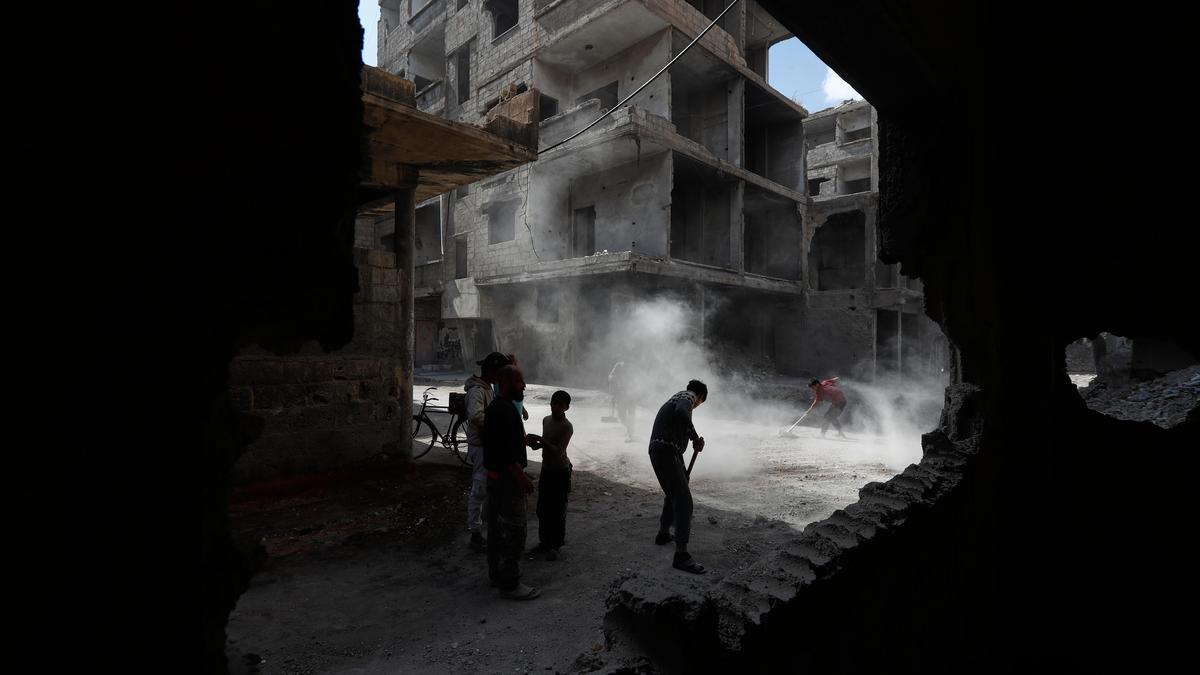
Syria is not a "safe corridor." It is a toll booth in a graveyard.
The current narrative circulating in geopolitical circles suggests that because the surrounding Levant is on fire, Damascus is suddenly a viable logistics hub. It’s a seductive idea for the desperate. The logic goes like this: Lebanon is crippled, the Red Sea is a shooting gallery for Houthi rebels, and Jordan is squeezed. Therefore, the "M4 and M5 highways" are back in business.
This isn't analysis. It’s wishful thinking masked as a pivot.
Anyone telling you that a war-battered state, still partitioned by four different foreign armies and a dozen localized militias, can serve as a stable bridge for regional trade hasn't looked at a map since 2011. Stability is not the absence of active frontlines. Stability is the presence of a functioning, predictable legal and physical infrastructure. Syria has neither.
The Myth of the Neutral Transit State
The competitor’s view rests on the "lazy consensus" that geography is destiny. They argue that because Syria sits at the crossroads of Europe, Asia, and Africa, it must eventually reclaim its role as a regional artery.
Here is what they miss: Geography is irrelevant if the sovereign entity controlling it is a pariah.
When you ship goods through a "safe corridor," you are betting on three things:
- Security of Assets: That your trucks won't be seized by a local commander who hasn't been paid by Damascus in six months.
- Predictable Costs: That "informal taxes" (extortion) at checkpoints won't exceed the value of the cargo.
- Legal Recourse: That if something goes wrong, there is a court system that recognizes international commercial law rather than the whims of the Mukhabarat.
I have watched logistics firms try to "risk-manage" their way through shattered states before. They treat it like a math problem. They calculate the cost of a private security detail, add it to the bribe budget, and compare it to the cost of shipping around the Cape of Good Hope. They always underestimate the volatility. In Syria, the "risk" isn't a variable; it is the environment itself.
Weaponized Logistics and the Captagon Economy
Let’s talk about what Syria actually exports. It isn't textiles or olive oil anymore. The primary driver of the Syrian economy is Fenethylline, known locally as Captagon.
When an economy becomes a narco-state, every "transit corridor" is repurposed. The infrastructure exists to facilitate the movement of illicit goods, not to protect your shipment of electronics or grain. To believe that the Syrian government will pivot from a billion-dollar illicit trade to a low-margin transit economy is to fundamentally misunderstand how power is maintained in Damascus.
The Syrian state survives on "controlled chaos." A truly open, transparent, and safe trade corridor requires transparency. Transparency is the one thing the current administration cannot afford. If you open the doors to international auditors and logistics giants, you expose the very mechanisms that keep the elite in power.
The False Dichotomy of Regional Conflict
The media loves a "relative safety" argument. They say, "Look at Beirut. Look at the Red Sea. Syria looks quiet by comparison."
This is a dangerous fallacy. Syria is "quiet" only in the sense that the internal conflict has reached a frozen stalemate. The underlying tensions—the Turkish presence in the north, the US-backed SDF in the east, the Iranian entrenchment, and the frequent Israeli strikes—haven't vanished. They are just vibrating at a different frequency.
Imagine a scenario where a major logistics provider moves 15% of its regional volume through the M5 highway. One Israeli strike on an Iranian-linked warehouse near the road, or one Turkish drone strike on a Kurdish position near the transit route, and the entire "corridor" collapses. You cannot build a supply chain on a foundation of unexploded ordnance and shifting alliances.
The E-E-A-T Reality Check: Why Experience Trumps Theory
I have seen companies blow millions trying to "front-run" the reconstruction of Syria. They did it in 2018. They did it again in 2021. They are doing it now. They send in consultants who stay in the Four Seasons Damascus, see people drinking lattes in the Old City, and report back that "normalcy has returned."
Normalcy has not returned. Normalcy is a facade maintained for the benefit of attracting foreign currency.
Precise definitions matter here. A corridor is a protected path. A corridor requires international guarantees. Currently, Syria is a gauntlet.
- Sovereignty: Divided. You aren't dealing with one government; you are dealing with a patchwork of "reconciled" areas where local warlords hold more sway than the central ministry.
- Sanctions: The Caesar Act isn't a suggestion. Any serious international player attempting to utilize Syrian infrastructure at scale will find themselves in the crosshairs of the US Treasury Department.
- Infrastructure: The electrical grid is a joke. Fuel is scarce. Communications are monitored and unreliable.
The "safe corridor" narrative is being pushed by two groups: regional neighbors (like Jordan and the UAE) who desperately need to offload the burden of Syrian refugees, and the Syrian government itself, which needs to break its isolation. Neither group cares about the safety of your cargo.
People Also Ask: The Wrong Questions
Is it safe to drive from Jordan to Turkey through Syria?
If you are asking this, you are looking at a map, not a geopolitical risk report. While the road exists, the "safety" is entirely dependent on your nationality, your connections, and your willingness to pay at every "checkpoint." It is a gamble, not a route.
Will Syrian reconstruction benefit regional trade?
Reconstruction requires capital. Capital requires trust. Trust requires the rule of law. Until Syria undergoes a political transition that satisfies the international community, "reconstruction" will remain a series of vanity projects funded by allies, not a systematic rebuilding of a national economy.
Is the Red Sea crisis making Syria relevant again?
Only to those who prefer landmines over missiles. The Red Sea crisis is a maritime security issue. Solving it with a Syrian land route is like trying to fix a leak in your roof by setting the basement on fire.
The Counter-Intuitive Truth
The reality is that Syria's "re-emergence" is a controlled theatrical performance. The regime is selling the idea of stability because that is its only remaining currency.
If you are a logistics professional, a regional investor, or a policy analyst, do not mistake exhaustion for peace. The Syrian people are exhausted. The warring factions are exhausted. But the structural reasons for the conflict—corruption, lack of representation, and a shattered social contract—remain untouched.
Investing in the Syrian "corridor" is not a bold contrarian play. It is a classic "sunk cost" fallacy. You are hoping that if you put enough weight on a broken bridge, it will somehow fuse itself back together. It won't. It will just collapse under the pressure of your expectations.
The smart money isn't looking for a shortcut through a war zone. The smart money is building resilience elsewhere, accepting that the Levant will remain a fractured geography for the foreseeable future.
Stop looking at the map for the shortest distance between two points. Start looking at the map for the shortest distance between two points that actually exist in a functional legal reality. Syria is a ghost state. Do not build your future on its wreckage.
Move your cargo. Keep your eyes open. Ignore the siren song of the "Damascus Shortcut." It’s a dead end.