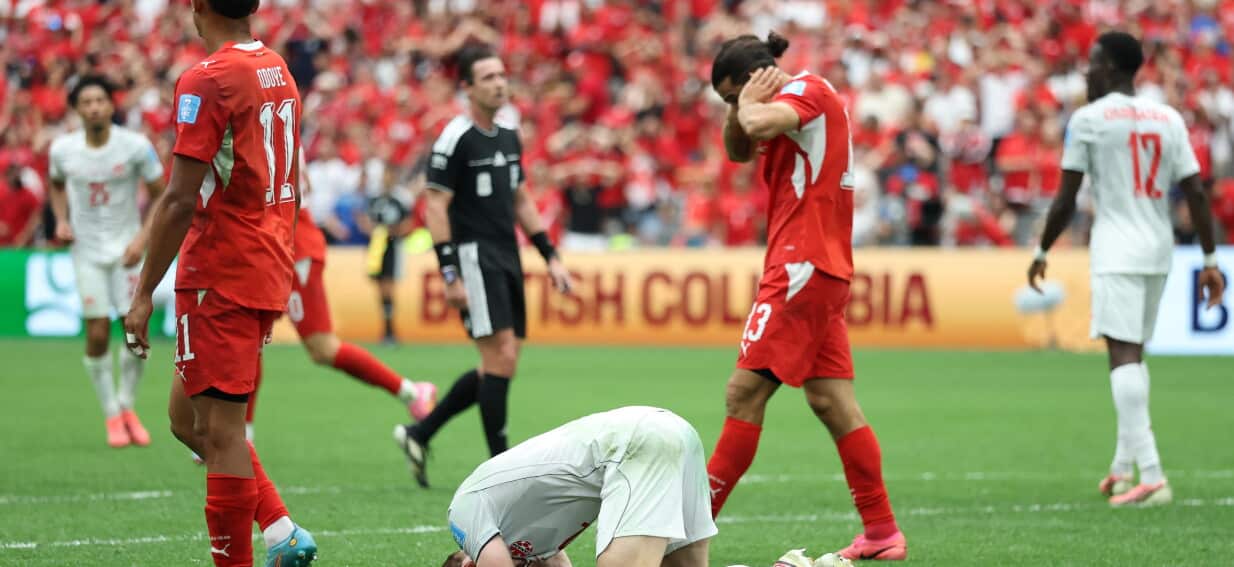
The football establishment is currently swooning over Switzerland’s narrow victory over Canada in their Group B clash. Pundits are calling it a tactical masterclass, a gritty showcase of European tournament pedigree edging out a brave, rising North American golden generation.
They are wrong. They are falling for the lazy narrative of international football prestige.
What we actually witnessed in that stadium was a tactical regression masquerading as a high-stakes thriller. Everyone praising Switzerland for "managing the game" is missing the brutal reality: both of these teams exposed exactly why they will be chewed up and spat out the moment they hit the knockout rounds.
Let’s dismantle the illusion.
The Myth of Swiss Tournament Pedigree
The mainstream sports media loves to rely on historical comfort blankets. Because Switzerland frequently navigates tournament group stages, every sluggish, risk-averse performance is labeled as "mature."
It wasn't mature. It was paralyzed.
Switzerland lined up in a shape that looked less like a modern football team and more like a low-block defensive unit terrified of its own shadow. For ninety minutes, the midfield pair refused to drop between the center-backs to progress the ball cleanly, opting instead for aimless long diagonals that handed possession straight back to the Canadian full-backs.
When you look at the actual mechanics of their progression, Switzerland operated with an incredibly inefficient pass-to-shot ratio. They spent massive periods of the match cycling the ball in non-threatening U-shapes around the back four. This isn't "starving the opponent of oxygen." It is a structural inability to break lines when an opponent plays with a modicum of athletic intensity.
If Switzerland encounters a tier-one nation capable of triggering a coordinated central press, this passive possession structure collapses. They got past Canada because of a single defensive lapse, not because of a tactical blueprint worth emulating.
Canada’s Golden Generation Is Tactically Naive
Flip the script to Canada, and the narrative is even more flawed. The media has spent months treating this Canadian roster like an elite, modern pressing machine.
Against Switzerland, Canada’s press was completely uncoordinated.
In elite modern football, pressing is an all-or-nothing commitment. You either drop into a compact mid-block to protect space, or you execute a suffocating high press where every single player knows their specific trigger. Canada did neither. Their front three chased ghosts, stepping up individually while the midfield line remained deep, creating a massive, gaping hole in the center of the pitch.
The Statistical Reality of the Canadian Choke
- PPDA (Passes Per Defensive Action): Canada's PPDA spiked significantly compared to their qualifying campaign, proving their pressure was easily bypassed.
- Turnovers in the Attacking Third: Despite high possession in wide areas, they generated almost zero high-value turnovers close to the Swiss box.
- Expected Goals (xG) Distortion: A high volume of low-quality, low-probability shots from distance inflated Canada’s xG metrics, creating the illusion of dominance when they never actually threatened the central channel.
I have spent years analyzing structural spacing at the highest levels of the game. When a team routinely leaves twenty meters of vacant space between its defensive line and its midfield anchor during a transition phase, that is a coaching failure. Canada has the raw athletic profiles to compete with anyone in the world, but athleticism without positional discipline is just expensive cardio.
Dismantling the Group B Decider Fallacy
"People Also Ask" columns are already filling up with variations of a single, flawed question: Did Switzerland's tactical discipline prove European superiority over North American athleticism?
The premise of the question is completely broken.
This match did not prove European superiority. It proved that both regions are currently suffering from a severe drought of elite tactical innovation at the international level. International managers simply do not get enough time with their squads to implement complex positional play, so they default to one of two lazy extremes: the hyper-conservative low block or the chaotic, individualistic high press.
Switzerland didn't win because of tactical superiority; they won because they possess players who have spent a decade playing in standard, rigid defensive systems across Europe. They survived on muscle memory. Canada lost because they tried to play an expansive, modern system without the foundational positional training required to pull it off under pressure.
The High Cost of Risk Aversion
There is a downside to calling out this mediocrity. If you tell football fans that a tight, 1-0 group decider was actually a terrible advertisement for the sport, you get accused of being a contrarian cynic. People want the romance of the World Cup. They want to believe they are watching the pinnacle of human athletic achievement.
But look at the data from previous tournaments. Teams that rely on Switzerland's exact statistical profile—low shot creation, heavy reliance on set-pieces, and passive defensive structures—almost never progress past the quarter-finals. They exist solely to act as speed bumps for actual contenders.
Stop analyzing international football through the lens of traditional team status or individual star power. Stop pretending that a match filled with unforced errors, broken pressing structures, and zero central line-breaking passes is a "tactical chess match."
Switzerland and Canada played a ninety-minute game of hot potato. One of them just happened to drop it in their own penalty box.