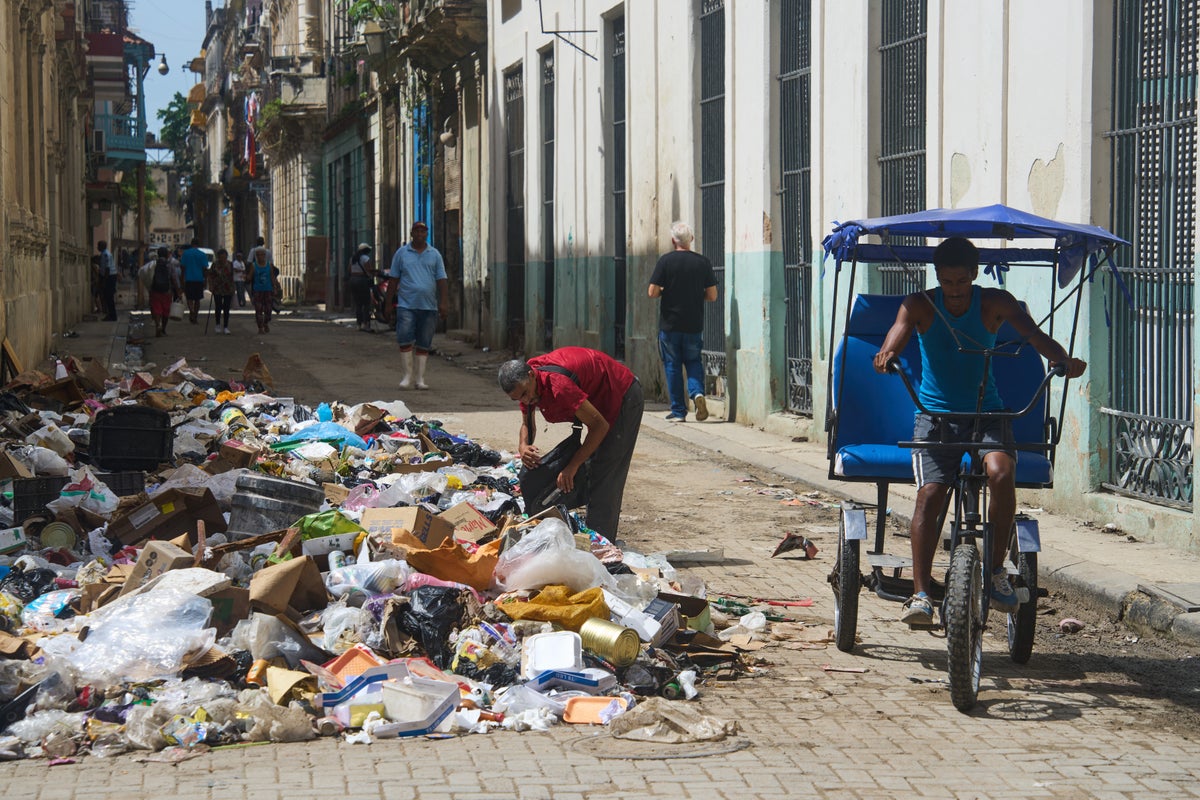
The heat in Havana does not just sit on you. It presses. By mid-afternoon, the humidity transforms the air into a thick, breathable soup, carrying the scent of sea salt, diesel exhaust, and roasting coffee. But lately, those familiar notes have been utterly swallowed by something else. A heavy, sweet, choking stench of rot.
Walk down Calle Neptuno on any given Tuesday. The brilliant turquoise and pastel pink paint of the neoclassical facades is peeling like sunburned skin. Beneath a balcony that looks ready to surrender to gravity, a mountain of black plastic bags has ruptured. Watermelons turned to gray slime, chicken bones picked clean, and sodden cardboard spill across the cracked pavement.
A grandmother pushes a vintage pram, maneuvering it expertly into the middle of the street to avoid the sludge. She does not look down. To look down is to acknowledge a defeat that Havana’s residents are forced to swallow every single day.
This is not a story about a temporary breakdown in municipal services. It is the story of a city choking on its own waste, where the simple act of throwing things away has become an agonizing logistical crisis that threatens the health, dignity, and future of millions.
The Mountain at the Doorstep
To understand how a capital city loses control of its baseline sanitation, you have to look at the math of scarcity. Havana generates over 20,000 cubic meters of garbage daily. Under normal circumstances, a fleet of specialized compaction trucks would circulate through the fifteen municipalities, swallowing the waste and depositing it in landfills outside the urban perimeter.
The circumstances are not normal.
On a good day, barely half of those trucks are operational. The rest sit in cannibalized rows in government depots, missing tires, lacking hydraulic fluid, or starved of fuel. Cuba is weathering its worst economic crisis since the collapse of the Soviet Union. When a country lacks the foreign currency to buy basic medicine or fuel for the power grid, spare parts for garbage trucks slip far down the ledger of priorities.
The result is visible from space, but it is felt most acutely on the ground.
Consider a hypothetical citizen named Elena. She lives in Central Havana, three flights up a winding stone staircase. For decades, the communal dumpster at the corner was an afterthought. Now, it is a landmark. The metal bin vanished a year ago—perhaps stolen for scrap, perhaps rusted through—and was replaced by a designated "micro-dump."
Every morning, Elena walks past a pile that has grown to the size of a school bus. When the tropical rains hit, the pile acts as a dam. The water pools, turns black, and ferments under a fierce 90-degree sun.
The crisis changes the geography of the city. Sidewalks are no longer pedestrian walkways; they are obstacles. Streets narrow as the trash creeps outward from the curbs, forcing Soviet-era Ladas and American classic cars to navigate single-lane bottlenecks created entirely by discarded organic matter.
The Vector War
Where there is rot, there is life. Not the kind of life a city wants to cultivate.
The buzz is the first thing that hits you when you approach these urban dumps. Millions of green bottle flies form shifting, iridescent clouds. Below them, the ground moves. Rats, bold from an endless buffet and a lack of predators, scatter casually across the asphalt, indifferent to human footsteps.
This is where the inconvenience of a bad smell crosses the line into a public health catastrophe.
Cuba has a long, proud history of medical exceptionalism. Its doctors are dispatched globally, and its healthcare system has historically beaten back tropical diseases through aggressive, militarized sanitation campaigns. But those campaigns require fuel for fumigation trucks and chemicals for larvicide. Today, both are luxury items.
The consequences are measurable. Cases of dengue fever, carried by the Aedes aegypti mosquito that breeds in the stagnant water pooling around uncollected trash, are quietly climbing. Oropouche virus, another insect-borne illness, has made its presence felt across the island.
The vectors do not care about political ideology or economic blockades. They find a bottle cap filled with rainwater in a pile of rotting mango skins, lay their eggs, and multiply.
Doctors in Havana’s polyclinics speak privately of an increase in diarrheal diseases and skin infections, particularly among children and the elderly who must navigate these filthy corridors daily. The air itself feels compromised. When the piles become too large to ignore, desperate residents resort to an ancient, dangerous solution.
They set them on fire.
As twilight falls over neighborhoods like Diez de Octubre, toxic plumes of white smoke rise from the street corners. The smell of rotting food is replaced by the acrid, stinging stench of burning plastic. It settles into the lungs of asthmatics sleeping in un-air-conditioned rooms nearby. It is a choice between two poisons: live with the mountain, or breathe its ash.
The Invisible Architecture of Survival
How does a society function when the basic contract between citizen and state—taxes and compliance in exchange for running water and trash removal—is severed?
It improvises.
In some neighborhoods, a shadow economy has emerged. Men with wooden handcarts, known as carretilleros, charge residents a few pesos to cart their refuse away from their immediate doorsteps. But these private collectors have nowhere official to dump the load. They simply move the problem, depositing the trash in larger piles near the fringes of the neighborhood or along the banks of the Almendares River.
The river, once a focal point for conservation efforts, has become a moving conveyor belt of plastic and organic waste, carrying the city's crisis out into the pristine waters of the Straits of Florida.
The crisis also exposes the deep socioeconomic fractures widening across the island. In Miramar, the leafy neighborhood of embassies, boutique guesthouses, and foreign businesses, the streets remain relatively clear. The trucks find fuel for these routes because the appearance of normalcy must be maintained for international visitors and diplomats.
But cross the invisible border into Old Havana or Cerro, where the density is suffocating and the buildings are packed tight as teeth, and the reality is undeniable. Here, the garbage is a democratizing agent of misery, affecting everyone who steps outside their door.
The Stained Mirror
Havana is a city built on pride. It is a place of breathtaking architectural beauty, where jazz spills out of open windows and neighbors spend hours leaning over balconies talking to one another. The current state of the streets feels like an affront to that collective identity.
It is hard to maintain a sense of civic pride when you must leap over a river of garbage juice to catch the bus.
The tragedy lies in the collision between Havana’s timeless allure and its immediate, visceral decay. Tourists still ride in pink Chevy convertibles down the Malecón, snapping photos of the breaking waves, but the drivers must carefully steer around mounds of refuse piled against the sea wall. The illusion is cracking.
There are no easy solutions on the horizon. Resolving the crisis requires an injection of capital, infrastructure, and fuel that the Cuban government simply does not possess right now. International donations of garbage trucks from cities like Tokyo or Vienna help temporarily, but without a steady supply of specialized tires and filters, those foreign saviors eventually join the ranks of the dead machinery in the depots.
As darkness settles over the city, the heat slowly bleeds from the concrete. The streets quiet down, and the grand, decaying buildings look magnificent in the moonlight, silhouetted against the Caribbean sky.
Then, a sudden scurry breaks the silence. A plastic bag rustles on the corner of Calle Villegas. A large gray rat emerges from the debris, pauses under the glow of a flickering streetlamp, and disappears back into the mountain.