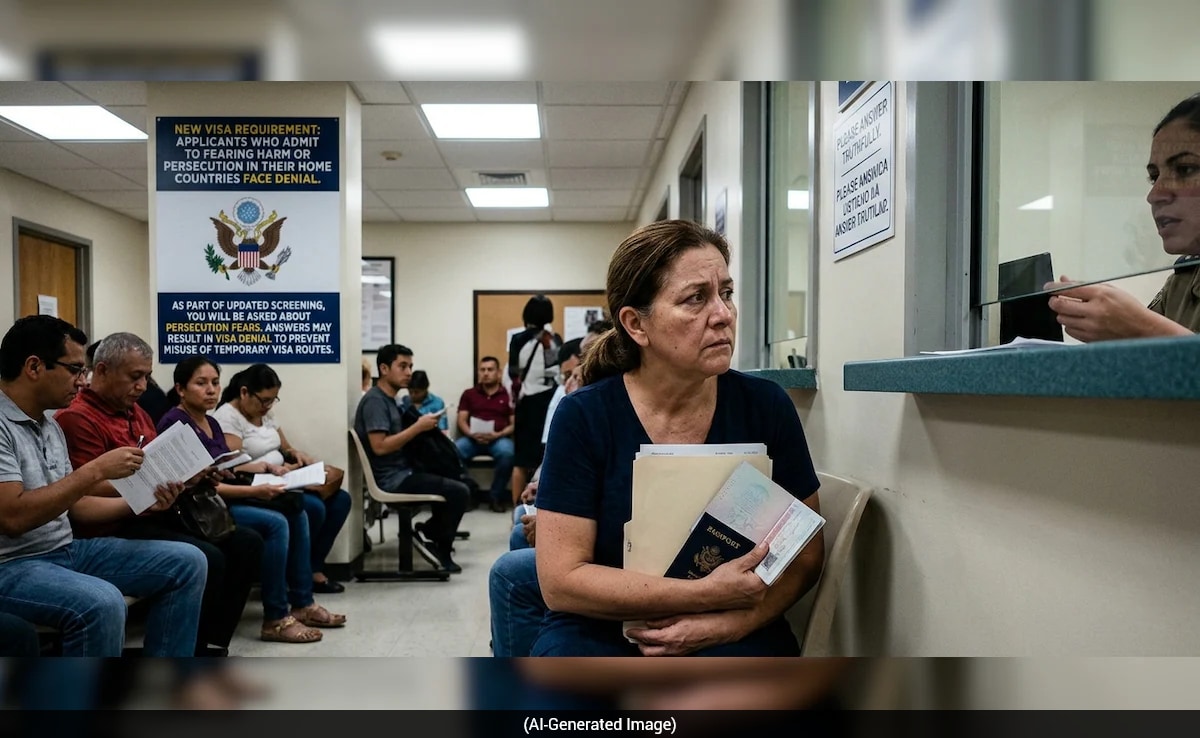
The United States Department of State and Department of Homeland Security have initiated a quiet but systemic pivot in how consular officers evaluate nonimmigrant visa (NIV) applications, specifically targeting individuals who disclose fears of persecution during their interviews. This shift represents a fundamental change in the operational definition of "nonimmigrant intent" under Section 214(b) of the Immigration and Nationality Act (INA). The current policy environment effectively transforms a claim of persecution from a potential humanitarian consideration into a disqualifying admission of immigrant intent. To understand the mechanics of this shift, one must analyze the interplay between mandatory legal presumptions, the operational pressures on consular discretion, and the specific evidentiary thresholds that now define the NIV landscape.
The Section 214b Mechanism and the Presumption of Permanence
At the core of every B1/B2 (business/tourist) visa interview lies a statutory mandate: every applicant is presumed to be an intending immigrant until they prove otherwise to the satisfaction of the consular officer. This is not a neutral starting point; it is a legal weight placed on the applicant's side of the scale.
The adjudication process functions through the "Tie-to-Home-Country" framework. An officer evaluates three distinct variables:
- Economic Connectivity: Local income levels relative to the cost of travel, stable employment history, and asset ownership.
- Social Connectivity: Nuclear family remaining in the home country and deep-rooted community involvement.
- The Incentive to Return: The specific, time-bound reason the applicant must go back to their origin point after the authorized stay.
When an applicant mentions persecution, they inadvertently destroy the "Incentive to Return." By definition, if a person fears for their safety or life in their home country, their incentive to return is zero. From a data-driven consular perspective, the risk of the applicant overstaying or filing for asylum once on US soil approaches 100%. Consequently, the disclosure of persecution acts as a confession of immigrant intent, triggering a mandatory denial under Section 214(b).
The Strategic Misalignment of NIV and Asylum Frameworks
The current administrative tightening exploits a critical gap between the legal standards for a Nonimmigrant Visa and the standards for Asylum.
Under the NIV framework, the burden of proof is high and the officer’s decision is generally non-reviewable (Consular Non-reviewability). Under the Asylum framework (governed by Section 208 of the INA), an individual must demonstrate a well-founded fear of persecution based on race, religion, nationality, membership in a particular social group, or political opinion.
The conflict arises because these two legal paths are mutually exclusive in the eyes of an adjudicator. A nonimmigrant visa is designed for a temporary visit. An asylum claim is a pathway to permanent residency. By expressing a fear of persecution at a consulate, the applicant is attempting to use a temporary vehicle (the NIV) to solve a permanent problem (persecution). Consular training now emphasizes that the proper channel for persecution claims is the refugee processing system or an asylum application made at a Port of Entry (POE), not a visa interview at an embassy.
The Adjudication Bottleneck and Risk Management Logic
Consular officers operate under extreme temporal constraints, often spending less than three minutes per interview in high-volume posts. This creates a reliance on "heuristics"—mental shortcuts used to assess risk. The "Persecution Red Flag" has become one of the most powerful heuristics in the system.
The risk management logic follows a binary path:
- Path A: The applicant claims a standard vacation. The officer assesses ties. If ties are "moderate," the visa may be granted.
- Path B: The applicant claims persecution. The officer no longer needs to assess ties. The fear itself constitutes a motive to abandon the home country. The risk of the applicant becoming an "asylum seeker" (which is a burden on the US domestic legal system) outweighs any individual merit in the application.
This shift is exacerbated by the "Credible Fear" backlog within the US. To prevent further strain on the domestic immigration court system, the Department of State acts as a frontline filter. Denying the visa at the source—the consulate—is exponentially more cost-effective than managing an asylum claim after the individual has arrived at a US airport.
Geopolitical Variables and Country-Specific Thresholds
The tightening of rules is not applied uniformly across the globe. Adjudication severity scales based on two primary metrics:
- The Overstay Rate: The percentage of citizens from a specific country who remain in the US after their visa expires.
- The Asylum Conversion Rate: The percentage of NIV holders from that country who apply for asylum within 180 days of arrival.
In countries with high political instability or active conflict, the threshold for proving nonimmigrant intent is nearly impossible to meet. For example, an applicant from a conflict zone who claims they are traveling to "get a break from the violence" is technically admitting they are fleeing. In the rigid logic of Section 214(b), "fleeing" is the polar opposite of "visiting." The more dangerous the home country becomes, the harder it is to get a tourist visa, creating a paradoxical situation where those who most need to leave are the ones most likely to be denied.
Operational Realities of the DS-160 and Interview Dynamics
The tightening of rules is also reflected in the digital screening process. The Form DS-160 (Online Nonimmigrant Visa Application) and subsequent social media screenings allow officers to identify potential "risk profiles" before the applicant even speaks.
Specific triggers in the data include:
- Employment Gaps: Interpreted as a lack of economic ties.
- Recent Travel to Specific Conflict Zones: Investigated for potential security risks or "asylum-shopping" behavior.
- Public Statements: Any online activity indicating a desire to relocate to the US or criticizing the home government in a way that suggests future persecution.
During the interview, the "persecution trap" often occurs when an officer asks, "Why now?" or "Why is it important for you to leave today?" If the answer involves the worsening political climate or threats from local actors, the officer will likely conclude that the applicant is seeking a "bridge" to the US rather than a round-trip journey.
The Disappearance of the "Humanitarian B-2"
Historically, there was a narrow window for "Humanitarian Parole" or B-2 visas for "emergency reasons" that involved personal safety. That window has effectively closed for standard NIV processing. Officers are now instructed to direct these cases toward the United Nations High Commissioner for Refugees (UNHCR) or specific humanitarian parole programs (such as the CHNV program for Cubans, Haitians, Nicaraguans, and Venezuelans).
This centralization of humanitarian relief into specific, capped programs allows the US government to control the flow of migrants more precisely than the unpredictable NIV system. The result is a clinical separation of "travel for pleasure/business" and "travel for survival."
Strategic Implications for Stakeholders
The current trajectory indicates that the US visa system is moving toward a purely transactional model based on verifiable economic data. For legal practitioners and applicants, the following structural realities must be integrated into any strategy:
- The Primacy of Documentation over Narrative: In an era of skepticism toward "fear-based" claims, objective evidence of ties—such as long-term property deeds, corporate ownership documents, and high-value domestic investments—is the only counter-weight to the presumption of immigrant intent.
- The Permanent Record of Refusal: Under Section 214(b), a refusal is not permanent, but it creates a "record of intent." If an applicant is denied because they cited persecution, a subsequent application that omits this fear will likely be flagged for "material misrepresentation" (Section 212(a)(6)(C)(i)), which carries a potential lifetime ban.
- The Narrowing of the B-1/B-2 Scope: Applicants must treat the NIV interview as a business pitch regarding their return, not an appeal for empathy regarding their departure. Any mention of domestic instability must be framed through the lens of how it strengthens the applicant's resolve to return and protect their interests at home—a difficult, and often impossible, logical leap.
The systemic tightening of visa rules represents a hardening of the US border at the consular level. By redefining "persecution" as "intent to remain," the administration has created a self-executing filter that prioritizes domestic administrative efficiency over the traditional, more flexible interpretation of international travel. For the foreseeable future, the "nonimmigrant" designation will be reserved exclusively for those whose home-country environment is stable enough to guarantee their eventual return.