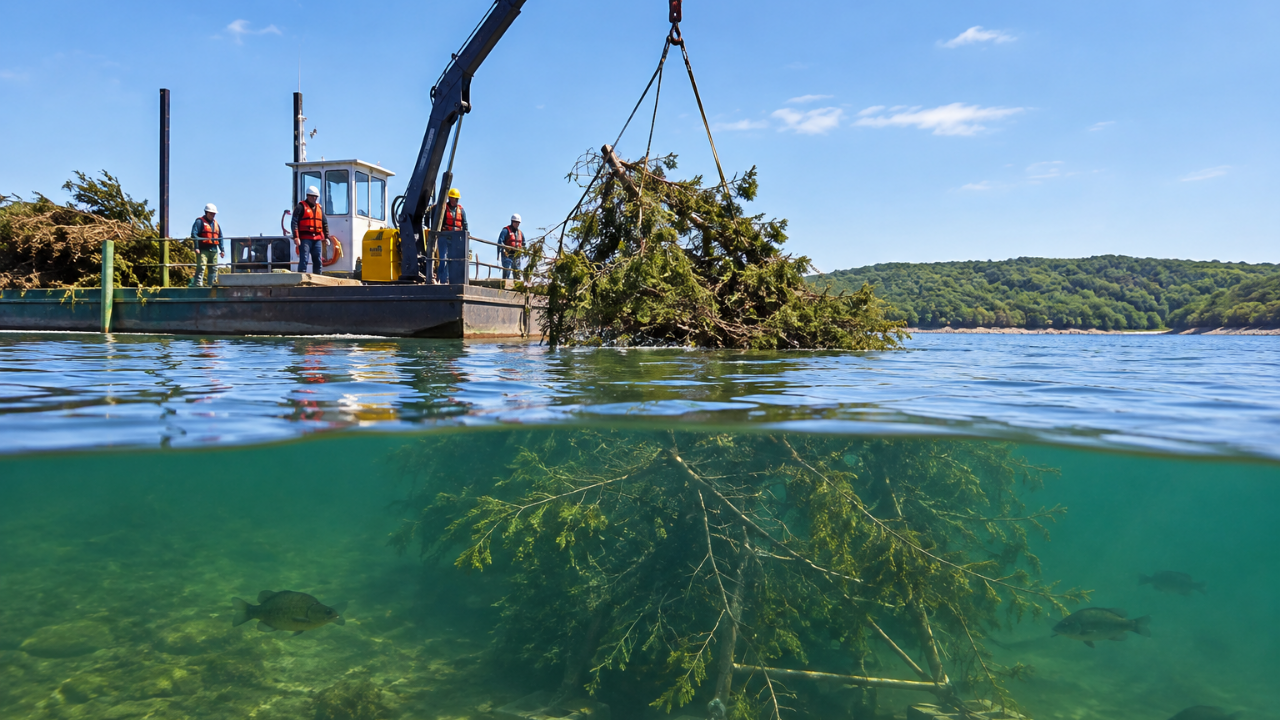
Freshwater reservoirs undergo a predictable ecological aging process known as reservoir maturation and subsequent habitat decay. As submerged timber, standing dead trees, and organic cover degrade due to anoxia and microbial decomposition, aquatic ecosystems face a structural deficit that depresses recruitment rates for sport fish and forage species alike. The deployment of 93 cedar brush piles into Truman Lake, backed by a targeted $75,000 grant aiming for 450 total structures, represents an intervention in reservoir succession. Evaluating the return on investment for artificial aquatic habitat requires examining the physical deployment mechanics, the financial allocation metrics, and the biological carrying capacity of aging impoundments.
The Ecological Deficit of Aging Impoundments
When a terrestrial valley is initially flooded, the standing biomass provides abundant structural complexity. Predator-prey dynamics thrive because juvenile fish find interstitial refugia within submerged canopies, minimizing predation mortality while maximizing foraging efficiency on periphyton and zooplankton. Over decades, wave action, sediment deposition, and aerobic or anaerobic decomposition break down these natural attractors.
Without human intervention, the reservoir bottom transitions into a featureless basin. This bathymetric homogenization triggers several systemic ecological failures:
- Forage fish lose primary shelter, exposing them to pelagic predators before reaching reproductive maturity.
- Angler catch rates plummet as fish scatter across vast, unstructured zones rather than concentrating along predictable depth gradients.
- The overall carrying capacity of the water body shifts downward, reducing biomass yield per surface acre.
The introduction of Eastern red cedar trees counteracts this decay. Cedar wood contains natural resins and dense heartwood that resist rapid fungal and bacterial decay underwater, outlasting softer deciduous woods by factors of three to five. Sinking these trees recreates the lost structural complexity, anchoring localized food webs around hard substrate.
Financial and Operational Resource Allocation
A grant capitalization of $75,000 directed toward a 450-structure deployment establishes a strict unit-economic baseline. This capital structure breaks down to approximately $166.67 per completed and deployed habitat unit, covering material harvesting, weighting systems, transport logistics, and labor overhead.
Executing this deployment efficiently requires strict operational management. Moving heavy green timber, attaching concrete or ballast weights, and transporting materials across large open water bodies demands heavy machinery, specialized barges, and organized volunteer corps. The economic efficiency of public-private conservation grants relies heavily on volunteer labor hours replacing commercial marine contractor expenses. By utilizing community volunteers for the manual phases of harvesting and staging, project coordinators preserve capital for heavy equipment operation and precise GPS mapping.
Strategic placement dictates whether capital expenditures yield ecological dividends. Dumping structural brush randomly across a basin yields negligible returns. Maximizing the utility of 450 structures requires adherence to spatial distribution matrices:
- Placing clusters along secondary points and drops within the 10-to-25-foot depth range to intercept seasonal fish migration routes.
- Anchoring structures near spawning flats to provide immediate post-spawn recovery zones for adult game fish.
- Maintaining multi-depth arrays that remain functional during both high-water spring pool elevations and late-summer drawdowns.
Quantifying Habitat Productivity and Angler Dynamics
Artificial habitat arrays act as biological concentration engines. Periphyton colonizes the submerged cedar needles within weeks, grazing macroinvertebrates follow, and baitfish congregate to feed and hide. This trophic accumulation draws apex predators such as largemouth bass, crappilidae, and hybrid striped bass.
The integration of precision GPS coordinates published through state conservation applications transforms these brush piles into managed fishery assets. Rather than allowing harvest pressure to deplete localized populations blindly, public mapping distributes fishing pressure across all 450 sites. This spatial distribution prevents over-harvesting of single hot spots and stabilizes catch-per-unit-effort metrics across the entire reservoir.
To determine whether these interventions achieve long-term viability, fisheries managers evaluate structural integrity using side-imaging sonar and acoustic telemetry. Monitoring structural decay rates against localized sedimentation helps predict when secondary rehabilitation phases will be required.
Direct capital injection combined with volunteer execution models a scalable blueprint for inland reservoir management. Sustaining aquatic biodiversity and recreational fisheries in aging impoundments requires continuous structural replenishment rather than passive stewardship. Future management frameworks must prioritize high-density cluster configurations over single-tree drops to optimize structural longevity and maintain consistent fish aggregation across fluctuating hydrological cycles.