The physical return of human presence to lunar space is not merely a feat of ballistics; it is a forced realignment of the American aerospace industrial complex and its diplomatic utility. When President Trump convened the Artemis II crew in the Oval Office, the event signaled a transition from theoretical research to high-stakes operational deployment. This mission represents the first crewed flight of the Space Launch System (SLS) and the Orion spacecraft, establishing a critical path for the permanent occupation of the lunar South Pole. To understand the gravity of this milestone, one must analyze the mission through three distinct lenses: the propulsion bottleneck, the life-support risk profile, and the strategic signaling of the executive branch.
The Propulsion Bottleneck and the SLS Architecture
The Artemis II mission relies on the Block 1 configuration of the Space Launch System. Unlike commercial launch vehicles designed for rapid reusability and low Earth orbit (LEO) logistics, the SLS is a heavy-lift vehicle optimized for deep space injection. The architecture utilizes four RS-25 engines and two five-segment Solid Rocket Boosters (SRBs), producing a combined thrust of 8.8 million pounds.
This massive expenditure of energy is required to accelerate the Orion capsule to a speed of approximately 24,500 miles per hour, sufficient to break Earth’s gravitational well. The mission profile uses a "Hybrid Free Return Trajectory." This specific orbital mechanic ensures that if the service module fails to ignite for its lunar injection, the spacecraft’s momentum and Earth’s gravity will naturally pull the crew back into an atmospheric reentry corridor. This choice reflects a conservative risk-management framework essential for the first crewed test of a new flight system.
The core constraint of this architecture remains the cost-per-launch and the production cadence of the RS-25 engines. Because these engines are legacy hardware from the Space Shuttle program—modified for higher thrust—the inventory is finite. The transition to the RS-25E (the expendable, cheaper variant) is a prerequisite for the long-term economic viability of the Artemis program. Without this shift, the cadence of lunar missions cannot exceed one every 18 to 24 months, creating a structural bottleneck for the establishment of the Lunar Gateway.
Human Factors and Life Support System Stress Tests
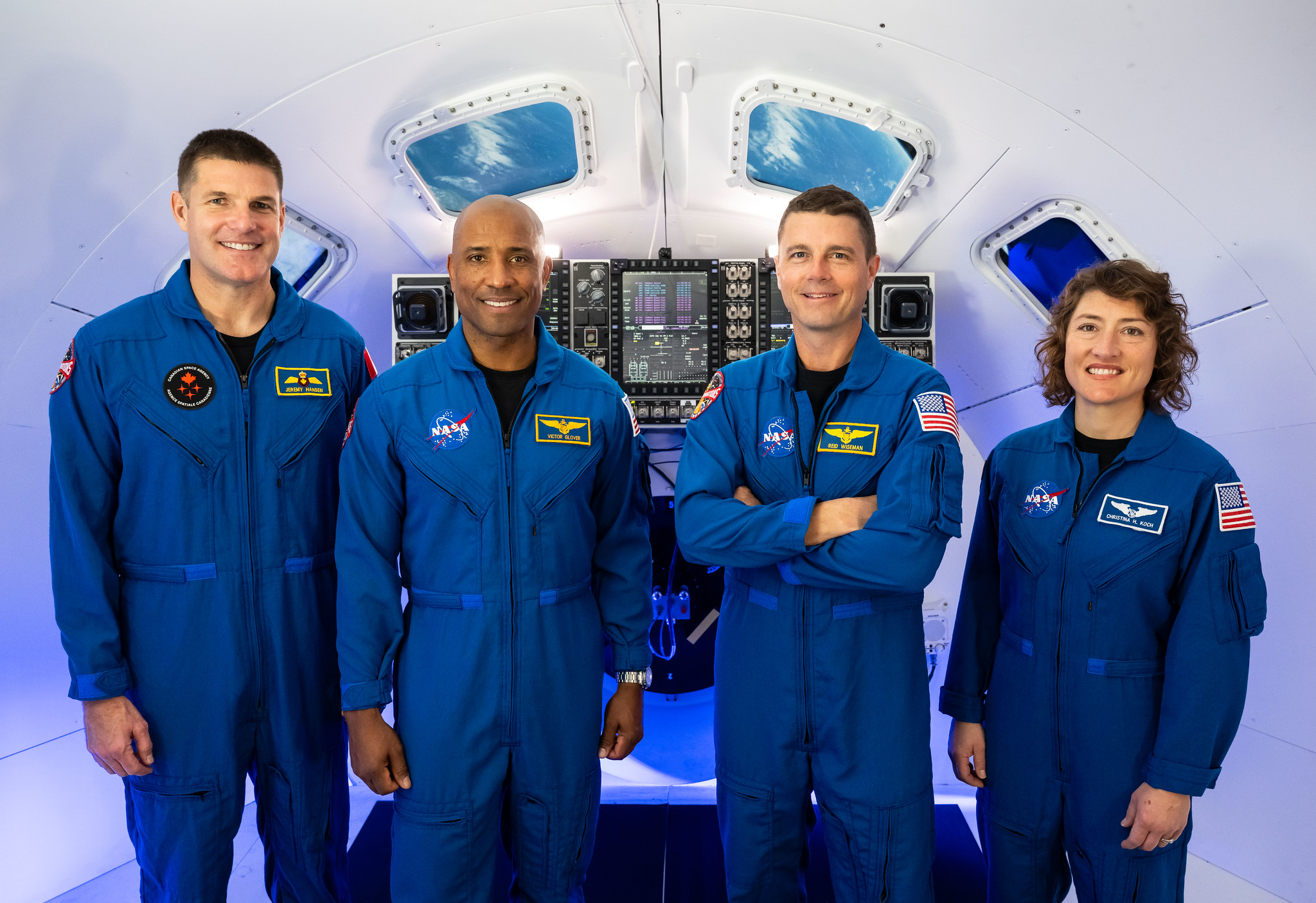
The four-person crew—Commander Reid Wiseman, Pilot Victor Glover, and Mission Specialists Christina Koch and Jeremy Hansen—occupies a pressurized volume of 316 cubic feet. While the Artemis I mission validated the heat shield and basic flight telemetry, Artemis II is the definitive stress test of the Environmental Control and Life Support System (ECLSS).
The ECLSS must perform three non-negotiable functions in a deep-space environment:
- Atmospheric Regulation: Maintaining a partial pressure of oxygen while scrubbing carbon dioxide (CO2). Unlike the International Space Station (ISS), which utilizes massive, modular systems for air revitalization, Orion’s systems are miniaturized and must operate with higher reliability due to the lack of an immediate "abort-to-Earth" option once the lunar flyby commences.
- Radiation Mitigation: Outside the protection of Earth's Van Allen belts, the crew is exposed to solar energetic particles (SEPs) and galactic cosmic rays (GCRs). The Orion spacecraft features a designated "storm shelter" area where the crew can shield themselves using onboard mass (water tanks and equipment) during solar flares.
- Active Thermal Control: Deep space presents extreme temperature gradients. The spacecraft uses a pumped fluid loop to transfer heat from the electronics and the crew to external radiators.
A failure in any of these subsystems during the 10-day mission would necessitate an immediate abort. The technical risk is compounded by the fact that Artemis II is the first time humans will rely on these specific iterations of life-support hardware in a high-radiation environment.
The Geopolitical Utility of the Oval Office Endorsement
The meeting between the President and the Artemis II crew serves as a high-visibility validation of the Artemis Accords—a legal framework designed to govern lunar resource extraction and "safety zones." By positioning the crew within the executive inner circle, the administration reinforces the notion that space leadership is a primary pillar of national security and economic competition.
The presence of a Canadian astronaut, Jeremy Hansen, is a tactical inclusion. It solidifies the "Lunar Gateway" partnership, wherein international contributors provide hardware (such as robotic arms or habitation modules) in exchange for flight opportunities. This creates a locked-in diplomatic coalition that makes the program harder to cancel across successive administrations.
The executive endorsement also functions as a market signal to the private aerospace sector. The SLS is the "backbone," but the landing systems (HLS) are being developed by entities like SpaceX and Blue Origin. The President's public support acts as an assurance to these contractors that the capital-intensive development of lunar landers will have a guaranteed customer in the federal government.
Structural Risks and the Moon-to-Mars Pathway
While the Artemis II flyby is a significant milestone, it exposes the gap between "flags and footprints" and "sustainable presence." The mission does not include a lunar landing; that objective is reserved for Artemis III. The delta between these two missions involves the successful orbital docking of the Orion capsule with a Starship HLS, a maneuver that has never been attempted.
The complexity of this "conjunction" architecture introduces several points of failure:
- Cryogenic Fluid Management: Transferring liquid oxygen and methane in zero-G to refuel the lander.
- Software Interoperability: Aligning the flight computers of legacy government hardware with agile, rapidly iterated private software.
- Launch Windows: The requirement for multiple "tanker" launches to fuel the HLS creates a compounding risk—if one tanker launch fails, the entire mission window for the crewed Orion may be lost.
The Strategic Recommendation for Mission Integration
To move beyond the ceremonial aspects of the Artemis II mission, the administration and NASA must pivot toward a "Commoditized Logistics" model. The current reliance on the SLS for every aspect of the mission is unsustainable from a budgetary perspective.
The strategic priority must be the decoupling of crew transport from heavy cargo. Utilizing the SLS exclusively for the Orion capsule while shifting all lunar infrastructure—habitats, power plants, and rovers—to commercial heavy-lift vehicles (like Starship or New Glenn) reduces the "single-point-of-failure" risk of the SLS production line.
Furthermore, the Artemis II data must be used to fast-track the development of autonomous medical systems. As mission durations increase and the distance from Earth grows, the "light-speed lag" makes real-time mission control support impossible. The crew must transition from being "pilots" to "systems managers" capable of performing complex repairs and medical procedures without terrestrial intervention.
The success of Artemis II will not be measured by the splashdown in the Pacific, but by the volume of telemetry generated regarding radiation shielding and ECLSS efficiency. These data points are the actual currency of the mission, dictating the design of the Mars-bound vehicles of the 2030s. The Oval Office meeting was the symbolic start; the engineering data will be the functional reality.
The immediate tactical move is the hardening of the lunar supply chain, ensuring that the industrial base can support a 12-month launch cadence, thereby transforming the Moon from a destination into an operational theater.