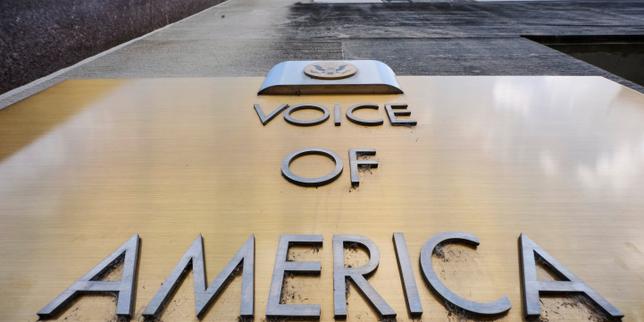
The recent federal court mandate forcing the reinstatement of over 1,000 employees and the resumption of specific broadcasts at Voice of America (VOA) is not merely a personnel dispute; it is a stress test for the legal firewall separating political executive power from independent state-funded journalism. This judicial intervention exposes the friction between the statutory mandates of the U.S. Agency for Global Media (USAGM) and the discretionary authority of its leadership. To understand the operational and strategic implications of this ruling, one must dissect the three structural pillars that define the boundaries of state-sponsored media: the "Firewall" principle, the contractual obligations of federal employment, and the specific legislative charter governing international broadcasting.
The Mechanics of the Statutory Firewall
The central conflict in this case hinges on the "firewall" established by the International Broadcasting Act. This is not a vague ethical guideline but a rigid structural constraint designed to prevent the transformation of VOA from a news organization into a propaganda organ.
- Editorial Autonomy as a Non-Negotiable Asset: The law mandates that news remain objective and independent. When an executive bypasses these protections—either through mass terminations without cause or by overriding editorial calendars—they violate the structural integrity of the agency.
- The Risk of Regulatory Capture: The court's intervention identifies a "bottleneck" where centralized executive control attempts to monopolize the narrative. By ordering the re-hiring of staff, the judiciary is effectively recalibrating the balance of power, ensuring that the agency’s output remains aligned with its legislative mission rather than a specific political agenda.
- The Credibility Multiplier: In the logic of international relations, the value of VOA is proportional to its perceived independence. A state-media apparatus that is seen as a direct mouthpiece for an incumbent administration suffers a "credibility tax," reducing its efficacy in competitive information environments.
The Cost Function of Mass Reinstatement
The judicial order to rehire 1,000 employees creates an immediate operational and fiscal shock. This is not a simple return to status quo; it is a complex logistical re-integration that carries significant overhead.
- Lump-Sum Back Pay Liabilities: Reinstatement often triggers "make-whole" provisions. The USAGM must account for months of unpaid wages, benefits, and potential legal fees, which creates an immediate deficit in the current fiscal year’s operating budget.
- Operational Friction: Integrating 1,000 employees who were previously purged creates a workforce divided by high internal friction. The management layer that executed the terminations must now oversee the return of those same individuals, leading to a breakdown in organizational trust.
- Infrastructure Degradation: During the hiatus of these broadcasts, technical infrastructure and frequency allocations may have been reassigned or mothballed. Resuming operations requires a technical audit to ensure that transmission capabilities still meet the "Voice of America" standard of global reach.
The Administrative Law Violation
The court's decision suggests that the initial mass terminations and broadcast suspensions likely failed the "arbitrary and capricious" test under the Administrative Procedure Act (APA). When a federal agency takes a drastic action—such as firing a significant percentage of its workforce or shuttering core programs—it must provide a reasoned explanation based on a factual record.
The failure to provide this record creates a legal vulnerability. If the leadership cannot demonstrate that the cuts were necessitated by budget shortfalls or specific mission changes authorized by Congress, the court views the action as a breach of administrative duty. This creates a precedent where the USAGM CEO’s power is explicitly limited by the "Reasoned Decision-Making" framework.
Strategic Vulnerabilities in State Media Management
The disruption at VOA highlights a critical vulnerability in how modern democracies manage soft-power assets. Unlike private media firms, state-funded entities are subject to "Dual-Agency Oversight": they must answer to the executive branch for funding and the judicial branch for statutory compliance.
The Human Capital Flight Risk
The primary risk of such high-profile legal battles is the erosion of elite talent. Specialized journalists with deep regional expertise (especially in linguistics and foreign policy) are difficult to replace. A cycle of purge-and-reinstate signaling instability drives top-tier talent toward the private sector or international competitors, resulting in a "brain drain" that no court order can instantly reverse.
The Global Information Competitive Set
While VOA was embroiled in internal litigation, competitors—specifically state-funded entities from rival powers—continued to expand their market share in key regions like Sub-Saharan Africa and Southeast Asia. The "Down-Time" caused by the broadcast suspension represents a lost opportunity cost in the global competition for narrative dominance.
Redefining the Executive-Legislative Boundary
This ruling reinforces the concept that the USAGM is a "quasi-independent" agency. While the President appoints the leadership, the leadership does not possess the same "at-will" flexibility found in traditional cabinet departments.
The court’s decision effectively defines the USAGM CEO as a steward of a legislative trust rather than an autonomous corporate director. This distinction is vital for future strategic planning. Any subsequent restructuring efforts must now be routed through a transparent, documented process that includes:
- Congressional Notification: Clear alignment with the committees of jurisdiction to ensure funding remains tied to the restructured mission.
- Impact Assessments: Quantitative data showing how changes to broadcast hours or staffing levels improve reach or efficiency without violating the editorial firewall.
- Labor Relations Stability: Adherence to federal civil service protections to avoid the high cost of litigation and mandatory reinstatement.
The strategic play for the USAGM leadership moving forward is to pivot from a model of "Disruptive Reform" to "Incremental Optimization." The court has signaled that it will protect the status quo against sudden, unvetted shifts in personnel or content. To achieve any meaningful change, leadership must build a documented, evidence-based case for reorganization that survives the scrutiny of both the federal bench and a divided Congress. Failure to do so ensures that the agency remains trapped in a cycle of litigation, further devaluing the very soft-power asset they were tasked with managing.