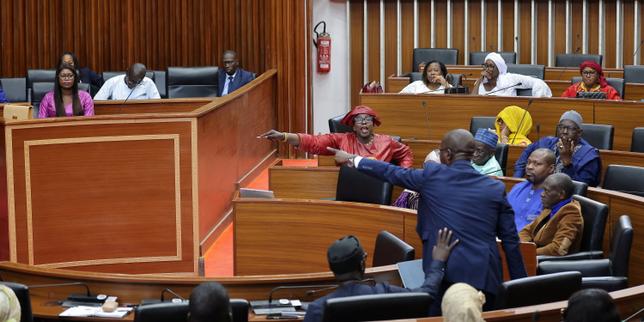
The tension within the Senegalese judicial system regarding the criminalization of homosexuality is not a mere clash of social values; it is a structural failure of the legal apparatus to reconcile imported colonial penal codes with contemporary legislative expansionism. When a state moves to tighten the penalization of "acts against nature" (Article 319 of the Penal Code), it creates a specific friction point for defense attorneys who are bound by a professional oath to provide a defense while navigating a judiciary increasingly influenced by non-secular social pressure. This analysis deconstructs the systemic bottlenecks, the breakdown of due process, and the erosion of attorney-client privilege within this heightened legislative environment.
The Triad of Judicial Compromise
The current legal climate in Senegal regarding LGBTQ+ rights functions through three distinct mechanisms of pressure. Each mechanism alters how law is practiced on the ground, regardless of the text written in the statutes. Don't miss our recent post on this related article.
- Social Jurisprudence: Judges and prosecutors do not operate in a vacuum. In matters of "public morality," the court often prioritizes social stability over strict evidentiary standards. This results in a "pre-trial guilt" bias where the burden of proof effectively shifts to the defendant.
- The Institutional Bottleneck: Lawyers representing individuals accused under Article 319 face professional ostracization. This creates a scarcity of specialized legal counsel, driving up the "risk premium" for defense and leaving many defendants with under-resourced or ideologically hostile representation.
- The Evidentiary Paradox: Because the acts in question are private, the state relies heavily on digital surveillance, leaked private communications, and forced confessions. The legality of how this evidence is obtained is rarely challenged successfully because the "moral gravity" of the charge is used to justify procedural shortcuts.
Deconstructing Article 319 and the Push for Reform
The existing legal framework, a relic of the 1966 Penal Code, uses the term "unnatural acts" (actes contre nature). The vagueness of this terminology is a deliberate legislative tool. It provides the state with a broad "elasticity of interpretation" that can be expanded or contracted based on the political needs of the moment.
Recent legislative attempts to explicitly name and increase the minimum sentencing for homosexuality from five to ten years represent a shift from Regulatory Penalization to Symbolic Criminalization. In a Regulatory model, the law seeks to manage behavior. In a Symbolic model, the law exists to affirm the identity of the majority by criminalizing the identity of the minority. For a defense attorney, the Symbolic model is nearly impossible to fight because the evidence becomes secondary to the performance of "protecting the nation." To read more about the context of this, The Guardian offers an excellent breakdown.
The Mechanics of Procedural Erosion
When a legal system prioritizes symbolic victory over procedural integrity, four specific breakdowns occur:
- Violation of Inviolability: The principle that a home is a private sanctuary is frequently bypassed. Arrests are often made based on "denunciation" by neighbors, which the police treat as "flagrante delicto" (in the act) to bypass the requirement for search warrants.
- Chain of Custody Failures: Digital evidence, such as WhatsApp messages or photos, is often handled without forensic rigor. In standard criminal cases (theft, fraud), a lawyer could easily have this evidence suppressed. In "moral" cases, the court often admits it under the guise of "intimate conviction" of the judge.
- The Defense Barrier: Lawyers who specialize in human rights are labeled as "proxies" for the accused. This conflation of the lawyer with the client’s alleged crime is a direct violation of the UN Basic Principles on the Role of Lawyers, yet it is a daily reality in the Dakar courts.
The Economic and Geopolitical Cost Function
The intensification of these laws introduces a specific set of costs that the Senegalese state must balance. This is not just a human rights issue; it is a macroeconomic variable.
Direct State Costs: The expansion of the carceral population for non-violent "moral" offenses increases the strain on the Ministry of Justice’s budget. Overcrowded facilities like the Rebeuss Prison in Dakar are already at a breaking point. Adding a new class of long-term prisoners increases the state's daily operational expenditure without any corresponding increase in public safety.
Indirect Institutional Costs: Senegal has long positioned itself as a "hub of stability" in West Africa to attract Foreign Direct Investment (FDI) and international NGO headquarters. A shift toward aggressive, identity-based criminalization creates a "Reputational Discount." International partners and multi-lateral donors often have clauses regarding non-discrimination. When the state institutionalizes discrimination, it risks the withdrawal of technical assistance and a downgrade in "Rule of Law" indices, which directly correlates with the cost of sovereign debt.
The Attorney’s Dilemma: Strategic Neutrality vs. Rights Advocacy
For the Senegalese bar, the dilemma is operational. A lawyer has two primary strategies when defending a client under Article 319, neither of which is optimal.
Strategy A: Technical Nullity
The lawyer ignores the "moral" aspect entirely and focuses on procedural errors. This includes challenging the legality of the arrest, the lack of a warrant, or the absence of physical evidence of an "act." This is the safest path but is increasingly blocked by judges who view procedural technicalities as "obstruction of justice" in the face of moral outcry.
Strategy B: Constitutional Challenge
The lawyer argues that Article 319 contradicts the Senegalese Constitution, which guarantees the equality of all citizens before the law and the right to privacy. This is a high-risk strategy. It positions the lawyer as a direct adversary to the state’s current political trajectory and often leads to the lawyer being targeted by religious and social groups.
Mapping the Future of the Legal Landscape
The trajectory of Senegalese law is currently moving toward a more rigid, codified intolerance. This is a reaction to perceived "external pressure" from the West, creating a feedback loop where the law is used as a shield for national sovereignty.
This creates a Dual-Track Legal System. On one track, commercial and business law continues to modernize to attract investors. On the second track, criminal and family law is regressing toward a more conservative, communalist framework. This duality is unsustainable. A legal system cannot remain "pro-business" while simultaneously eroding the fundamental right to privacy and the sanctity of the attorney-client relationship. If a phone can be searched without a warrant for a "moral" crime, it can be searched for a political or commercial one.
The legal community in Senegal is currently at a point of forced silence. The bar association (Ordre des Avocats) faces internal division. Younger, more secular-leaning lawyers view the new legislative proposals as an existential threat to the profession’s independence. Older, more traditionalist members see them as a necessary reflection of the "Suniu Gal" (Our Boat) philosophy—the idea that the collective must be protected at all costs, even at the expense of individual rights.
The strategic reality is that as the law becomes more specific in its prohibitions, it becomes more difficult to defend. The transition from "acts against nature" to specific naming of sexual orientations in the penal code removes the "gray area" that lawyers previously used to secure acquittals or reduced sentences. This narrowing of the legal field effectively transforms the courtroom from a place of adjudication into a theater of condemnation.
The only viable path for the preservation of the Senegalese legal profession is a refocus on Procedural Fundamentalism. Lawyers must stop litigating the "morality" of the act—a battle that is currently unwinnable in the court of public opinion—and instead litigate the "integrity of the file." This means an obsessive focus on the Fourth Amendment equivalent in Senegalese law: the inviolability of the home and the person. If the defense can make the "cost of conviction" too high in terms of procedural rigor, they can create a de facto shield for their clients, even as the de jure landscape becomes more hostile. The future of Senegalese jurisprudence rests not on the definition of a "nature," but on the definition of a "warrant."