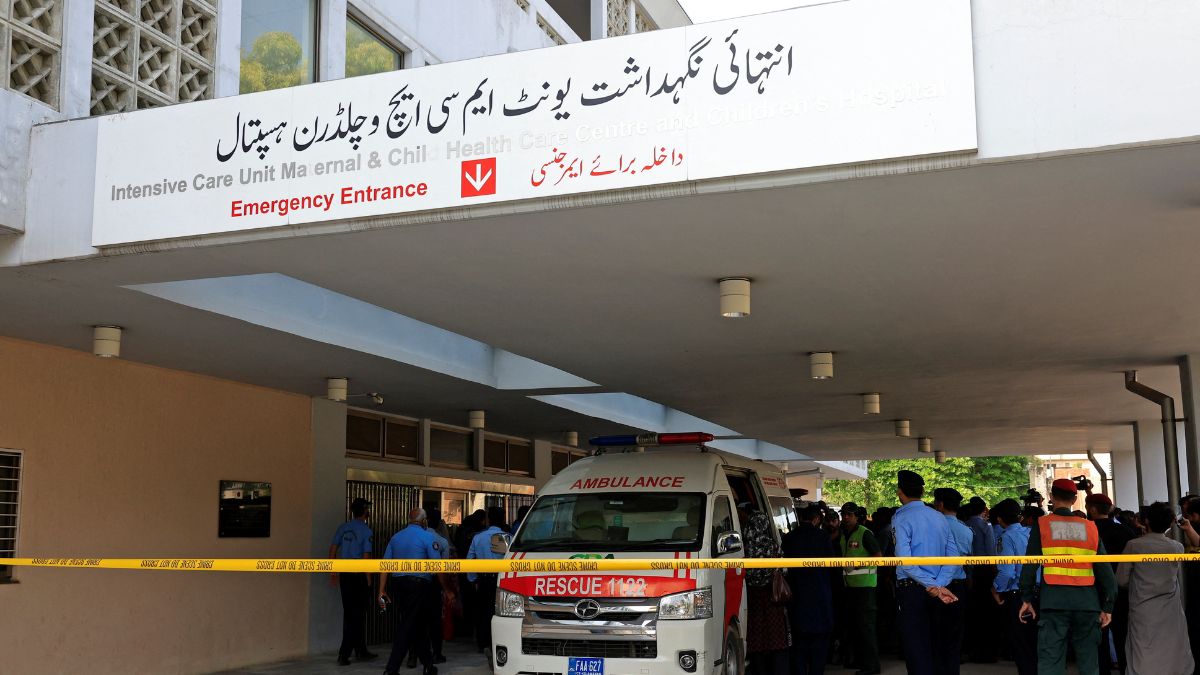
Systemic institutional decay produces catastrophic outcomes long before an ignition source appears. The recent disaster at the Pakistan Institute of Medical Sciences in Islamabad, where fourteen newborns perished during an early morning fire on the third floor of the mother and child ward, exemplifies a complete failure of operational safety architecture. Attributing such an event to a localized electrical short circuit or an air conditioning compressor explosion misses the underlying structural vulnerabilities that permit mechanical faults to escalate into mass mortality events.
The Vector of Vulnerability
Neonatal intensive care units and hospital gynaecology wards present unique engineering and operational challenges. A standard adult ward allows for ambulatory self-evacuation, meaning the occupant density can safely react to early-stage smoke or thermal alerts. Conversely, a neonatal nursery houses patients who possess zero motor independence and absolute physiological dependency on life-support machinery, including mechanical ventilators and regulated thermal incubators.
When an infrastructure failure occurs in this specific environment, the response window collapses to seconds. The presence of enriched oxygen environments inside closed incubators converts standard electrical sparks into instantaneous, high-intensity deflagrations. The physical layout of the third-floor nursery at the Islamabad facility created a single point of failure where environmental control systems, power distribution grids, and medical gas lines intersected without adequate physical compartmentalization or automated suppression mechanisms.
The Cost Function of Deferred Maintenance
Public healthcare systems in developing economies frequently operate under severe capital constraints, forcing facility managers into reactive maintenance cycles rather than predictive asset management. The economic calculus governing state-run hospitals prioritizes acute curative care capacity over background infrastructure resilience.
This creates a hidden cost function:
- Capital expenditure on fire suppression systems, active smoke evacuation pathways, and continuous electrical thermal imaging is deferred.
- The probability of localized equipment failure increases linearly with time and lack of preventative servicing.
- The potential impact severity scales exponentially due to high patient dependency and density.
When an air conditioning compressor or electrical conduit fails under heavy operational loads, the lack of redundant safety switches permits localized arcing to ignite surrounding polymeric building materials and medical plastics. Institutional oversight mechanisms that fail to mandate strict fire-stop bulkheads between electrical chases and patient wards directly violate baseline healthcare engineering standards.
Systemic Oversight Deficits
Official responses to hospital fires universally involve the immediate formation of inquiry committees and political directives demanding punitive accountability. While identifying individual negligence or equipment malfunction is necessary for judicial records, it fails to address the organizational pathologies that permit hazardous conditions to persist.
Regulatory bodies often suffer from regulatory capture or resource starvation, preventing independent safety audits of state-run medical facilities. When hospitals operate without enforced certification standards for electrical load management and medical gas storage, safety becomes dependent on individual vigilance rather than systemic reliability. Trust in public medical infrastructure erodes permanently when administrative reviews focus solely on terminal trigger events while ignoring the decades of accumulated deferred capital investment that preceded them.
Institutional Risk Mitigation Architecture
Preventing future mass-casualty incidents in high-dependency clinical environments requires transitioning from reactive inquiries to proactive engineering controls.
- Decouple environmental life-support systems from standard ward power grids by installing dedicated, isolated sub-stations with automated arc-fault circuit interrupters.
- Implement rigid spatial compartmentalization, ensuring that neonatal nurseries feature independent, positive-pressure smoke extraction systems and Class-A fire-rated physical barriers.
- Establish continuous thermal and electrical diagnostic monitoring on all high-draw compressor units and heavy-load wiring harnesses located within proximity of medical gas distribution points.