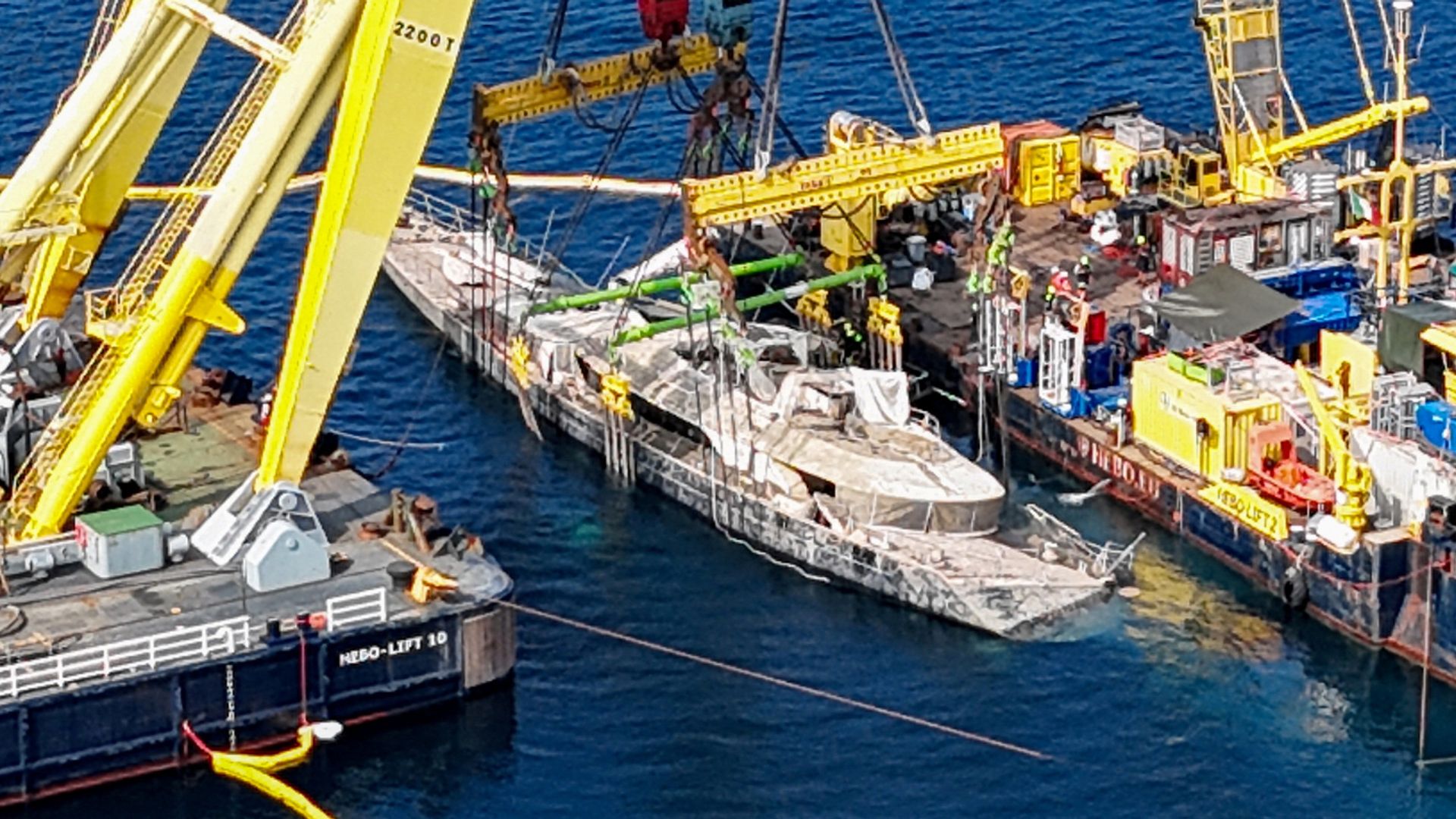
The sinking of the Bayesian superyacht near Porticello was not an unavoidable casualty of an extreme meteorological event, but a catastrophic convergence of technical vulnerability and operational oversight. While initial media narratives focused on a "freak storm" or a waterspout, the physics of maritime stability and the investigative findings from the Termini Imerese Public Prosecutor’s Office suggest a failure to manage the vessel’s center of gravity and watertight integrity. In high-performance sailing vessels, safety is a function of the equilibrium between the righting moment of the keel and the heeling moment generated by wind and water ingress. The Bayesian lost this equilibrium because of a series of preventable human-induced mechanical states.
The Stability Equation and the Righting Moment
A sailing vessel’s ability to recover from a tilt is dictated by its Metacentric Height ($GM$). The $GM$ is the distance between the center of gravity ($G$) and the metacenter ($M$). For a 56-meter Perini Navi ketch like the Bayesian, the stability profile is engineered to withstand significant wind pressure, provided the vessel remains a closed system. Don't forget to check out our previous coverage on this related article.
The righting moment ($RM$) is calculated as:
$$RM = \Delta \cdot GZ$$
Where $\Delta$ represents the vessel's displacement and $GZ$ is the righting arm.
Investigative data indicates that the Bayesian featured a 75-meter aluminum mast—one of the tallest in the world. This height creates a massive lever arm. When wind hits the mast and rigging, it generates a heeling moment. Under normal conditions, the heavy retractable keel provides a counteracting force. However, if the keel was retracted at the time of the storm, the $GZ$ arm was significantly shortened, reducing the vessel's ability to right itself after a critical angle of heel. If you want more about the background of this, Al Jazeera provides an excellent summary.
Failure of the Watertight Envelope
The transition from a stable vessel to a sinking one is defined by the "Angle of Downflooding." This is the specific degree of tilt at which water begins to enter the hull through non-watertight openings. In the case of the Bayesian, investigators have focused on two primary points of failure:
- The Submersion of Open Hatches: Reports suggest that the large aft garage door or side companionways may have been left open. Once the vessel heeled beyond a certain degree—likely accelerated by the retracted keel—water would have poured into the hull at a rate of several tons per second.
- Ventilation and HVAC Induction: Large yachts require significant airflow for engine cooling and interior climate control. If the waterproof dampers on these vents were not sealed, they became direct conduits for seawater once submerged.
The sudden influx of water shifted the center of gravity ($G$) upward and toward the submerged side, a phenomenon known as the Free Surface Effect. This effect drastically reduces the $GM$, eventually making it negative. At that point, the vessel loses all "Righting Energy" and capsizes.
The Downburst vs. Waterspout Distinction
Meteorological reconstruction indicates the presence of a "downburst"—a localized area of powerful downward air currents—rather than a sustained waterspout. While a waterspout involves rotational wind, a downburst creates a sudden, linear "starburst" of wind upon hitting the ocean surface.
This distinction is critical for understanding the crew's failure to react. A downburst provides almost no visual warning on radar compared to a rotating storm system. However, the Bayesian was equipped with sophisticated weather monitoring systems. The failure lay not in the lack of data, but in the "Black Swan" assessment of the risk. The crew did not transition the ship into a "Heavy Weather State," which requires:
- Closing all portholes and external doors.
- Lowering the retractable keel to its maximum depth.
- Securing all heavy internal furniture to prevent a shift in ballast.
- Centering the rudders to maintain a predictable drift pattern.
The "Unsinkable" Fallacy in Marine Engineering
The designer of the Bayesian, Perini Navi, has long marketed these vessels as virtually unsinkable due to their ballast-to-weight ratios. This claim holds true only as long as the hull remains "weathertight." The investigation has highlighted a "Chain of Error" where mechanical superiority was negated by operational negligence.
A primary bottleneck in the vessel’s defense was the speed of the sinking. Survivors reported the ship vanished in approximately 16 minutes. For a vessel of 473 gross tons to sink that rapidly, the volume of water ingress must have bypassed the internal bulkhead divisions. This suggests that internal "watertight" doors were likely open to allow crew and guest movement, effectively turning the compartmentalized hull into a single, massive flooding chamber.
Quantifying the Human Element: The "Bridge Team" Failure
In maritime law and strategy, the "Master of the Vessel" bears ultimate responsibility for the safety of the ship. The investigation has raised questions regarding why the engines were not started to reposition the bow into the wind. By keeping the ship broadside (perpendicular) to the wind, the crew allowed the maximum possible surface area to be exposed to the downburst.
The "Broadside Risk" can be visualized as a pressure calculation:
$$P = \frac{1}{2} \rho v^2 C_d A$$
Where $P$ is the force, $\rho$ is air density, $v$ is wind velocity, $C_d$ is the drag coefficient, and $A$ is the exposed surface area. By failing to turn the bow into the wind, the crew maximized $A$, ensuring the heeling moment would exceed the ship's physical recovery limits.
Strategic Implications for the Superyacht Industry
The loss of the Bayesian serves as a structural warning for the ultra-high-net-worth maritime sector. It exposes a dangerous gap between vessel capability and crew execution. High-performance yachts are increasingly designed with extreme features—like the Bayesian’s 75-meter mast—which reduce the margin for error.
The industry must now pivot from a focus on aesthetic luxury to "Active Stability Management." This involves:
- Automated Hull Integrity Systems: Sensors that automatically trigger the closing of all external apertures when wind speeds or heel angles reach a predefined threshold.
- Mandatory Keel Protocols: Strict regulatory requirements that retractable keels must be fully extended whenever a vessel is at anchor in regions prone to thermal instability.
- Redefining "Heavy Weather" Readiness: Moving away from subjective crew judgment and toward data-driven, mandatory checklists triggered by real-time meteorological feeds.
The Bayesian was not defeated by nature; it was compromised by the failure to respect the fundamental physics of buoyancy and the precarious nature of a high-center-of-gravity design in a dynamic environment. The path forward for maritime safety requires an abandonment of the "unsinkable" narrative in favor of a rigorous, mechanical commitment to watertight discipline.