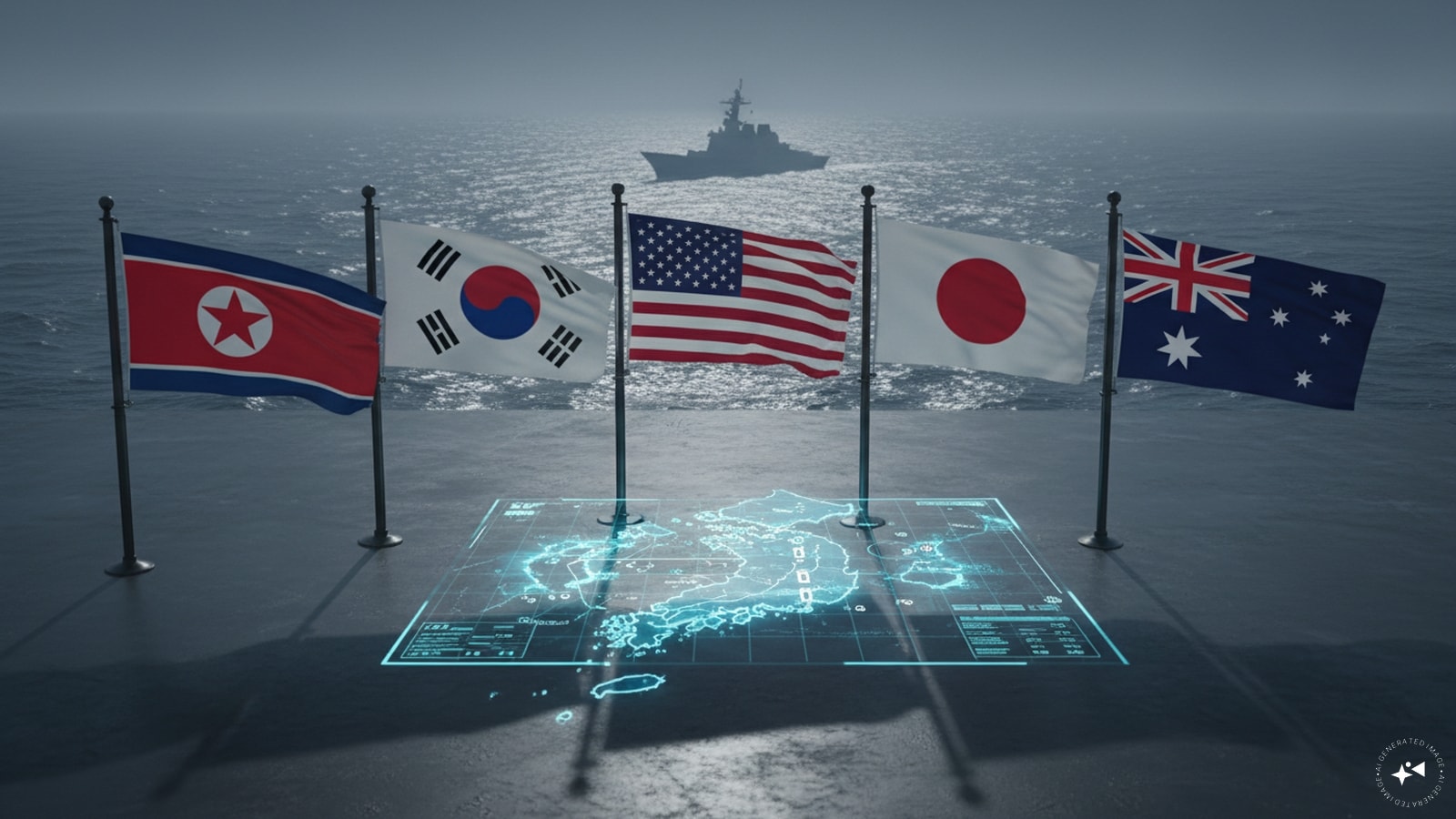
Geopolitical signaling follows an arithmetic of deterrence where military exercises and rhetorical escalation operate within a closed feedback loop. When defense leadership in Pyongyang articulates threats of powerful retaliation against combined military drills executed by Washington and Seoul, observers routinely misinterpret the posture as immediate tactical unpredictability. A rigorous examination of state-to-state friction reveals structural patterns rather than erratic emotional outbursts. State rhetoric functions as an institutionalized pressure valve, compensating for asymmetric conventional military capabilities through targeted strategic messaging.
The Asymmetric Deterrence Trap
Pyongyang maintains a security doctrine predicated on force multiplication through nuclear deterrence and asymmetric capabilities. Traditional military exercises conducted by the United States and South Korea introduce a high-frequency stress test into this architecture.
The Resource Constraint Dilemma
- Operational Tempo: Combined exercises require massive logistical mobilization, real-time intelligence sharing, and persistent aerial and naval patrols.
- Defensive Stress: For North Korea, matching this operational tempo conventional-wise triggers unsustainable economic drain.
- Rhetorical Substitution: Strategic threats serve as a low-cost, high-yield substitute for matching conventional force expenditures dollar-for-dollar.
State media positioning acts as a domestic cohesion mechanism and an international signaling device. The defense minister's declarations are bounded by systemic requirements to project strength internally while raising the political cost of allied operations externally. Analyzing these statements through a cost-benefit lens strips away the sensationalism typical of standard media reporting, exposing a calculated calculus of intimidation.
Escalation Ladders and Operational Thresholds
Understanding how rhetoric transforms into kinetic posturing requires mapping the escalation ladder governing the peninsula. Each phase of allied training maneuvers corresponds to a predictable tier of state response.
Phase One: Intelligence Gathering and Posture Shifts
Allied forces initiate large-scale computer-simulated command post training alongside field maneuvers. Pyongyang responds via ministerial statements framing these actions as direct invasion rehearsals, legally and politically justifying future countermeasures.
Phase Two: Weapon System Demonstration
Rhetorical warnings routinely transition into technical testing cycles. Short-range ballistic missile launches or artillery drills serve as empirical proof of capability, translating verbal threats into physical telemetry that foreign intelligence apparatuses must evaluate.
Phase Three: Institutionalization of Counter-Measures
Bilateral or multilateral defense agreements between adversaries prompt structural shifts in defense policy, such as the formal suspension of domestic pacts or the acceleration of tactical warhead integration.
This progression operates on a closed loop. Neither party seeks total kinetic engagement due to mutually assured destruction dynamics, yet both require continuous friction to validate their respective alliance commitments and internal security narratives.
The Economic Impact of Permanent Crisis
Security friction on the peninsula shapes regional market behavior and sovereign risk ratings, particularly for South Korea. Foreign direct investment and currency valuations absorb the shock of recurrent missile tests and defense minister pronouncements, though markets have developed a structural tolerance to chronic volatility.
Risk Mitigation by Market Actors
- Capital Flight Suppression: Institutional investors price in long-term geopolitical stalemate rather than imminent armed conflict, preventing structural capital flight.
- Supply Chain Hedging: Multinational entities operating in Northeast Asia maintain localized redundancy plans to insulate semiconductor and heavy manufacturing sectors from sudden maritime corridor disruptions.
The persistent threat environment imposes an invisible tax on the South Korean economy, often termed the Korea discount. Defense spending as a percentage of gross domestic product remains elevated for both nations, locking capital into unproductive security assets rather than infrastructure or technological innovation.
Intelligence Limitations and Analytical Blind Spots
Assessing statements from insulated leadership structures presents inherent analytical hazards. External analysts often rely on mirror-imaging, assuming foreign actors evaluate risk using Western strategic frameworks. This introduces critical blind spots.
- Closed-Circuit Decision Making: Strategic choices in Pyongyang are mediated through a hyper-centralized command structure where dissent carries terminal penalties, filtering out nuanced risk assessments before they reach high-level planners.
- Doctrinal Rigidity: Pre-emptive doctrine emphasizes swift, decisive strategic retaliation rather than protracted conventional defense, altering how leadership perceives the threshold of allied drills.
Recognizing these structural limitations prevents miscalculating strategic bluffs as tactical deployments. Observers must evaluate posture changes against structural military readiness indicators—such as fuel truck movements, armor dispersal, and submarine deployments—rather than ministerial communiques alone.
Strategic planners operating within the region must abandon reactive forecasting. Long-term stability relies on recognizing that defense minister threats are structural byproducts of an enduring security dilemma. Countervailing strategies should focus on maintaining unshakeable deterrence credibility while systematically narrowing the window for miscalculation through backchannel communication channels, insulating economic and diplomatic infrastructure from the recurring shockwaves of routine military exercises.