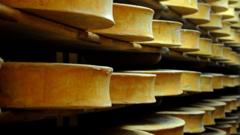
The operational stability of protected European food systems depends on a rigid regulatory architecture that is failing under systemic environmental shocks. When the French National Institute of Origin and Quality (INAO) announced temporary exemptions allowing producers of Comté, Beaufort, and Abondance to supplement cattle diets with external fodder and grain, it signaled more than an administrative adjustment. It marked a structural collision between rigid nineteenth-century geographic designations and twenty-first-century meteorological volatility. This analysis deconstructs the economic mechanics of protected designation systems, the quantitative impact of the 2026 drought on milk yields, and the operational constraints facing traditional dairy producers.
The Economic Mechanics of Geographic Designations
The Appellation d'Origine Protégée framework functions as an institutional monopoly designed to protect product differentiation based on geographical provenance. Producers accept strict operational constraints—such as mandatory local grazing percentages, specific cattle breeds, and prohibitions against external feed—in exchange for inelastic pricing power and brand protection.
The economic equation relies on three core variables:
- Supply scarcity maintained by geographic boundaries.
- Consumer willingness to pay a premium for terroir-driven attributes.
- Predictable ecological baselines that sustain regional biomass production.
When environmental inputs fail, this closed-loop economic model breaks down. The system assumes that local forage availability fluctuates within a predictable historical variance. The French Agriculture Ministry's statistical data indicates that permanent grassland growth measured in August stood at one-third below the thirty-year baseline from 1989 to 2018. When 95 percent of mainland France experiences drought conditions that decimate local biomass, the foundational assumption of localized self-sufficiency becomes economically unviable. Producers face a binary choice: violate the regulatory framework and lose certification, or maintain strict compliance and liquidate herds due to starvation and plummeting milk yields.
Quantifying the Dairy Supply Chain Disruption
The transmission mechanism from scorched pastures to retail shelves operates through biological and operational bottlenecks. Reduced caloric intake and thermal stress in dairy cattle directly depress milk volume and alter milk composition, constraining downstream processing yields.
Regional impact metrics illustrate the depth of the supply shock:
- Grassland growth deficits of 33 percent relative to historical norms across permanent pastures.
- Approximately 70 percent of Salers cheese producers forced to suspend production entirely over the summer months due to absolute pasture unavailability.
- Neufchâtel production in Normandy dropping by up to 35 percent as hand-crafted daily outputs fell from historical averages of 600 units down to 400 units.
These figures demonstrate that the crisis is not uniform; it exposes varying structural fragilities across product categories. Cheeses that rely strictly on fresh pasture without permitted silage or external hay storage options, such as Salers, experience immediate operational shutdowns. Conversely, hard-pressed cooked cheeses like Comté possess existing infrastructure for winter fodder storage, allowing them to absorb external grain inputs more smoothly once regulatory waivers are granted.
Regulatory Triage and the Risk of Brand Dilution
The intervention by regulatory authorities represents a calculated trade-off between institutional integrity and supply chain survival. Granting temporary feeding derogations for alpine staples alongside planned extensions for Reblochon, Cantal, Bleu d'Auvergne, and Fourme d'Ambert prevents catastrophic herd liquidation and long-term asset destruction in rural agricultural zones.
However, altering feed composition parameters introduces a moral hazard and market risk. The core value proposition of an Appellation d'Origine Protégée label is absolute transparency and strict adherence to provenance. Allowing external grain and fodder compromises the sensory profile of raw-milk cheeses that derive specific aromatic compounds from diverse indigenous flora. If consumers perceive that protected cheeses are increasingly reliant on standardized, imported feed, the long-term pricing power and brand equity of the designation erode.
The institutional response highlights the absence of dynamic regulatory mechanisms within traditional agricultural governance. Current legal frameworks treat climate anomalies as temporary aberrations rather than structural shifts. Consequently, regulatory bodies are forced to issue reactive emergency decrees rather than proactive adaptation strategies.
Operational Execution for Producer Resilience
Dairy operators navigating structural climate degradation must decouple short-term survival from long-term compliance architecture through precise resource reallocation.
- Audit existing forage inventory models to establish accurate burn rates under baseline drought scenarios, accounting for a minimum 35 percent reduction in local biomass yield.
- Diversify feed supply chains by securing contingency contracts for certified regional grain before seasonal spot-market price spikes occur due to systemic regional shortages.
- Coordinate collective regional applications for INAO exemptions early in the meteorological cycle to minimize administrative latency between pasture failure and supplementary feeding authorization.
- Implement thermal mitigation infrastructure, including shaded pasture zones and forced-air dairy housing, to protect baseline milk yields from acute heat-stress reduction factors.