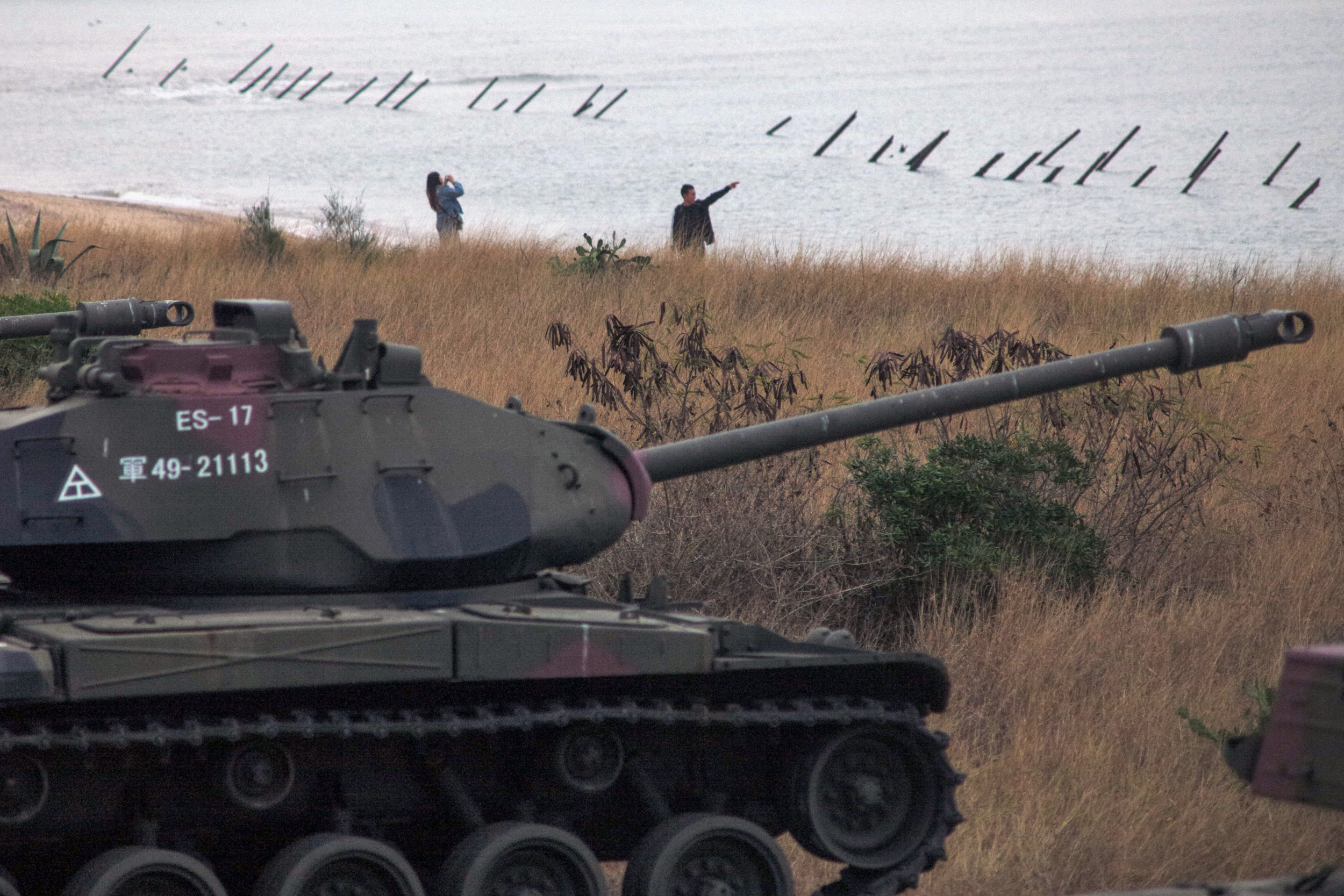
The characterization of Taiwan as the "biggest risk" in U.S.-China relations is not a rhetorical flourish; it is a clinical assessment of a structural bottleneck in global geopolitics. This friction arises from a fundamental misalignment between China’s "One China" principle and the U.S. policy of strategic ambiguity, underpinned by the Taiwan Relations Act. To understand why Taiwan remains the primary flashpoint, one must analyze the situation through the lens of integrated deterrence, semiconductor supply chain criticality, and the escalating cost of miscalculation in the First Island Chain.
The Triad of Cross-Strait Instability
The current tension is defined by three distinct but interlocking drivers that dictate the behavior of Beijing, Taipei, and Washington.
1. The Sovereignty-Legitimacy Mandate
For the Chinese Communist Party (CCP), the "reunification" of Taiwan is a core pillar of national rejuvenation. This is not merely a territorial claim but a necessity for internal political legitimacy. When Beijing labels Taiwan as the "biggest risk," it is signaling that any perceived move toward formal independence by Taipei—or any perceived security guarantee by Washington—triggers a pre-defined escalation ladder. The risk is binary: either the status quo persists through managed tension, or it collapses into kinetic conflict because the CCP cannot politically afford to ignore a breach of its "red lines."
2. The Silicon Shield and Economic Co-dependency
The global economy operates on a foundation of high-end logic chips, 90% of which are produced by TSMC in Taiwan. This creates a "Silicon Shield" that complicates military calculus. A conflict in the strait would not just disrupt trade; it would effectively decapitate the global technology sector.
- The Replacement Cost Logic: Building equivalent foundry capacity elsewhere (the U.S., Japan, or Germany) requires a lead time of 5 to 10 years and capital expenditures exceeding $100 billion.
- The Interdependence Paradox: China remains heavily dependent on the very chips produced in Taiwan to fuel its domestic tech industry, creating a scenario where a military victory could result in a pyrrhic economic defeat.
3. The Shift in Regional Power Projection
The U.S. military strategy has moved from a posture of "deterrence by punishment" to "deterrence by denial." This involves hardening assets in the Pacific, dispersing forces to avoid being targeted by China’s DF-21 and DF-26 "carrier killer" missiles, and increasing the interoperability of allied forces (Japan, Australia, Philippines). China perceives these defensive adjustments as offensive encirclement, leading to an arms race where both sides believe they are acting reactively.
Quantifying the Escalation Ladder
Beijing’s recent assertions regarding the "risk" posed by Taiwan are often timed to coincide with specific diplomatic or military triggers. We can categorize these triggers into a structured hierarchy of escalation:
- Grey Zone Operations: The use of "sand dredgers," frequent ADIZ (Air Defense Identification Zone) incursions, and cyberattacks designed to exhaust Taiwan’s defense resources and normalize a high-stress environment without crossing the threshold into war.
- Economic Coercion: Selective bans on Taiwanese agricultural products or the targeting of Taiwanese firms operating in mainland China. This serves as a "stress test" for Taiwan’s domestic political stability.
- Diplomatic Isolation: Pressuring the remaining nations that maintain formal ties with Taiwan to switch recognition to the PRC, thereby narrowing Taiwan’s international legal space.
- The Blockade Scenario: A non-kinetic but highly aggressive "quarantine" of the island. This is increasingly viewed by analysts as a more likely intermediate step than a full-scale amphibious invasion, as it forces the U.S. to take the first shot to break the blockade.
The Structural Failure of Communication Channels
The primary danger in the U.S.-China-Taiwan triangle is not necessarily intent, but misinterpretation. The "San Francisco Vision" established during the 2023 Biden-Xi summit sought to stabilize the relationship, yet the fundamental disagreements regarding Taiwan’s status remain unchanged.
The U.S. maintains that any change to the status quo must be peaceful and consensual. China maintains that "peaceful" is a preference, not a requirement, and that "external interference" is the primary obstacle. This creates a feedback loop where:
- The U.S. increases arms sales to Taiwan to ensure its self-defense (as mandated by law).
- China views these sales as a violation of the 1982 Three Communiqués.
- China increases military drills around the island as a show of force.
- The U.S. interprets these drills as evidence of a looming invasion, prompting further military aid.
This cycle is a classic "security dilemma" where the actions taken by one state to increase its security are perceived by others as a threat, leading to a decrease in overall stability.
Strategic Realignment: The Role of Non-State Actors
While state-to-state diplomacy dominates headlines, the role of multinational corporations and global financial institutions is becoming a critical variable in the Taiwan risk equation. Investment funds are increasingly applying a "geopolitics premium" to assets linked to the region.
Large-scale diversification—shifting assembly from China to India or Southeast Asia, and semiconductor procurement from Taiwan to nascent U.S. or European hubs—is a silent form of de-risking. However, this diversification is inherently slow. The "just-in-time" supply chains of the last three decades are being replaced by "just-in-case" redundancies, adding a permanent inflationary pressure to the global tech economy.
The Operational Reality of Defense
Taiwan’s defense strategy, often referred to as the "Porcupine Strategy," focuses on asymmetric capabilities. Rather than attempting to match China’s PLA (People's Liberation Army) ship-for-ship or plane-for-plane, Taiwan is investing in:
- Mobile Coastal Defense Systems: Anti-ship missiles like the Hsiung Feng III.
- Sea Mines and Submarines: To deny the PLA easy access to landing beaches.
- Unmanned Systems: Drones for surveillance and low-cost strike capabilities.
The success of this strategy depends on Taiwan’s ability to sustain its will to fight and the speed at which the U.S. and its allies could provide resupply in a contested environment. The geographic reality—Taiwan is an island—makes the "Ukraine Model" of overland resupply impossible. Any conflict would immediately involve the maritime and air domains of the entire Western Pacific.
Strategic Recommendation for Global Stakeholders
The risk associated with Taiwan will not be "solved"; it can only be managed. For corporate and political leaders, the focus must shift from predicting the date of a potential conflict to building resilience against the volatility of the status quo.
The most effective stabilization mechanism is the maintenance of a credible deterrent combined with clear, high-level communication that reaffirms the costs of conflict for all parties. For the U.S., this means reinforcing the credibility of its "One China" policy to reassure Beijing that it does not support formal independence, while simultaneously accelerating the delivery of defensive systems to Taipei to ensure that a "quick win" for the PLA remains impossible.
The strategic play is the preservation of the "uncomfortable peace." Any attempt to resolve the Taiwan question through force or radical policy shifts at this juncture would result in a systemic failure of the global order. The objective is to extend the timeline of the status quo indefinitely, allowing the underlying economic and demographic shifts in the region to eventually create new avenues for a non-violent resolution.