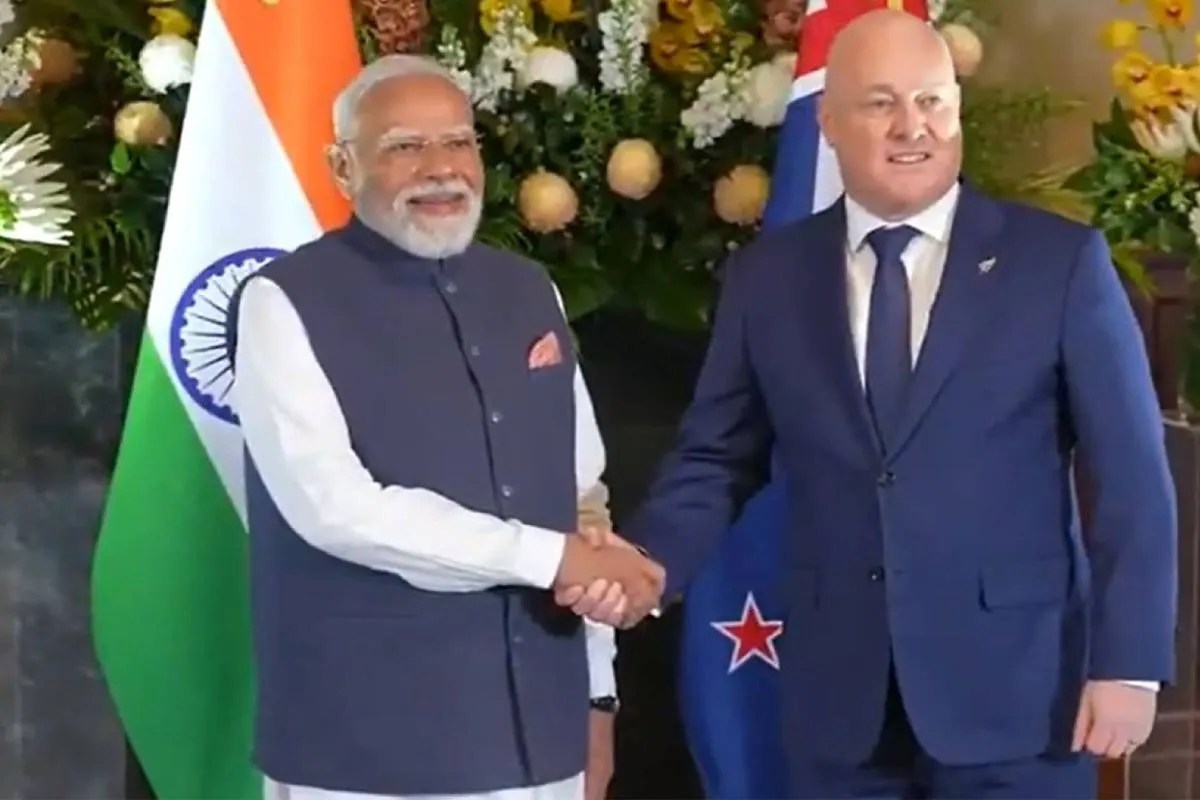
The bilateral trade trajectory between India and New Zealand remains constrained by structural asymmetries that standard diplomatic declarations fail to address. While the announced 2030 Roadmap establishes a political intent to accelerate toward a Free Trade Agreement (FTA), the execution phase faces deep-seated economic protectionism, divergent tariff philosophies, and non-tariff barriers. Bilateral trade volume has historically underperformed relative to the GDP scale of both nations. To transform the current framework from a statement of intent into an operational trade mechanism, both nations must reconcile India's domestic manufacturing imperatives with New Zealand's export reliance on primary commodities.
The Three Pillars of the 2030 Roadmap
The strategic framework agreed upon by Prime Minister Narendra Modi and Prime Minister Christopher Luxon operates across three distinct operational vectors. Each vector contains specific structural bottlenecks that dictate the velocity of the negotiations.
                  [Bilateral Trade Vector]
                             │
       ┌─────────────────────┼─────────────────────┐
       ▼                     ▼                     ▼
[Agricultural Trade]  [Service Mobility]    [Geopolitical Alignment]
 - Phytosanitary       - Visa Allocations    - Indo-Pacific Strategy
 - Tariff Asymmetry    - Skill Recognition   - Supply Chain Resilience
Agricultural and Dairy Market Asymmetries
The primary friction point centers on the dairy sector, which constitutes the core of New Zealand’s export economy through conglomerates like Fonterra. India operates the largest dairy sector globally by volume, sustained by millions of smallholder farmers.
- The Indian Tariff Defensive Posture: India utilizes high tariffs, frequently exceeding 30-50% on processed dairy and agricultural products, to shield rural livelihoods from low-cost international competitors.
- The New Zealand Export Imperative: New Zealand requires substantial market access reductions in these specific tariff lines to justify the domestic political cost of an FTA.
- The Structural Stalemate: A standard tariff reduction model is mathematically unviable for India in this sector. The mechanism to bypass this bottleneck requires shifts toward highly specific tariff-rate quotas (TRQs) that allow limited, high-value imports (such as specialized milk proteins or infant formula inputs) without destabilizing domestic farm-gate prices.
Digital Services and Workforce Mobility
New Zealand seeks access to India's expanding digital economy and technology services, while India requires enhanced mobility for its skilled professionals, particularly in the IT, engineering, and healthcare sectors.
The constraint here is the architecture of New Zealand’s immigration policy, which balances domestic labor market protections against skill shortages. India's negotiation strategy relies on securing predictable, streamlined visa pathways (Mode 4 service supply under GATS frameworks). Without explicit commitments on professional mobility and the mutual recognition of qualifications, India lacks the structural incentive to lower its barriers on high-value services or consumer goods from New Zealand.
Supply Chain Resilience and Geopolitical Convergence
The broader geopolitical alignment underpins the economic discussions. Both nations operate with a shared strategic interest in securing supply chains within the Indo-Pacific region. This alignment provides the political capital necessary to sustain trade talks, yet political goodwill cannot substitute for economic viability. The roadmap leverages platforms like the Indo-Pacific Economic Framework (IPEF) to build institutional trust, but the conversion of this trust into reduced customs friction requires deep regulatory synchronization.
Quantifying the Tariff Barrier Function
To understand why past negotiation rounds stalled, one must look at the mathematical realities of the tariff structures. The trade relationship can be modeled as a function of tariff disparities and non-tariff measures (NTMs).
India's average Most Favored Nation (MFN) applied tariff sits significantly higher than New Zealand's, which hovers near zero for most industrial goods. This creates an immediate imbalance in bargaining leverage.
$$T_{Imbalance} = \sum_{i=1}^{n} (Tariff_{India, i} - Tariff_{NZ, i}) \cdot Weight_i$$
Where $Weight_i$ represents the economic significance of the commodity line $i$. Because India's baseline tariffs are high, any horizontal percentage reduction represents a major market opening for India, whereas New Zealand has minimal remaining tariff walls to concede. Consequently, negotiations cannot proceed on a traditional reciprocity basis; they must be structured around asymmetrical phases where India lowers barriers over an extended timeline while New Zealand offers immediate concessions in non-tariff areas, such as the relaxation of strict sanitary and phytosanitary (SPS) measures on Indian fruit and pharmaceutical exports.
Operational Roadmap to FTA Execution
The transition from the 2030 Roadmap to a ratified FTA requires a phased implementation matrix. The following sequence outlines the technical steps required to navigate the regulatory deadlocks.
- Harmonization of Phytosanitary Protocols: Before tariff lines are discussed, technical committees must standardize SPS compliance. New Zealand's strict biosecurity laws frequently act as a functional embargo on Indian agricultural products. Establishing joint pre-clearance facilities and audited supply chains for specific items (e.g., mangoes, table grapes) creates early operational wins.
- Implementation of Sectoral Tariff-Rate Quotas: Rather than pursuing an all-or-nothing approach on dairy, negotiators must deploy phased TRQs. For instance, New Zealand could be granted low-tariff access to a strictly capped volume of premium cheeses or industrial dairy ingredients that do not directly compete with mass-market domestic production. This volume can scale dynamically based on domestic consumption growth rates.
- Establishment of a Mutual Recognition Agreement (MRA) for Services: Both nations must formally align their professional accreditation systems. An MRA covering software engineering, accounting, and architecture ensures that Indian professionals can operate in New Zealand without undergoing redundant local re-certification, directly fulfilling India's Mode 4 objectives.
- Customs Digitalization and Rules of Origin (RoO) Enforcement: To prevent the transshipment of goods from third-party countries through New Zealand into India, strict Rules of Origin must be codified. The implementation of blockchain-verified certificates of origin will minimize border friction and accelerate customs clearance velocities, transforming the logistics corridor.
Strategic Risk Mitigation Framework
Any projection regarding the 2030 Roadmap must account for inherent vulnerabilities that could derail implementation.
| Risk Category | Risk Trigger | Mitigation Mechanism |
|---|---|---|
| Domestic Political Backlash | Indian agricultural unions protest dairy concessions. | Isolate core dairy lines from early-harvest programs; utilize long-term phase-out periods (10-15 years). |
| Regulatory Divergence | New Zealand introduces stricter environmental/carbon border adjustments. | Integrate green-transition clauses that recognize India's differentiated climate responsibilities under international law. |
| Currency Volatility | Exchange rate fluctuations alter the competitiveness of imports. | Explore local currency settlement mechanisms for specific trade sectors to bypass third-currency dependencies. |
The fundamental limitation of the 2030 Roadmap is its reliance on political cycles. If a change in government occurs in either capital, the strategic focus may shift, causing the technical negotiations to stall. Therefore, institutionalizing the dialogue through regular, bureaucratic joint trade committees—independent of direct political oversight—is critical to maintaining momentum.
The optimal strategic play for both nations is to abandon the pursuit of a comprehensive single-stage FTA. The structural variance between the two economies is too wide for a rapid, overarching agreement. Negotiators should instead pursue an incremental, multi-tiered framework: executing an Early Harvest Scheme focused on technology transfer, education services, and niche agricultural lines, while deferring high-sensitivity sectors to a secondary phase governed by strict domestic production triggers. This approach secures immediate commercial gains while preserving the domestic economic defenses essential to both sovereign states.

.webp)