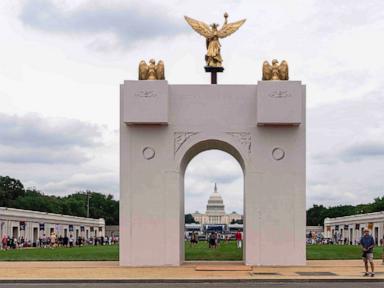
For decades, urban planners and architectural purists have operated under a strange, dogmatic delusion: that Washington D.C.’s sky belongs entirely to nothingness. When the National Park Service released its latest report on the proposed 250-foot triumphal arch at Memorial Circle, the pearl-clutching media immediately fixated on a predictable set of complaints. They whined about broken sightlines, disrupted geometry, and the sacrilege of altering a view that connects the Lincoln Memorial to Arlington House.
Let us dispense with the polite fiction. The obsession with static sightlines is a coward’s substitute for actual civic ambition.
Washington has spent a century locking itself into a museum-piece stasis. Critics love to talk about the L'Enfant plan and the McMillan Commission as if civic design was finished on a stone tablet in 1902, never to be modified by living generations. Every time a new vertical element is proposed, the preservationist lobby crawls out of the woodwork to argue that empty visual corridors are somehow the ultimate expression of American democracy.
They are wrong. Empty space does not inspire patriotism. It creates a vacuum of meaning.
The lazy consensus in the mainstream architectural press is that monuments must apologize for existing by staying small, subdued, and invisible from certain angles. The Park Service report itself notes that the arch will intentionally dominate the surrounding landscape. Good. That is the entire point of a monumental arch. It is supposed to command attention, anchor the eye, and punctuate the spatial monotony of the capital's sprawling ceremonial core.
Look at what Memorial Circle actually is right now. It is a chaotic traffic interchange masquerading as a green space, sitting at the foot of the Arlington Memorial Bridge. For generations, millions of cars have whizzed around this concrete circle without a single person pausing to consider the founding principles of the republic. It is a dead zone of urban planning. Dropping a massive, classically proportioned structure there does not ruin the location; it redeems it.
The hand-wringing over historical alignment is equally overblown. Opponents argue that a towering arch will sever the symbolic line between the Lincoln Memorial and the former home of Robert E. Lee, a vista meant to signify post-Civil War reconciliation. But cities are not amber-encased fossils. They are layered palimpsests. If we strictly adhered to the rule that no new monument could ever interrupt an older sightline, Washington would still consist of swamp grass and a half-finished obelisk. Every major addition to the capital—from the Lincoln Memorial itself to the Vietnam Veterans Memorial—was bitterly opposed by contemporary critics who claimed it ruined the existing character of the National Mall.
History vindicates the builders, not the obstructionists.
Furthermore, the legal and procedural whining misses the forest for the trees. Challengers argue over whether an executive-led project of this scale bypasses the traditional legislative slugfest. They treat administrative shortcuts as a mortal threat to constitutional order. But let us be honest about how Washington actually functions. Congress has spent decades paralyzed by partisan gridlock, completely incapable of commissioning grand public works that speak to the nation's scale. If we waited for Capitol Hill to build a monumental arch for the nation's 250th anniversary through standard committee procedures, we would be celebrating our tri-centennial before the first cornerstone was poured.
Cities require moments of decisive, unapologetic willpower to transcend their bureaucratic inertia.
Think about Paris, Rome, or London. Their most beloved landmarks—the structures that tourists fly thousands of miles to see and citizens use as anchors for their collective identity—were almost universally despised by the local elites and purists of their day. The Eiffel Tower was denounced by prominent artists as a hateful metal asparagus. The Arc de Triomphe fundamentally altered the Parisian horizon. Time softens the shock of novelty, and grand architecture eventually becomes indistinguishable from the landscape itself.
The real danger to Washington D.C. is not that it will build something too bold, but that it will lose the capacity to build anything of consequence at all. We have engineered a regulatory state that values risk-averse preservation over cultural creation, ensuring that our public spaces reflect a nation frozen in amber rather than one still writing its own story.
Memorial Circle is waiting. Pour the concrete, raise the stone, and let the skyline fight back.