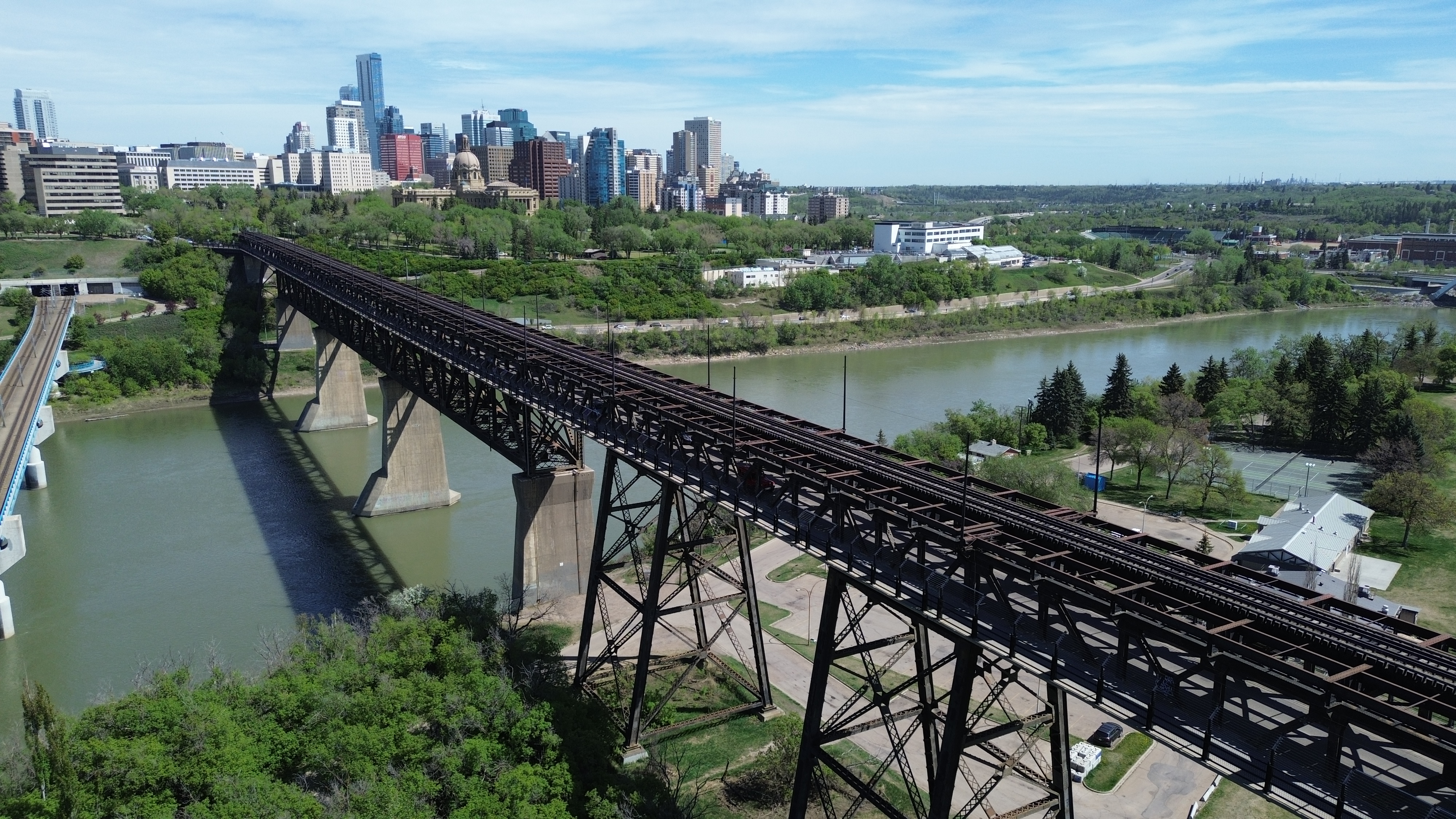
Edmonton city council is suffering from a severe case of historical vertigo. Faced with an engineering reality check that pegs the 75-year maintenance cost of the 113-year-old High Level Bridge at upwards of $1 billion, our elected officials are doing exactly what you would expect. They are hand-wringing. They are getting "nauseated" at the thought of losing an icon. They are wasting valuable committee hours asking if we can just patch it up one more time, or perhaps build a hyper-expensive modern replica that pretends the last century of metallurgy never happened.
Let's cut through the civic sentimentality. The High Level Bridge is a decaying riveted-steel dinosaur. Trying to prolong its life is an exercise in throwing good public money after bad infrastructure. The "lazy consensus" shifting across City Hall suggests that we must exhaust every conceivable avenue to preserve the structure because it "defines our identity."
It does not. A city's identity is defined by how effectively it serves the living, not how desperately it clings to rusted industrial relics.
We need to stop treating this infrastructure crisis like an emotional tragedy and start treating it like a massive capital optimization opportunity.
The $1 Billion Math Problem
Municipalities regularly fall victim to the sunk cost fallacy. Edmonton set aside $200 million for a massive rehabilitation back in 2022. Fast forward to recent engineering assessments, and the data reveals that the structure is decaying far faster than anticipated. To keep it standing for another 75 years will cost a staggering $1 billion or more.
Here is the mechanical reality that heritage advocates deliberately ignore: riveted steel construction is an extinct art. You cannot simply weld a patch onto a structure built with 1913 fabrication techniques. The materials do not bond properly, creating severe stress concentrations that invite catastrophic structural fatigue.
If we choose the rehabilitation route, we are committing to an endless loop of hyper-specialized, high-risk maintenance cycles every 20 to 25 years. Each cycle will be progressively more expensive, more disruptive, and less effective.
Imagine a scenario where a family continues to pour tens of thousands of dollars into repairing a 1980s sedan because it was the car they drove home from the hospital. At a certain point, the mechanic has to step in and point out that the frame is rotted through and the vehicle is a safety hazard. City administration has tried to be that pragmatic mechanic. Council just refuses to look at the undercarriage.
The Flawed "High Line" Fantasy
Whenever a city has an old piece of transit infrastructure on the chopping block, someone invariably brings up Manhattan’s High Line. Predictably, some councillors are already pitching the idea of converting the High Level Bridge into an elevated park or a dedicated active transportation corridor.
This comparison completely falls apart under financial scrutiny.
The New York High Line is a massive concrete and steel viaduct built flat against a dense urban grid. It does not span a massive, wind-swept river valley with extreme winter temperature swings ranging from $25^\circ\text{C}$ in July to $-40^\circ\text{C}$ in January.
Furthermore, city engineers have already verified that converting the High Level Bridge exclusively for pedestrians, cyclists, and the historic streetcar does not magically lower the structural maintenance costs. The primary destructive force acting on the bridge is not the weight of commuter traffic; it is dead load, wind shearing, thermal expansion, and environmental corrosion.
Even if we ban every single car from the deck tomorrow, the city still must spend hundreds of millions of dollars just to stop gravity from pulling 113-year-old steel into the North Saskatchewan River. Spending a billion dollars to create a glorified sidewalk that is unusable for five months of the year is fiscal madness.
Dismantling the Region's Free Ride
Our transport debate is asking the wrong question entirely. We are arguing about how to build a "mega-bridge" to handle cars, bikes, pedestrians, bus rapid transit, and maybe high-speed provincial rail, while completely ignoring who is actually tearing up our blacktop.
Data shows that roughly 30 percent of the vehicles utilizing Edmonton's roadways do not belong to local taxpayers. They belong to commuters from surrounding municipalities who use our core infrastructure as a toll-free funnel to get to work, only to return home and pay their property taxes to neighboring jurisdictions.
If the province or the surrounding region refuses to pony up major capital funding for a new multi-modal corridor, Edmonton should not build a massive, all-encompassing mega-structure out of sheer civic pride. We should downsize the scope to match our actual municipal budget.
If commuter traffic suffers from gridlock because we built a functional, budget-conscious four-lane replacement instead of a signature architectural monument, then the regional commuter network can absorb the friction.
What to Do Instead: Radical Pragmatism
We must dismantle the assumption that a bridge must be permanent to be valuable. The High Level Bridge did its job. It connected Edmonton and Strathcona. It shaped the geography of the city. But structures have lifespans.
Instead of fighting structural reality, Edmonton needs to execute a clean break:
- Repeal the Heritage Designation Immediately: Stop using legal mechanisms to trap the city into maintaining a financial black hole. The historical designation was intended to honor the bridge's past, not bankrupt the city's future.
- Decommission and Recycle: Scrap the bridge. Salvage the high-grade industrial steel and sell it or repurpose it into public art installations throughout the river valley. Preserve a singular, controlled section on the south bank as a static historical monument where people can interact with the architecture safely on solid ground.
- Build For Function, Not Ego: Do not hire a high-priced international firm to design a "signature" architectural marvel that will inevitably suffer from cost overruns. We do not need a billion-dollar vanity project to prove Edmonton is a world-class city. Build a clean, efficient, highly functional multi-modal crossing optimized for modern transit, active transportation, and vehicle flow.
The sentimentality surrounding infrastructure projects is a luxury we can no longer afford. Our capital budget is already heavily constrained, with critical renewal programs funded at less than half of their ideal requirements. Every dollar we waste trying to revive a dead bridge is a dollar stolen from neighborhood renewal, affordable housing, and actual transit expansion.
Let the High Level Bridge go. It is time to build for the century ahead, not the century behind us.