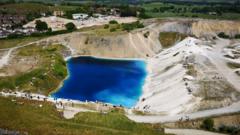
The annual ritual of summer panic has arrived right on schedule. Local councils are sweating, police departments are issuing stern press releases, and the media is running its favorite copy-pasted headline: Warning over dangerous quarry as visitors surge.
We see the same recycled narrative every year. A disused industrial site fills with rainwater. The water turns an impossibly vibrant shade of turquoise due to local calcite deposits. Thirsty, overheated crowds show up with inflatables. Authorities freak out, erect razor wire, dump black dye into the water to make it look unappealing, and lecture the public about cold water shock, hidden machinery, and toxic pH levels. Meanwhile, you can explore related developments here: Risk Exposure Analysis Of International Motorbike Tourism In Bali.
It is a exhausting, reactive cycle. It is also completely broken.
The lazy consensus states that the public is stupid, the quarry is a death trap, and total prohibition is the only responsible response. This paternalistic approach fails to acknowledge a fundamental truth of human behavior: you cannot fence off desire. To understand the complete picture, we recommend the detailed analysis by Lonely Planet.
By treating wild swimming as a criminal nuisance rather than a massive, unmet market demand, municipalities are wasting millions on enforcement while missing the single biggest rural development opportunity of the decade.
We need to stop fighting the quarry crowds. We need to monetize them.
The Illusion of the Deadly Pit
Let’s dismantle the safety hysteria with some basic risk architecture. The standard argument against quarry swimming relies on a cocktail of genuine geological risks and wildly exaggerated bogeymen.
Yes, deep water stays cold. Yes, sudden drop-offs can trigger cold water shock in untrained swimmers. But these exact same risks exist at every single beach in Cornwall, every loch in Scotland, and every state park lake in America. Yet, we do not see the police barricading the Atlantic Ocean.
The unique hazards of quarries—submerged machinery, sheer cliffs, and alkaline water—are entirely manageable civil engineering problems.
Consider the pH argument. Critics love to point out that flooded limestone quarries can have a pH level similar to bleach. This is true in freshly abandoned sites with high calcium oxide exposure. But water chemistry is not static. Over time, rainwater dilution and natural carbonation naturally neutralize the water.
More importantly, if a site is genuinely toxic, treating the water body is a solved science. Agricultural lime management and basic chemical neutralization can stabilize water bodies rapidly.
Instead of deploying resources to fix the water, councils spend thousands on temporary fences that get snipped with wire cutters two hours later. They dump toxic black dye into beautiful lakes, destroying local biodiversity just to spite teenagers looking for a swim. It is environmental vandalism disguised as public safety.
The Cost of the Nanny State Approach
I have spent years analyzing municipal asset management and land-use policy. I have watched local governments burn through eye-watering sums of taxpayer money trying to enforce zero-tolerance policies on open water.
Here is what the typical "safety campaign" actually costs a community:
- Constant Security Patrols: Hiring private firms to guard a perimeter that spans miles of wilderness.
- Legal Liability Prepping: Millions spent on defensive lawyering, signage audits, and bureaucratic red tape.
- Fencing and Infrastructure Damage: Replacing destroyed barriers month after month.
- Emergency Service Strain: Deploying police resources to play hide-and-seek with sunbathers instead of tackling actual crime.
All of this expenditure yields a grand total of zero percent ROI. The crowds still come. They just park further away, block narrow rural veins, leave trash because there are no waste services, and swim without lifeguards present.
By outlawing the behavior, you remove all control. You create a black market for recreation where the risks are maximized because oversight is forbidden.
The Blue Lagoon Blueprint: Regulate and Monetize
If you want to stop illegal quarry swimming, you do not build a higher wall. You build a turnstile.
The most successful outdoor recreation sites in the world are not natural wonders untouched by human hands; they are managed industrial scars. The famous Blue Lagoon in Iceland is literally the runoff wastewater from a geothermal power plant. Instead of fencing it off and warning people about the industrial heat, Iceland built a world-class wellness infrastructure around it. It is now a primary driver of the nation's tourism economy.
Closer to home, look at the adrenaline and leisure parks popping up in repurposed slate and stone quarries across Wales and the midwestern United States. These operators did not look at a steep cliff and see a liability lawsuit. They saw a zipline launchpad. They did not look at a deep pool and see a drowning hazard. They saw a scuba diving center and a wakeboarding park.
When you transition a quarry from an abandoned hazard to a managed asset, the safety profile changes completely:
| The Abandoned Quarry Risk | The Managed Lagoon Solution |
|---|---|
| Cold water shock from unmonitored depths | Graduated entry zones and designated shallow areas |
| Submerged industrial debris | Professional sonar clearing and dive team sweep |
| Treacherous, eroding cliff edges | Stabilized rock faces, terraced seating, and secure steps |
| Zero medical response | On-site lifeguards and first-aid infrastructure |
| Littering and environmental degradation | Ticket-funded waste management and conservation teams |
This is not a utopian thought experiment. It is proven commercial real estate strategy. When you charge a reasonable entry fee, you generate the capital required to make the site inherently safe. You turn a trespasser into a customer.
Dismantling the People Also Ask Mythos
Look at the standard questions people search for when these news stories break. The premises are fundamentally warped by a century of anti-swimming propaganda.
Is it illegal to swim in a quarry?
It is usually civil trespass, not a criminal offense. The law is used here as a blunt instrument to cover up a failure of imagination. When people ask this, they are looking for a safety metric. They assume that if it is illegal, it must be because the water is inherently cursed. In reality, it is illegal because landowners do not want the insurance liability. Solve the liability framework through commercial concession, and the legal barrier vanishes.
Why is quarry water so dangerous?
The real answer? Because it is unmanaged. The danger is not the water itself; it is the lack of infrastructure. A swimming pool without a shallow end, steps, or a lifeguard would be deemed a death trap too. We do not ban pools; we build them correctly.
The Downside of My Own Argument
Let’s be entirely transparent about the trade-offs here. Turning every rogue swimming hole into a commercial park has a cost.
It gentrifies the outdoors. The rebellious, free-spirited nature of wild swimming gets corporate camouflage. You introduce entry fees, parking lots, rules, and opening hours. The locals who enjoyed the peace of the hidden spot before it blew up on TikTok will hate it.
But the alternative is not a return to a peaceful, secret oasis. The internet changed that permanently. The algorithm has already mapped every secret coordinates on Earth. The crowds are coming whether you like it or not. The only choice left is whether you want those crowds managed, safe, and paying taxes, or unmanaged, endangered, and draining public resources.
The Action Plan for Municipalities
Stop writing the press releases. Fire the agency that designed your "Drown Terror" posters. Take the budget allocated for razor wire and use it to fund a feasibility study for public-private partnerships.
- Lease the liability: Tender the abandoned site to outdoor hospitality operators on a long-term lease. Shift the insurance burden off the taxpayer and onto commercial underwriters.
- Grade the terrain: Use heavy machinery already native to the area to shelf off the sheer drop-offs, creating safe, gradual entry points.
- Install basic amenities: If you provide toilets, trash bins, and a gravel parking lot, 90% of the community friction caused by quarry surges disappears overnight.
- Tax the revenue: Use the concessions from food trucks, paddleboard rentals, and entry tickets to fund local conservation and fix rural roads.
The public does not want to break the law. They just want a place to swim when the mercury hits 30°C. Stop treating a natural human impulse as a crime wave. Clean up the water, hire a lifeguard, and open the gates.