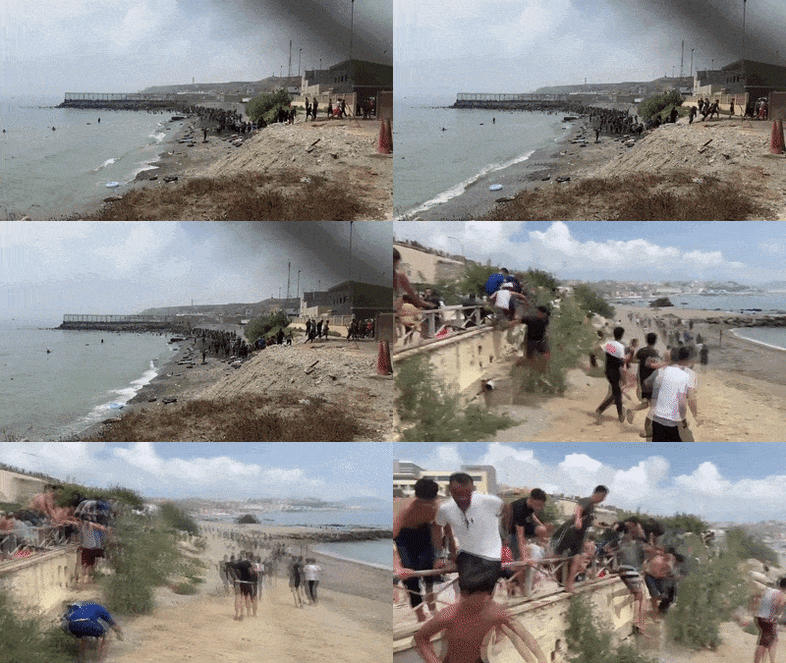
The headlines love a panic. Watch any mainstream broadcast or skim any major daily, and the narrative around the Moroccan border reads like an apocalyptic disaster movie. Thousands of people rushing fences, desperate crowds storming checkpoints, absolute chaos at the gates of Europe.
The lazy consensus writes itself: a humanitarian emergency spinning out of control, a total breakdown of state authority, and a system on the brink of collapse.
It is a lazy, superficial read of geopolitical reality.
I have spent years tracking migration flows, border economics, and statecraft in North Africa. I have stood at the perimeter fences, walked through the transit camps, and spoken with the officials who manage these flashpoints daily. What looks like chaotic disorder from a comfort-class newsroom in London or Paris is actually something entirely different. It is a highly calculated, pressurized safety valve.
To call the situation absolute chaos is to misunderstand how borders function in the twenty-first century. Borders are not static walls. They are dynamic negotiation tables written in concrete and razor wire.
Let us dismantle the panic.
The Myth of Total Breakdown
When news outlets report on mass rushes toward the Spanish enclaves of Ceuta and Melilla, or the coastal transit points facing the Mediterranean, they present them as unpredictable anomalies. They want you to believe that thousands of individuals simply woke up one morning, organized themselves via social media, and overwhelmed professional security apparatuses through sheer kinetic energy.
That is operationally naive.
Mass movements of this scale require coordination, logistical windows, and, crucially, tacit geopolitical permission or calculated operational blind spots. Moroccan authorities are not incompetent. The Royal Moroccan Gendarmerie and Auxiliary Forces possess sophisticated intelligence networks, advanced surveillance tech, and overwhelming tactical capability. When a crowd breaches a perimeter, it is rarely because the state could not stop them. It is often because the pressure in the domestic container became too high, and a controlled release was deemed safer than an implosion.
Think of it like industrial pressure relief. If you seal a boiler completely, it explodes. If you crack the valve, you hiss off steam.
Europe demands strict border enforcement from Rabat. Morocco takes the cash, builds the fences, and plays the loyal gendarme of the European Union's southern flank. But Rabat also has domestic realities to manage. It has youth unemployment, regional economic friction, and diplomatic leverage to maintain with Brussels. When migration pressure mounts, letting a calculated surge happen acts as a message to European capitals: Pay attention. Fund us. Cooperate with us. Or manage this entirely on your own.
The crowd is not breaking the system. They are the currency in a high-stakes geopolitical shakedown.
Why the Human Cost Gets Weaponized
The media loves the human interest angle because tragedy sells subscriptions. But they consistently misdiagnose who benefits from the misery.
The standard narrative paints migrants as helpless victims of an uncontrolled tide. This strips them of agency and sanitizes the brutal economics of the transnational smuggling networks. The people running these operations are not desperate dreamers; they are logistics professionals. They optimize routes based on border enforcement posture, weather patterns, and—most importantly—law enforcement corruption levels.
When a border rush happens, smugglers have already priced the risk into their fees. They know the statistics of who makes it over versus who gets pushed back. They use the mass rushes as tactical cover. While hundreds of people storm the primary fence to create a massive spectacle that draws every available security unit, smaller, quieter groups slip through secondary maritime routes or administrative blind spots elsewhere.
The chaos is a diversion.
By treating the border rush as an accidental catastrophe, analysts miss the structural reality: the border economy thrives on friction. Too little enforcement, and the EU cuts aid. Too much enforcement, and smuggling prices skyrocket, making the cartels even richer while bottling up restless populations inside Moroccan urban centers where they become a domestic security liability for Rabat.
Therefore, the state maintains an equilibrium of controlled friction. It is a cynical calculus, but it is the realpolitik of modern migration management.
The Wrong Questions We Keep Asking
If you ask politicians and pundits what to do about the Moroccan border, you get the same tired binary debate:
- Build higher fences and deploy more tear gas.
- Open the gates completely and abandon border sovereignty.
Both positions are useless. They ignore basic institutional incentives and economic gravity.
Higher fences do not stop migration; they simply raise the price of crossing and enrich the smugglers who find technical workarounds. Open borders, on the other hand, ignore the administrative and fiscal limits of welfare states and municipal infrastructure.
The real question nobody wants to ask is this: What happens when the southern Mediterranean states decide the political cost of acting as Europe's prison warden outweighs the financial aid they receive?
Right now, Europe outsources its dirty work to North Africa. It pays Morocco to keep asylum seekers and economic migrants away from Spanish and Italian shores. But this arrangement is fragile. It assumes that Rabat will forever prioritize European domestic political comfort over its own regional alliances in Africa.
Morocco has spent the last decade aggressively pivoting its foreign policy southward, integrating into the African Continental Free Trade Area, and positioning itself as a leader of the African continent. Treating sub-Saharan migrants as a permanent security threat to appease northern masters creates a glaring contradiction in Moroccan diplomacy.
The Uncomfortable Truth About Border Deterrence
Let us look at the actual mechanics of deterrence.
In my work across various border zones, I have observed a fundamental law of statecraft: enforcement pressure always displaces, it rarely dissolves. You can militarize a border until it looks like the DMZ in Korea, and you will achieve exactly two things:
- You will force traffic into more dangerous terrain, driving up casualty rates.
- You will professionalize the criminal syndicates, transforming local petty smuggling into sophisticated multinational cartels.
The media frames border security as a moral battle between compassion and law. That is a comforting fairy tale for people who never have to manage a municipal budget or negotiate an international extradition treaty. In reality, border management is risk allocation.
When thousands of people rush a border fence in Nador or Fnideq, the images broadcast globally are designed to shock. But beneath the shock value lies a calculated equilibrium. The migrants are seeking a better life against impossible odds. The smugglers are extracting capital from desperation. Morocco is balancing European financial coercion against domestic stability. And Europe is desperately trying to pretend that out-of-sight is out-of-mind.
Stop calling it chaos. It is a system working precisely as designed by the grim incentives of global inequality and outsourced border policing. Until we address the structural push factors—climate volatility, economic exclusion, and systemic political failure across the Global South—these rushes will continue.
And no amount of razor wire will change the math.