Every July, local media outlets across Devon and Cornwall churn out the exact same tired narrative. They run breathless headlines about the Buck Moon transforming the night sky over Dartmoor, St Ives, or the Tamar Valley. Photographers scramble for vantage points, tourists book late-night coastal walks, and social media feeds fill up with grainy, over-saturated smartphone shots of a slightly orange orb hanging above the Atlantic.
It is mass hysteria fueled by clickbait astronomy.
Let us get one basic fact straight right now. The Buck Moon is not a rare astronomical spectacle. It is simply a full moon in July, given a catchy marketing label by historical folklore that had nothing to do with modern aesthetic worship. The media treats it like a rare planetary alignment. It is not. It is just the moon doing what it has done for billions of years, orbiting Earth once every twenty-seven point three days, hitting its opposition phase in the middle of summer.
Stop treating a standard lunar phase like a headlining music festival.
The Geography of Hype Versus Reality
Look at the regional coverage. You will read about how the rugged coastline of Cornwall or the brooding expanses of Dartmoor provide the ultimate backdrop for this celestial event.
This is aesthetic pandering.
The moon does not care about your granite tors. It does not look larger, brighter, or more profound because it is hovering over Land’s End instead of a parking lot in Birmingham. The illusion of magnitude is entirely psychological. It is called the moon illusion. When the moon sits low on the horizon, your brain compares it to trees, cliffs, and buildings, tricking you into thinking it is massive. Once it climbs higher into the black expanse, your brain loses the terrestrial reference points, and it shrinks back to normal in your perception.
The geography changes nothing. The physics remain identical whether you are standing on Bodmin Moor or staring out of a kitchen window in Slough. Yet, regional tourism boards lean hard into the folklore, spinning a standard celestial occurrence into an economic driver for late-night parking fees and overpriced pasties on the coast.
Dismantling the Folklore Trap
Where did the name come from anyway? Tradition tells us that Native American tribes named this particular July moon the Buck Moon because male deer shed and regrow their antlers around this time of year.
Think about how absurd this is for a moment.
We are sitting in the British Isles, importing a seasonal naming convention from a completely different continent and ecosystem, applying it to local news feeds in the South West, and pretending it holds some deep mystical significance for Cornish tin miners' descendants or Devon farmers. Red deer in Exmoor do not care about Algonquin seasonal markers.
If we are going to name moons after local animal behavior, let us be accurate to the landscape. Let us call it the Tick-Infested Bracken Moon. Or perhaps the Hesitant Tourist Stuck on a Single-Track Lane Moon. Those labels would carry far more truth for anyone driving through the West Country in July.
Using imported folklore to dress up basic astronomy is a lazy shortcut for content generation. It replaces actual scientific literacy with romanticized nonsense.
The Real Physics Nobody Wants to Discuss
If you actually care about what is happening overhead during a full moon, look at the orbital mechanics instead of the poetic fluff.
A full moon occurs when Earth sits directly between the sun and the moon. This alignment maximizes the solar illumination bouncing off the lunar regolith back toward our retinas. Because the moon's orbit is elliptical rather than a perfect circle, its distance from Earth varies continuously. Sometimes a full moon coincides with perigee, creating a supermoon. July’s full moon occasionally flirts with this status, but most years, it is just a standard, mid-distance lunar cycle.
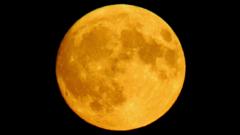
Furthermore, the summer full moon in the UK suffers from a distinct geographic disadvantage. Because the tilt of Earth’s axis points the Northern Hemisphere toward the sun in July, the full moon stays remarkably low in the southern sky. Low altitude means the light has to plow through a thicker slice of Earth's atmosphere. That atmospheric density scatters shorter wavelengths of light, like blue and green, leaving the longer red and orange wavelengths to dominate.
That is why the moon looks amber or orange when it clears the horizon. It is not magic. It is Rayleigh scattering.
The atmosphere is acting like a dirty window. You are looking at a filtered, distorted image, yet people stand on clifftops gasping as if they are witnessing a cosmic revelation.
Why We Crave Manufactured Wonder
Why do intelligent adults fall for this every single year?
Because modern life is sterile, predictable, and heavily digitized. We live inside climate-controlled boxes, staring at glass screens, moving between structured workspaces and domestic routines. When a publication tells you that nature is putting on a special show tonight—a Buck Moon over the rugged coast—it taps into an artificial craving for primal connection.
It offers an easy out. You do not need to learn orbital mechanics, buy a telescope, or understand astrophysics. You just need to drive to the coast, stand in the dark, snap a blurry photo with your phone, and post it online to prove you experienced something profound.
It is consumerist escapism disguised as outdoor appreciation.
You are not connecting with the cosmos. You are participating in a synchronized digital ritual where everyone looks at the same ordinary rock through a filter of media-induced hype.
What You Should Do Instead
If you want to look at the night sky, do it when nothing special is happening.
Turn off your phone. Ignore the regional headlines telling you that tonight is the night to look up. Go outside on a moonless night in the middle of winter when the air is crisp, the atmospheric moisture is low, and the Milky Way cuts a razor-sharp scar across the dark. Stare at the Andromeda Galaxy, light travelling for two and a half million years just to hit your eye. Realize how insignificant your local council's tourism PR campaign really is.
Stop chasing calendar gimmicks designed to fill ad space on local news websites. The moon does not need a PR team, and you do not need an excuse to look up.