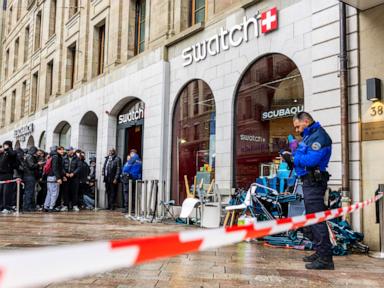
Tear gas in Paris. Fistfights in Milan. All-night lines snaking through the streets of London and New York.
The media is running its standard, lazy playbook over the launch of the Swatch x Audemars Piguet "Royal Pop" pocket watch. Commentators are wringing their hands over "overexcited drop culture." Academics are emailing quotes about how people have "gone crazy just to make money through resale." Critics are calling the decision to keep the $400 bioceramic watch offline a "risky mistake" that compromised public safety. If you liked this article, you might want to look at: this related article.
They are completely misreading the room.
What the mainstream financial press calls a chaotic failure of crowd control is actually a masterclass in corporate theater. Swatch didn't screw up the launch. They engineered the chaos. The secondary market scalpers selling the Royal Pop for $4,000 on eBay aren't ruining the brand; they are subsidizing its marketing budget. For another angle on this development, check out the latest coverage from The Motley Fool.
I have spent two decades watching lifestyle brands burn millions on artificial digital hype, only to watch their cultural relevance evaporate in months. Swatch just proved, for the second time in four years, why the old-school physical bottleneck is the ultimate weapon in modern retail.
The Myth of the Accidental Riot
The standard critique argues that Swatch "didn't get the memo" that sneaker and streetwear drops moved online years ago due to safety concerns.
Imagine a scenario where Swatch put the Royal Pop online. The website crashes in three seconds. Sophisticated checkout bots clear out the entire inventory before a human being can enter a credit card number. The public complains on X for six hours, and the product disappears from the cultural consciousness by Tuesday morning.
By forcing human beings to stand on a sidewalk on Carnaby Street or Times Square, Swatch drags the digital hype machine kicking and screaming into the physical world. Eleven billion views on social media do not happen because a product is good. They happen because the imagery of a riot over a $400 plastic pocket watch is irresistible.
When police shut down a store due to "public security considerations," that isn't a failure. It is the ultimate validation of demand. It tells every bystander, every teenager scrolling TikTok, and every luxury watch collector that whatever is inside that store is worth fighting for. You cannot buy that level of cultural penetration with a Super Bowl ad.
Scalpers Are Not the Enemy, They Are the Distribution Network
The loudest complaints focus on the resellers. "Genuinely passionate fans are losing out to people looking for a quick buck," the purists moan.
Let's dissect the mechanics of the high-low watch collaboration. The Royal Pop is an unlimited production piece. Swatch explicitly stated the watch will be available for months. There is no actual scarcity.
Therefore, the premium paid on the secondary market isn't for the watch itself; it is a tax on impatience.
The scalper performs a vital service for the brand by establishing a temporary, highly inflated anchor price. When a consumer sees a watch selling for £3,000 on eBay, the $400 retail price tag at the Swatch boutique suddenly looks like the bargain of the century. It triggers a psychological mechanism that transforms a cheap lifestyle accessory into an aspirational asset.
When the dust settles and production catches up, the genuine fans will walk into a quiet store and buy the watch at retail. They will feel like they won the lottery, despite buying a mass-produced piece of plastic. The scalpers create the illusion of exclusivity that sustains the product's desirability long after the lines disappear.
The "Genuine Fake" Strategy
The underlying genius of what Swatch is doing with Audemars Piguet—and what they previously executed with the Omega MoonSwatch in 2022—lies in the creation of a new product category: the authorized replica.
Purists argue that these collaborations dilute the prestige of ultra-luxury brands like Audemars Piguet. Why would someone pay $50,000 for a Royal Oak when they can get a candy-colored bioceramic nod to it for $400?
The premise is fundamentally flawed. The consumer buying a Swatch pocket watch was never in the market for an AP heirloom. However, by placing the AP design language within arm's reach of the middle class, Swatch acts as a gateway drug. It democratizes the aesthetic while preserving the unattainability of the original metal timepiece.
The downside to this approach is obvious: it burns out retail staff and irritates a segment of traditional watch enthusiasts who view horology as a sacred pursuit. But corporate strategy isn't about making everyone happy. It is about capturing attention in an economy where attention is the scarcest commodity.
Stop viewing retail chaos through the lens of logistics. Swatch knows exactly how these drops play out. They didn't miss the memo on moving sales online. They tore the memo up because they know that a line around the block is the only thing real left in marketing.


