For over two decades, urban planners and community boosters have paraded the same tired fantasy through Edmonton. Drop a multi-million-dollar cultural center on a neglected corridor, stamp a trendy label on it, and watch urban decay magically evaporate. The recent land acquisition for the long-delayed ArtsCommon 118 project on Alberta Avenue is being hailed as a monumental triumph.
It is nothing of the sort. If you liked this piece, you should read: this related article.
It is another round of magical thinking funded by municipal tax dollars and fueled by wishful community organizing. I have watched organizations sink millions into concrete pipe dreams while ignoring the fundamental economic mechanics of urban corridors. Buying land is not execution. Breaking ground is not success. And slapping the word "hub" onto a blueprint does not create an organic market.
The Fallacy Of The Savior Building
The lazy consensus in modern municipal development states that bricks and mortar solve structural socioeconomic stagnation. If an area lacks foot traffic, retail density, and private capital, the standard bureaucratic playbook demands a publicly subsidized arts incubator. For another perspective on this story, refer to the latest update from The Motley Fool.
The math behind ArtsCommon 118 exposes the flaw. With a projected price tag soaring past ten million dollars and millions extracted directly from public coffers, the project relies on a dangerous premise: that state-backed culture can artificially force a neighborhood to "tip" without first establishing organic commercial gravity.
Real estate developments do not revitalize communities. People with disposable income, sustained private sector employment, and risk-tolerant capital do. When you build a heavily subsidized cultural facility in an area lacking basic private investment, you are not sparking a district renaissance. You are building an insulated bubble that requires perpetual life support.
Follow The Funding Void
Let us look closely at how these projects survive. They live on grants, political cycles, and optimistic press releases.
When a project stalls for over twenty years—pushed back, scaled down, redesigned, and re-announced—the rational market is trying to tell you something. The market is screaming that the risk-to-reward ratio does not pencil out. Yet, civic leaders ignore the signal, right-size the ambition down to fit the acquired dirt, and declare victory because a deed finally changed hands.
Imagine a scenario where municipal governments stopped pouring capital into boutique real estate experiments and instead cleared away the zoning hurdles, tax penalties, and regulatory friction that choke ordinary small business formation on 118 Avenue.
An arts center does not generate a grocery store, a hardware shop, or a sustained evening economy. It generates scheduled events where people drive in, park, consume subsidized art, and drive right back out to their suburban garages without spending a single dollar at neighboring independent storefronts.
The Gentrification Trap Disguised As Community Building
There is a glaring hypocrisy at the heart of projects like ArtsCommon 118. Proponents champion inclusivity, social revitalization, and grassroots protection. Yet, anchoring neighborhood recovery to purpose-built, publicly funded creative real estate almost always accelerates the exact displacement advocates claim to fear.
When you inject millions in public infrastructure into a working-class corridor, property values shift. Landlords take notice. Taxes creep up. The independent mom-and-pop operations that survived the hard decades are squeezed out by the very cultural renaissance meant to save them.
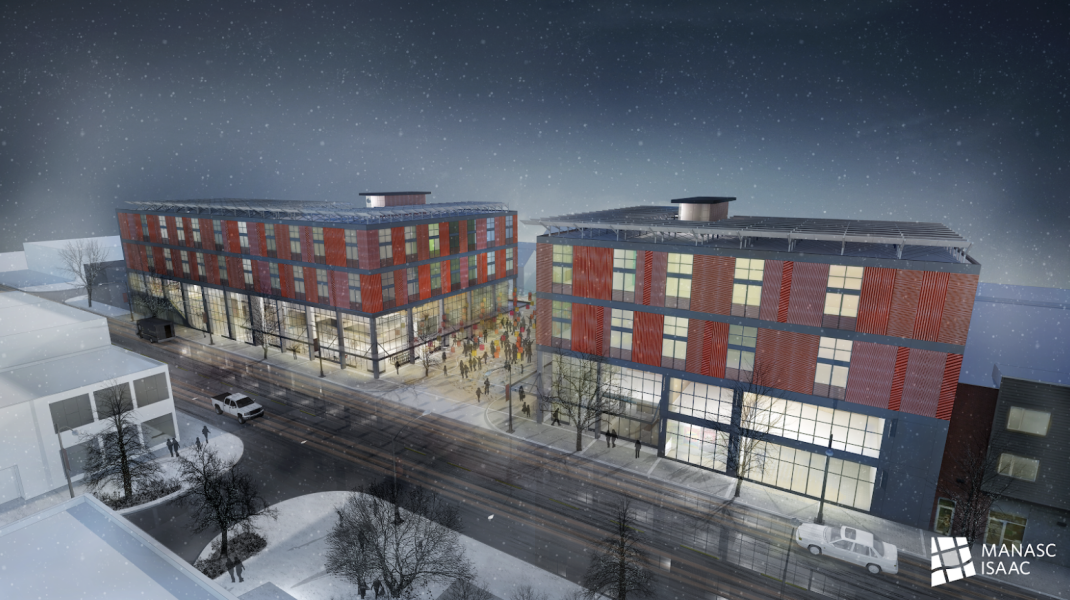
You cannot engineer authenticity. You cannot zone a vibe into existence through multi-story architectural concepts featuring green roofs and community kitchens. Authenticity is a byproduct of cheap space, low regulatory overhead, and organic grit—all of which vanish the moment a multi-million-dollar institutional development moves onto the block.
What Real Urban Health Looks Like
If Edmonton truly wants to transform Alberta Avenue, stop celebrating land transactions and start looking at economic fundamentals.
- Lower the barrier for private capital: Reduce commercial property taxes along transit corridors instead of subsidizing competing non-profit real estate entities.
- Abolish restrictive commercial zoning: Let micro-businesses, light manufacturing, and independent traders occupy empty storefronts without requiring endless variance applications.
- Stop picking winners: Municipalities have a dismal track record as real estate developers. Leave building construction to private balance sheets that suffer real consequences when projects fail.
Until policymakers accept that economic vitality comes from profitable commerce rather than institutional charity, 118 Avenue will remain a perpetual project waiting for its moment.
Stop funding the rendering. Show me the profit.