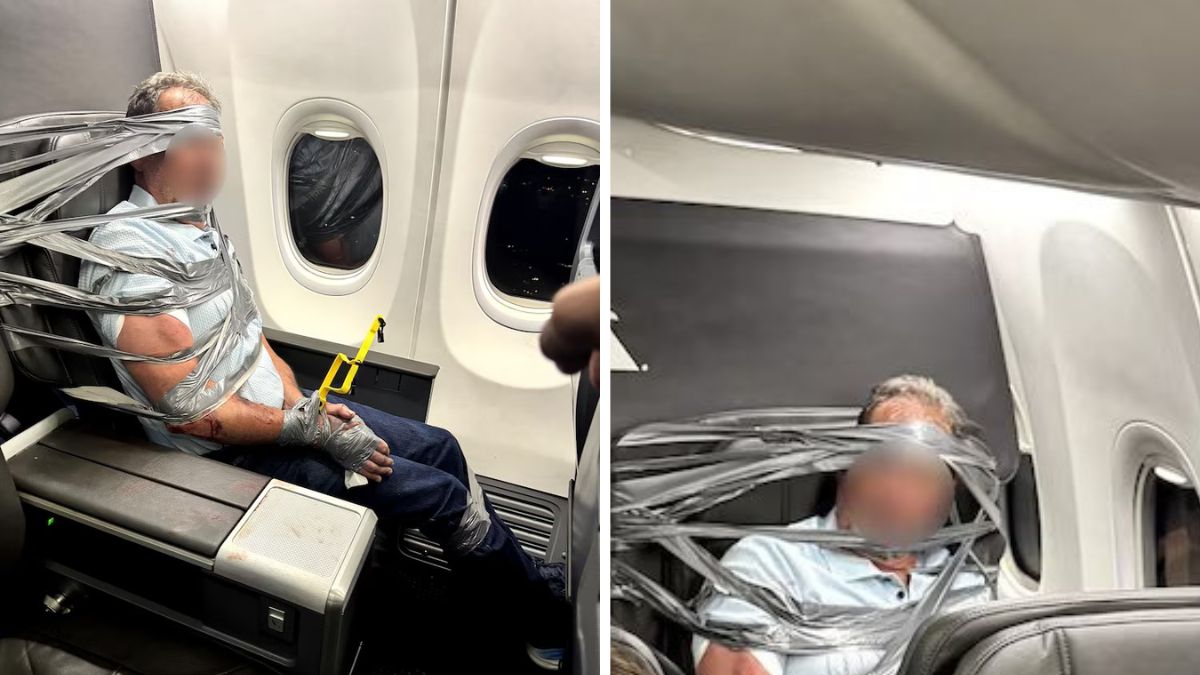
Another day, another viral clip of an unhinged flyer wrapped like an industrial mummy with packaging tape. Social media is having a collective field day. Commenters are cracking wise about DIY justice and how adhesive strips are the last thing holding civil society together.
Save your applause.
The lazy consensus treats the Arthur Lundeen incident on American Airlines Flight 618 as a satisfying morality play. A 67-year-old man throws racist and anti-LGBTQ slurs, gets physical with passengers, and gets grounded permanently by cargo-grade adhesive and zip ties. Justice served, right? Everyone goes home happy after an unscheduled pit stop in Baltimore.
Except this framing is dangerously naive. It misses the structural rot eating commercial aviation from the inside out. We are treating systemic failures as viral entertainment.
The Myth Of The Quick Fix
When people see a disruptive passenger subdued by fellow travelers and crew, they assume the system works. "The crew handled it," they say. "Passengers stepped up."
I have watched airlines blow millions on PR campaigns touting zero-tolerance policies while ground operations cut corners on passenger screening and alcohol monitoring. Relying on retired law enforcement passengers and cabin crew to act as impromptu tactical units at 35,000 feet is not a security plan. It is a liability lottery.
Imagine a scenario where a mid-air physical restraint goes wrong, resulting in positional asphyxiation or a medical emergency over the Atlantic. Who takes the fall? The flight attendant making hourly wages or the executive board hiding behind vague corporate statements about safety being their top priority?
Let us define terms clearly. Restraining an individual with duct tape is not a standard security protocol born of high-tech innovation; it is a makeshift survival tactic born of institutional helplessness. According to data from the Federal Aviation Administration, unruly passenger incidents remain stubbornly elevated compared to pre-2021 baselines, despite public relations spin.
The Real Failure Is Upstream
The internet wants to focus exclusively on the bigoted tirade. Bigotry is ugly, loud, and makes for great clickbait. But focusing only on the hate speech ignores the operational breakdown that allowed a volatile individual to board a metal tube bound for Newark in the first place.
Why was a passenger exhibiting clear signs of severe volatility allowed past the gate? Why are gate agents so overwhelmed, understaffed, and incentivized to rush boarding that behavioral red flags are routinely ignored?
Carriers treat boarding like cattle movement. Speed is king. Throughput metrics dictate bonuses. When you optimize exclusively for turnaround times, situational awareness drops to zero. You get gate agents scanning boarding passes on autopilot while severe behavioral hazards slip right past them into first class.
Furthermore, the complicity of airport concessions and pre-flight alcohol consumption remains the elephant in the room no one wants to address. Witnesses noted that the situation turned violent, and while the exact chemical mix is still being sorted in court filings, the aviation sector's heavy reliance on airport bar revenue creates a perverse incentive to keep travelers well-lubricated before they step onto a plane.
What Actually Needs To Change
If you want to fix unruly skies, stop waiting for viral videos to validate your worldview.
First, mandate comprehensive behavioral threat assessment training for gate staff, not just flight crews. Once a plane leaves the tarmac, your options drop from proactive prevention to reactive damage control.
Second, overhaul the legal enforcement loop. Too many of these cases vanish into light misdemeanors or dragged-out court dates that end with minor bonds, sending zero deterrent signal to the traveling public. Federal air marshals need to be visibly scaled or dynamically deployed based on risk profiles, rather than spread thin on symbolic routes.
The next time a video surfaces of a man taped to a seat, do not treat it as a feel-good meme. Treat it for what it is: a terrifying reminder that commercial aviation is holding together with literal tape because the people running the show refuse to fix the foundation.