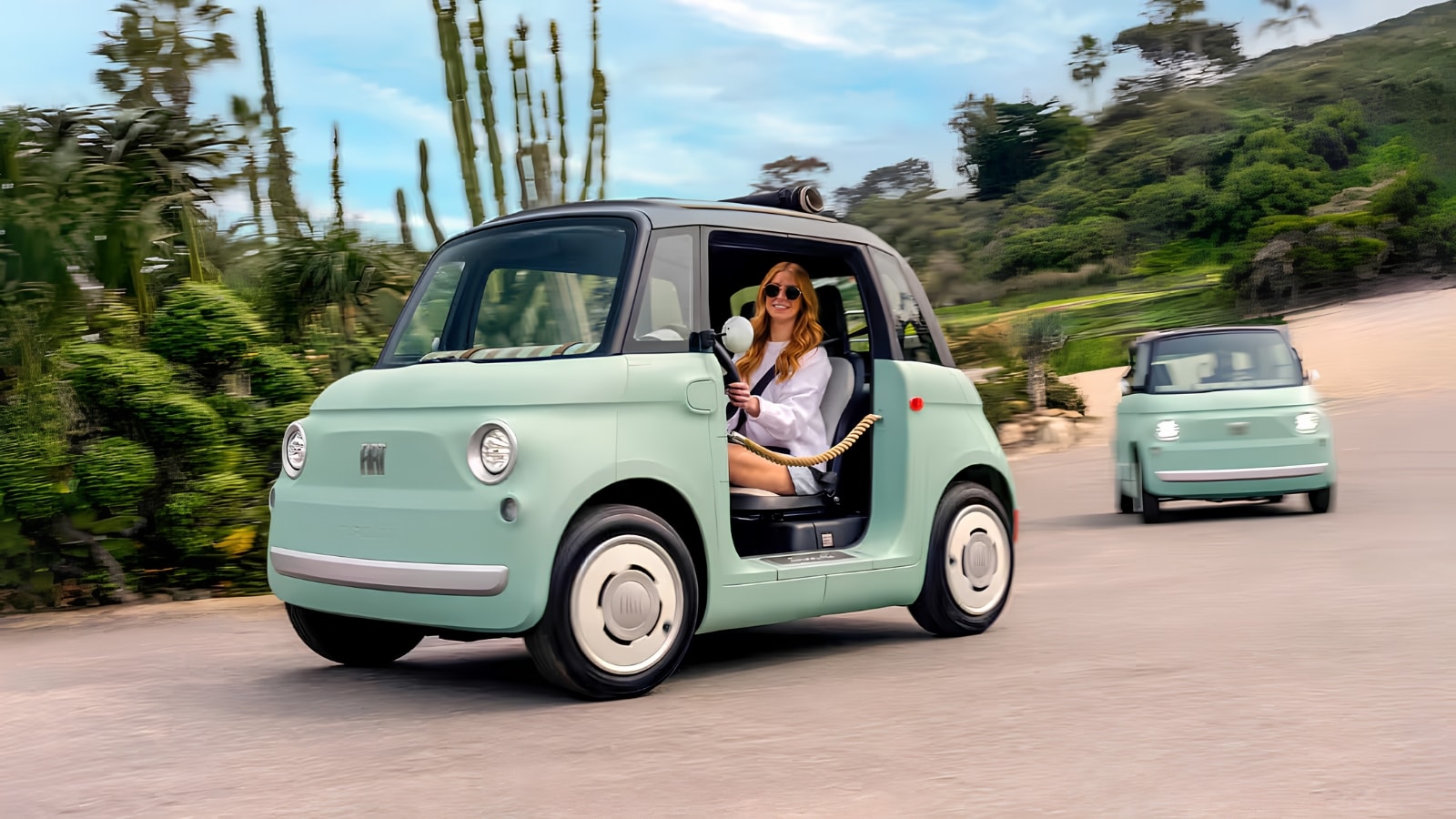
The automotive press loves a cozy narrative. When Stellantis announced it was dragging the Fiat Topolino across the Atlantic for a starting price of roughly $15,000, the pundits immediately scrambled for the lowest common denominator. They called it an overgrown toy, a quadricycle, or—most lazily—an overpriced golf cart with a roof.
They are missing the entire point. Recently making headlines recently: Stop Obsessing Over Publisher Creator Relationships.
I have watched companies burn hundreds of millions of dollars trying to force full-sized electric SUVs into dense urban cores where they make zero economic or physical sense. Meanwhile, a 1,073-pound, 8-foot-long Italian box with an 8-horsepower motor arrives, and the establishment pats it on the head like a novelty poodle. This isn't a golf cart substitute. It is a calculated execution blow to the traditional American obsession with vehicular excess.
The Anatomy of a Lazy Consensus
The mainstream critique goes like this: With a 46-mile range and an initial 19-mph top speed (bumped to 25 mph via a coming low-speed vehicle conversion kit), the Topolino cannot handle a 70-mph freeway commute. Therefore, it is functionally useless. Further information into this topic are explored by Investopedia.
That logic is broken. It assumes every mile traveled on American asphalt requires a 4,000-pound steel containment unit capable of crossing state lines. That is like driving a semi-truck to buy a gallon of milk.
Look at the data. Over half of all daily car trips in the United States are under three miles. We are deploying multi-tonne battery packs, tearing up municipal pavement, and burning through precious raw materials just to haul a single 180-pound human and a gym bag down to the local coffee shop. The Topolino’s 5.4-kilowatt-hour battery doesn't need to cross the desert; it needs to absorb the short-hop trash miles that destroy internal combustion engines through constant cold-starts.
Why the Golf Cart Comparison Falls Flat
Calling this vehicle a golf cart exposes a fundamental misunderstanding of regulatory classification and engineering standards. A standard golf cart is a loose assembly of fiberglass and tubular steel exempt from federal safety mandates, stability controls, or weatherproofing.
The Topolino features a reinforced passenger cell, a conforming windshield, an onboard heater/defroster, a rearview backup camera, and a designated Vehicle Identification Number (VIN). It plugs into a standard 120-volt household outlet and refills its battery from zero to full in roughly five hours for pennies.
Imagine a scenario where a suburban household replaces its third gas-guzzling commuter car with a micro-EV for local errands, school drop-offs, and train station runs. The household electric bill barely flickers, maintenance drops to zero oil changes and occasional tire rotations, and neighborhood parking congestion vanishes. That is not a toy lifestyle. That is financial efficiency.
The Real Flaw Nobody Wants to Admit
To maintain intellectual honesty, we must look at the downside of this micro-mobility push. The barrier isn't the vehicle; it's American municipal infrastructure.
Most American cities were bulldozed for the automobile. Zoning laws, hostile stroads, and aggressive traffic patterns make operating a 25-mph low-speed vehicle on public arteries genuinely terrifying if local municipalities refuse to build protected micro-mobility lanes. If you drop a Topolino onto a 55-mph county highway with no shoulder, you become a speed bump.
Fiat and Stellantis are betting that the explosive growth of master-planned communities, beach towns, and dense urban pockets will bypass this hurdle. They are right. The demand is already saturated by illegal, unregulated custom golf carts driven by teenagers on public roads. The Topolino provides a legal, weather-tight, crash-tested adult alternative that actually meets federal specifications once the low-speed kit is applied.
The Economic Reality Check
At $14,985 out the door, the Topolino is not competing with a Honda Civic. It is competing against the absurd total cost of ownership of keeping an old crossover alive just to run local errands. When you factor in insurance rates, registration fees, and maintenance for a legacy vehicle sitting idle 95% of the day, micro-mobility emerges as a masterclass in capital preservation.
Stop judging micromobility by the metrics of a highway cruiser. The era of hauling a 5,000-pound battery to pick up dry cleaning is coming to an end.
Adapt or get stuck in traffic.