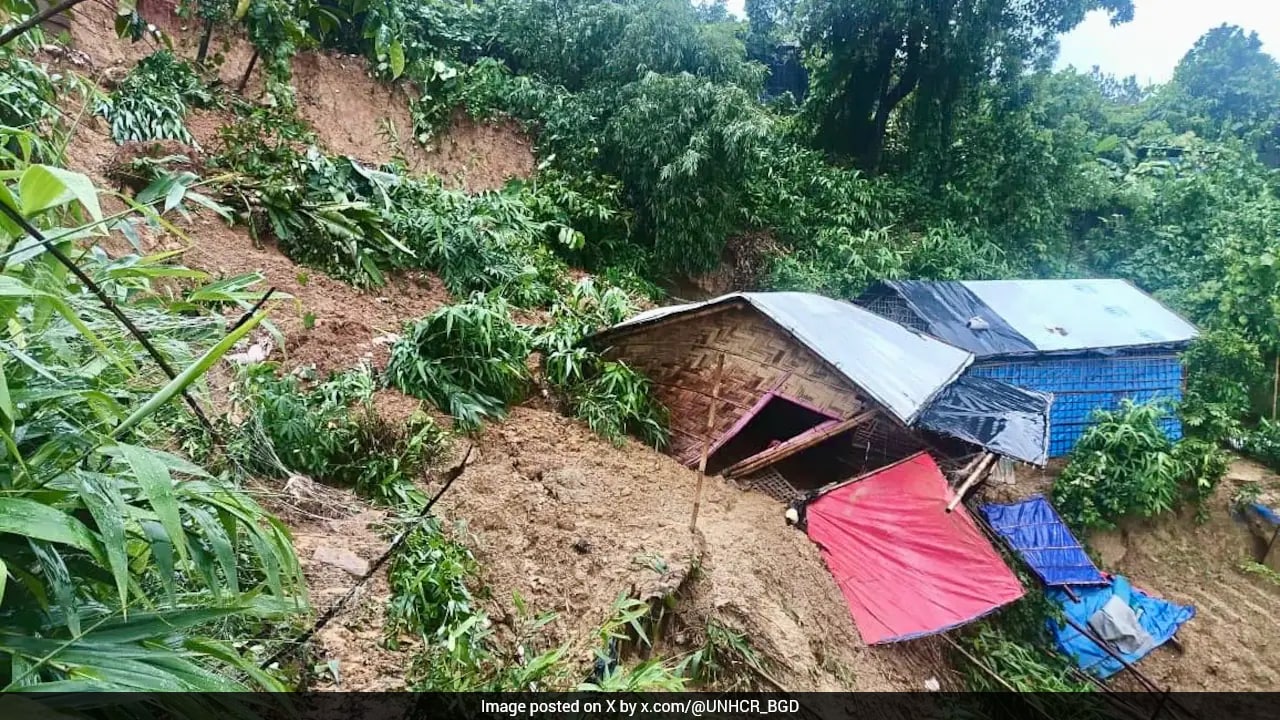
Media coverage of the recent tragedy in Cox’s Bazar follows a predictable script. Heavy monsoon rains fall. Hillsides give way. Eight Rohingya refugees, including five children, lose their lives. The headlines immediately frame this as a natural disaster, an unavoidable act of God, or a grim reminder of climate vulnerability.
That narrative is completely wrong.
Calling these deaths a natural disaster is an insult to the victims. It covers up systemic policy failures, intentional infrastructure restrictions, and an international aid apparatus that has grown comfortable managing a permanent crisis with temporary tools. The hillsides in southeastern Bangladesh did not just collapse because it rained. They collapsed because thousands of people are legally forced to live in conditions designed to fail.
The Myth of the Unavoidable Disaster
Every monsoon season, the same cycle repeats. Media outlets send reporters to photograph mud-soaked tarpaulins. UN agencies issue press releases begging for emergency funding. Drone footage shows the staggering density of the camps. The public walks away thinking the problem is simply that too many people are packed onto fragile slopes during a storm.
This perspective ignores basic engineering and policy facts.
Landslides happen when soil loses its shear strength due to water saturation. In a normal environment, deep root systems of native trees hold the soil matrix together. When the camps were rapidly established in 2017, hundreds of hectares of forest were cleared. That was an emergency necessity. Keeping the hills bare for nearly a decade, however, is a policy choice.
Geotechnical engineers know exactly how to stabilize these slopes. You use retaining walls, terracing, proper deep-drainage channels, and extensive reforestation with specific deep-root vegetation. These are not experimental techniques. They are standard civil engineering protocols used worldwide to secure inhabited hillsides.
Why are they not used in Cox’s Bazar? Because the policy frameworks governing the camps strictly forbid permanent structures.
The Cruel Logic of Mandatory Temporariness
The government of Bangladesh, understandably concerned about the long-term integration of over a million refugees, maintains a strict policy: the camps must remain temporary. This means refugees cannot build shelters out of brick, concrete, or corrugated iron with proper foundations. They are mandated to use bamboo and plastic tarps.
This restriction extends directly to the infrastructure meant to protect them.
International NGOs and UN agencies operate under tight constraints. They cannot build concrete retaining walls to hold back a hill. They cannot install permanent, heavy-duty drainage networks to channel monsoon runoff away from shelters. Instead, they are forced to rely on bamboo piling, sandbags, and micro-terracing.
Imagine trying to hold back thousands of tons of wet earth with hollow grass stalks and woven plastic bags.
I have watched aid workers patch up hillsides with bamboo stakes, knowing full well the next major downpour would wash them away. It is aSisyphean task funded by hundreds of millions of dollars. We are spending vast sums of money to maintain a state of permanent vulnerability, all to satisfy a political fiction that these camps will disappear overnight.
The result of this policy is a manufactured hazard. When eight people die under a mudslide, they are not victims of the weather. They are victims of a policy configuration that makes structural safety illegal.
The Aid Industry Funding Trap
The international humanitarian architecture is complicit in this cycle. The funding model for major refugee crises relies on short-term appeals. Donors prefer to give money for immediate emergency relief—food distributions, medical supplies, and temporary tents—rather than long-term infrastructure stabilization.
An emergency appeal after a fatal landslide generates headlines and opens donor pockets. A proposal to spend five years completely engineering the hillsides of Ukhiya and Teknaf to prevent future collapses does not have the same emotional urgency. It looks too much like permanent settlement.
This creates a perverse incentive structure. The aid complex has built an entire economy around managing the symptoms of the crisis.
- Emergency response teams are permanently deployed to clear mud after the fact.
- Logistics networks stay ready to distribute new tarps to replace the destroyed ones.
- Assessments and reports are continuously generated to document the predictable damage.
This constant state of emergency justification keeps the machinery moving, but it does nothing to alter the baseline risk. True expertise in camp management means acknowledging that when an displaced population remains in one location for nearly ten years, the "emergency" phase is over. You are no longer managing a camp; you are managing a poorly built city. And cities require concrete, steel, and real civil engineering to survive the elements.
Dismantling the Displacement Fallacy
Look at the questions routinely asked by analysts and the public alike:
- How can we improve early warning systems in the camps?
- How can we speed up evacuation times when a storm hits?
These questions are fundamentally flawed. They assume that moving people back and forth between flimsy shelters and slightly less flimsy community centers every time it rains is a viable strategy. It is not. It is a logistical nightmare that inflicts continuous trauma on an already brutalized population.
The right question is: Why are we legally preventing the structural stabilization of the land these people occupy?
The answer is political fear. Host governments fear that allowing concrete infrastructure creates permanence. Western donors fear long-term financial commitments. The result of this collective anxiety is a compromise where the currency paid is human life.
Admitting the downside of a contrarian approach is necessary: allowing permanent infrastructure in refugee camps does complicate the geopolitics of repatriation. It signals to the region that the population is staying. It places a different kind of administrative burden on the host nation. But the alternative is what we see now—a recurring body count every single summer.
The current strategy is an expensive, deadly failure. You cannot educate or warn a family out of the path of a collapsing hill when they are legally barred from moving somewhere safer or reinforcing the earth behind their home. The mud does not care about geopolitical sensitivities. It obeys gravity. Until the policy shifts from forced temporariness to structural engineering, the next landslide is already guaranteed.