The modern Open Championship is no longer merely a golf tournament; it is a massive logistical machine. With ticket demand surging—highlighted by over 750,000 lottery applications in just nine days for the 2027 event at St Andrews—and attendance figures at venues like Royal Birkdale surpassing 300,000 spectators, the physical footprint of the championship has expanded beyond the capacity of traditional sporting venues.
The ongoing negotiations between the R&A, Portmarnock Golf Club, and the Irish Government to bring the Open Championship to the Republic of Ireland represent a major commercial and geopolitical shift. For the first time in the tournament's history, the Claret Jug may be contested outside of the United Kingdom. However, the delay in formalizing this agreement exposes the friction between historical prestige and the physical limitations of modern sports infrastructure.
The Economics of Scale: Why Modern Majors Outgrow Historic Links
The R&A’s feasibility study on Portmarnock is completed, confirming that the course itself can test the world’s best players. The bottleneck is not the 18 holes of championship turf; it is the secondary infrastructure required to support a modern major.
To evaluate the feasibility of Portmarnock, we must analyze the Open Championship Scale Equation, which balances three competing variables:
- The Athletic Footprint: The physical course layout, practice facilities, and competitive integrity of the links.
- The Commercial Footprint: Sponsor pavilions, hospitality structures, merchandise zones, and media centers requiring substantial, flat acreage adjacent to the course.
- The Civil Infrastructure Capacity: Public transport links, arterial road networks, hotel room inventory within a 45-minute radius, and emergency services.
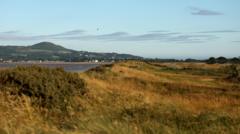
When the Open returned to Royal Portrush in 2019, the club had to permanently sacrifice its traditional 17th and 18th holes, utilizing that land to construct a massive spectator village. Portmarnock, situated on a low-lying peninsula in north Dublin, presents an even tighter geographical constraint.
Unlike inland courses with adjacent agricultural land available for temporary lease, a peninsula offers only one way in and one way out. This spatial bottleneck limits access for heavy machinery, emergency services, and daily gallery flows exceeding 80,000 people.
The Three Bottlenecks of the Portmarnock Bid
Establishing a recurring major championship venue outside the UK requires solving three distinct operational challenges.
1. The Transport and Access Bottleneck
Portmarnock is accessed primarily via narrow, residential coastal roads. The local rail network, while functional, lacks the high-frequency throughput capacity needed to clear tens of thousands of spectators within two hours of the final putt.
To resolve this, the Irish Government’s projected €40 million infrastructure fund must target targeted civil engineering upgrades, specifically dedicated park-and-ride corridors, temporary arterial lanes, and upgraded rail terminus facilities managed in tandem with Fingal County Council.
2. The Commercial Footprint Deficit
A modern Open requires a flat, dry "tent village" of up to 30,000 square meters. Portmarnock’s delicate dune ecosystem is environmentally protected, meaning temporary structures cannot be anchored haphazardly without risking long-term ecological damage.
The R&A is forced to design a highly unconventional, fragmented corporate hospitality layout that distributes the commercial footprint across non-adjacent parcels of land, increasing operational costs.
3. The Practice Range Minimum Threshold
The R&A mandates a practice range of specific dimensions to accommodate modern professional ball speeds and launch-monitor tracking systems. Traditional links clubs rarely possess such expansive driving ranges near their first tees.
Portmarnock has had to approve extensive internal course renovations to secure its position, a process that balances member satisfaction with international tournament specifications.
Sovereign Underwriting and the Long-Term Return on Investment
The Irish Government's willingness to commit significant capital is not a sporting decision; it is a calculated economic play. The state’s financial underwriting acts as a direct subsidy to de-risk the R&A's operational migration outside the United Kingdom.
| Economic Driver | Strategic Mechanism | Projected Impact |
|---|---|---|
| Direct Tourism Yield | Inflow of high-net-worth international travelers during tournament week. | Multi-million euro injection into the Dublin hospitality sector. |
| Global Media Value | Hundreds of hours of live television coverage showcasing the Dublin coastline. | Long-term appreciation in high-end golf tourism and foreign leisure spend. |
| The Portfolio Play | Establishing a recurring model for both the Men's Open and the AIG Women's Open. | Amortizes the initial €40 million infrastructure spend over decades. |
This multi-event portfolio strategy is critical. The R&A does not want to invest years of feasibility work and diplomatic capital into Portmarnock for a single, one-off event.
Instead, they are negotiating a long-term operational framework where Dublin becomes a permanent, recurring hub in the rota, alternating between the men's and women's championships. This long-term horizon justifies the state's upfront infrastructure investment.
The Rota Realignment: Who Loses as Portmarnock Wins?
The addition of a new venue to the Open Championship rota is a zero-sum game. The calendar can only support one Open per year, meaning the integration of Portmarnock inevitably displaces or de-prioritizes existing venues.
[Portmarnock Integration] ---> [Dilution of Rota Rotations]
                                    |
                                    +---> Trump Turnberry (Political & Logistical Exile)
                                    |
                                    +---> Muirfield (Operational & Structural Bottlenecks)
                                    |
                                    +---> Royal Portrush (Increased Competition for Irish Market Share)
This realignment creates clear winners and losers across the golf landscape:
- Trump Turnberry: Despite possessing one of the finest links layouts in the world, Turnberry remains frozen out of the rotation. While the R&A publicly cites "logistical challenges" and spectator volume limitations, the political and reputational costs associated with its ownership continue to serve as an insurmountable barrier.
- Muirfield: The historic Scottish venue faces its own operational challenges. The R&A's push to modify the course layout—specifically moving the fifth green to relieve spectator "pinch points"—has met resistance. As Muirfield struggles with structural adaptations, its return timeline slips further, opening a natural calendar window for Portmarnock.
- Royal Portrush: Having successfully hosted in 2019 and 2025, Portrush proved that the island of Ireland is an elite market for major championship golf. However, a Dublin-based tournament introduces direct commercial competition for corporate hospitality dollars and local government funding.
The Final Strategic Play
With the feasibility study complete, the path to bringing the Open Championship to Portmarnock hinges entirely on the finalization of the tripartite agreement between the R&A, the Irish Government, and Fingal County Council.
The R&A expects to deliver a definitive verdict by the end of 2026. To secure the tournament, the Irish Government must shift from theoretical financial commitments to concrete civil engineering timelines.
The strategic play is to treat the €40 million funding package not as a sports subsidy, but as a long-term regional development project. Upgrading the transport links and access corridors around the Portmarnock peninsula will unlock the area's tourism potential for the next fifty years, ensuring that when the Claret Jug finally crosses the Irish Sea, the logistical engine is fully equipped to handle the weight of history.