The United States has quietly broken its promise of open-market technology, forcing its closest global partners to confront a stark new reality. When Washington abruptly pulled the digital plug on advanced artificial intelligence models worldwide on national security grounds, it triggered an immediate crisis of faith in New Delhi. For India, which has staked its public infrastructure and future economic growth on imported American software, the realization that an ally can instantly deactivate a foundational model has reshaped the geopolitics of computing.
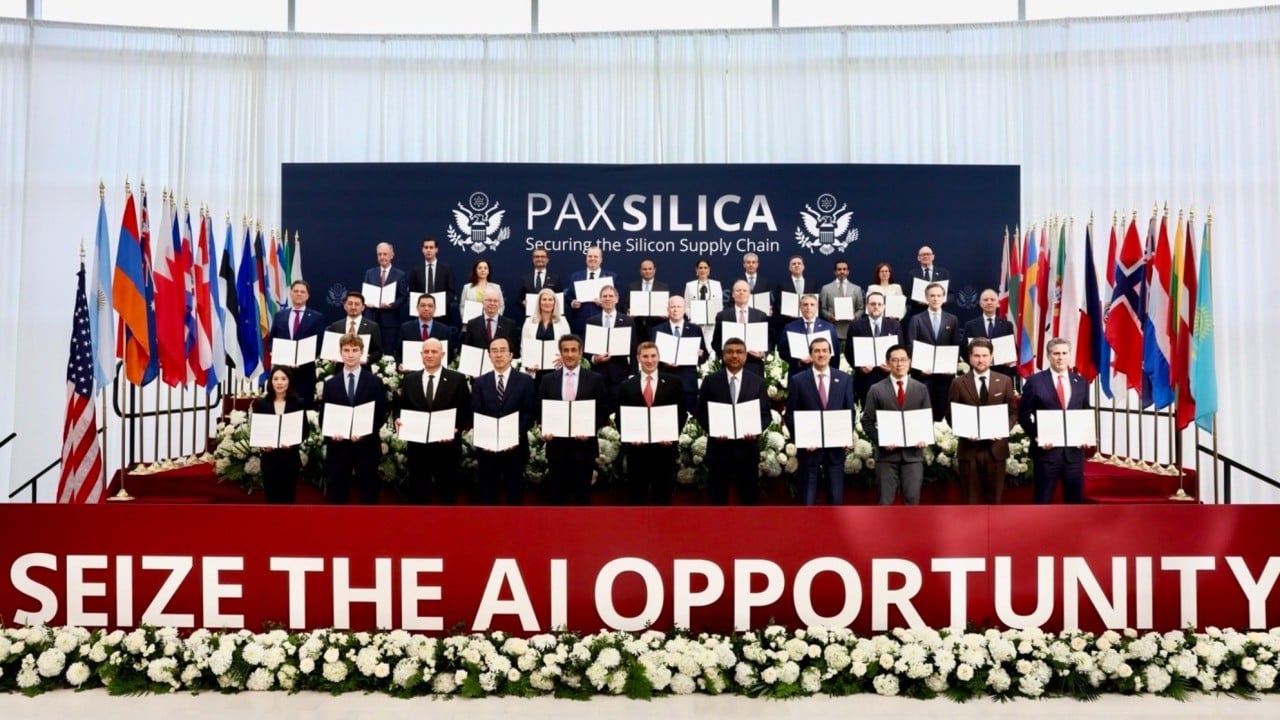
At the heart of the panic are Anthropic’s advanced Fable 5 and Mythos 5 models. In early June, the Trump administration issued a sudden export control directive barring foreign nationals from using these systems, prompting the developer to cut off access globally without warning. The fallout reached a boiling point at the two-day Pax Silica Summit in Washington, where a senior Indian delegation cornered US officials to demand ironclad guarantees against a future AI kill switch.
While S. Krishnan, secretary of India’s Ministry of Electronics and Information Technology, emerged from the meetings claiming the US provided assurances that access would not be severed once granted, the underlying mechanics of the Pax Silica framework tell a vastly different story. Washington is not offering a blank check. It is building an enforcement mechanism designed to keep its partners on a tight, conditional leash.
The Illusion of Continuity
The diplomatic language coming out of Washington is deliberately soothing. Under Secretary of State Jacob Helberg publicly emphasized a gradual, measured approach to releasing cutting-edge models to ensure they remain safe for critical infrastructure and power grids. Yet, behind the mutual understandings lies an unalterable technical reality: cloud-hosted AI models are inherently centralized, and the hand on the main breaker belongs exclusively to the United States.
For decades, international technology transfers involved physical hardware or localized software installations. Once a country bought the machine or licensed the code, they owned it. If relations soured, they could still run the factory.
Frontier artificial intelligence completely upends this historical precedent.
Because advanced models require massive distributed server farms to operate, foreign enterprises do not run them locally; they ping them via an Application Programming Interface (API) connected to American datacenters. This architecture means a change in Washington's political winds can turn off a foreign nation's automated healthcare routing, financial fraud detection, or municipal scheduling overnight.
[Indian Enterprise API Request] ---> [US State Dept Export Ban] ---> [Anthropic Datacenter: ACCESS DENIED]
This structural vulnerability mirrors the strategic shock India suffered during the 1999 Kargil War, when the US military denied New Delhi access to GPS data over the conflict zone. That historical betrayal forced India to spend more than a decade building NavIC, its own independent satellite navigation system. The sudden disappearance of Fable 5 and Mythos 5 has triggered identical alarm bells within the Indian defense and technology establishments, exposing the high risk of treating American commercial AI as a utility.
Inside the Pax Silica Architecture
The Pax Silica initiative was not created to spread open technology; it was designed to wall it off. Originally launched to construct an AI and semiconductor supply chain entirely free of Chinese influence, the coalition has rapidly evolved from a loose trade forum into an economic and military security pact.
The alliance is built upon a hard-nosed assessment of current industrial capabilities rather than future economic potential. By binding together nations that control specific, irreplaceable nodes of the technology pipeline—such as the United States for design, the Netherlands for lithography machines, and Japan for specialized chemical resists—Pax Silica creates a closed loop.
India joined the pact to safeguard its burgeoning electronics and semiconductor ambitions, but the alliance introduces an existential catch-22 for New Delhi.
| Country/Region | Core Supply Chain Asset Controlled | Geopolitical Leverage |
|---|---|---|
| United States | Cloud compute, foundational AI architecture, EDA design software | Can impose instant global software blocks |
| Netherlands | ASML extreme ultraviolet lithography systems | Restricts export of physical chipmaking machinery |
| India | Mass technical engineering workforce, raw software execution | Vulnerable to sudden Western technology revocations |
The architectural trap lies in hardware degradation. AI accelerators and server components operate under immense thermal stress, requiring routine replacement and upgrading every few years. Even if India builds domestic fabrication plants, it remains dependent on Western lithography tools, American design software, and proprietary architectures. This continuous dependency gives Washington a perpetual, structural kill switch. If a partner nation drifts too close to Beijing, or uses the technology in a manner that contradicts American foreign policy, the supply of upgrades can simply be choked off.
The Indian Dilemma between Innovation and Control
The immediate response from New Delhi reveals a deep internal tension between the raw economic need for rapid innovation and the long-term necessity of digital sovereignty. While American regulators push for stringent internal review mechanisms before models are released to the public, India remains fiercely resistant to early-stage regulation.
In discussions on the sidelines of the Washington summit, Indian officials maintained that the artificial intelligence sector is too nascent for heavy-handed legal frameworks. New Delhi’s priority is deployment: embedding smart systems into agricultural forecasting, tax collection, and telecommunications to lift its broader economy. Forcing these systems to comply with Western-style compliance regimes would stall momentum.
Yet, this aversion to regulation complicates India's defensive position. Without robust domestic legal barriers governing data storage and localized model training, Indian enterprises remain completely exposed to extraterrestrial US laws like the CLOUD Act. This statute grants American authorities the legal right to compel tech companies headquartered in the US to hand over data stored on their servers, regardless of whether that data physically resides in a server farm in Mumbai or Virginia.
India is attempting to play a delicate balancing game. It is offering its vast pool of skilled engineering talent to help clear the global semiconductor worker shortage, while simultaneously demanding that Washington treat it as an equal stakeholder rather than a conditional consumer.
The Myth of the Ironclad Assurance
The diplomatic assurances celebrated in New Delhi are structurally fragile because they rely on political intent rather than binding international law. A verbal agreement with a current administration cannot override an executive export control order issued under national security statutory authorities.
When the US State Department asserts that it is prioritizing a collaborative rollout of frontier AI, it is describing a preference, not a legal obligation. The abrupt ban on Anthropic's top-tier models proved that when the American intelligence community identifies a potential risk of technology leakage—specifically the fear that adversarial state actors could access American compute power through third-party cloud systems—commercial partnerships are sacrificed instantly.
For global enterprises and sovereign states relying on the Pax Silica umbrella, the lesson of the Anthropic freeze is clear. The global technology market has officially entered an era of fragmenting ecosystems. The open, borderless internet that defined early corporate globalization has been replaced by a system of digital checkpoints, where access to the advanced mathematical engines of the modern world is subject to continuous political vetting.
Washington’s reassurance to India may keep New Delhi at the negotiating table, but it cannot alter the physical architecture of the cloud. The kill switch remains wired, and the button is firmly located inside the Beltway.