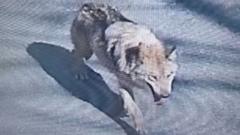
South Korea does not have a wild wolf population. Every ecological record and government survey confirms that the Korean wolf, a distinct subspecies, was wiped out by colonial-era "pest control" and the devastation of the Korean War. Yet, for weeks, the nation remained gripped by the pursuit of a predator that technically shouldn't exist. The escape of a captive wolf from an unlicensed facility in the rural outskirts of Gyeonggi Province turned a local administrative failure into a national security event.
The animal, a female named Arong, didn't just jump a fence. She exposed the messy reality of Korea’s unregulated private zoos and the deep-seated public anxiety toward a nature that the country has largely paved over. This wasn't a story about a "fugitive" in the criminal sense, but rather a tragic collision between a misplaced apex predator and a society that has forgotten how to live alongside anything it cannot cage.
The Illusion of the Korean Wilderness
South Korea’s rapid industrialization left little room for the messy, unpredictable edges of the natural world. While the country prides itself on lush mountain hiking trails and meticulously maintained national parks, these are controlled environments. They are gardens, not wilderness.
When Arong escaped, the immediate reaction from the Ministry of Environment and local police wasn't one of conservation, but of containment and elimination. This stems from a historical trauma. During the Japanese occupation in the early 20th century, the Hae-su-gu-je (Harmful Wild Animal Extermination) policy systematically eliminated tigers, leopards, and wolves. The goal was to "civilize" the peninsula. That mission was so successful that for the modern Korean citizen, a wolf is a creature of folklore or a Netflix documentary, not a neighbor.
The "fugitive" status assigned to the animal by the domestic press reflected this disconnect. By framing the wolf as an outlaw, authorities justified a disproportionate response. Hundreds of officers, thermal drones, and specialized hunters were deployed. The fear wasn't just about a potential bite to a livestock animal or a hiker; it was the fear of the uncontrollable.
The Dark Economy of Private Menageries
To understand how a wolf ends up wandering through a suburban forest in 2024, one must look at the loophole-ridden landscape of South Korean animal welfare laws. For decades, "experience zoos" and private wildlife cafes flourished under lax oversight. These businesses allowed tourists to feed, pet, and take photos with exotic species in settings that were often little more than concrete boxes.
The Regulatory Void
Until very recently, registering a private zoo was a matter of simple paperwork rather than a rigorous inspection of animal welfare or security protocols. Arong lived in a facility that occupied a legal gray area. These establishments often source animals from domestic breeders who treat wolves and wolf-hybrids as high-value commodities.
- Breeding for "Cute" Factors: Many private owners cross-breed wolves with large dog breeds like Malamutes or Huskies to create "wolf-dogs" that look wild but are marketed as manageable.
- The Status Symbol: Owning a "pure" wolf, or something close to it, carries a specific weight in certain underground collector circles in East Asia.
- Failed Enforcement: While the Zoo and Aquarium Act was amended in 2023 to ban new "animal cafes," existing facilities were given long grace periods to comply.
Arong was the product of this system. She was a creature bred for human curiosity, kept in a facility that lacked the structural integrity to hold a determined predator. When she found a gap in the perimeter, she didn't run toward a forest to hunt; she ran because the cage was the only world she knew, and it had finally failed her.
The Anatomy of a Manhunt
The search for the Gyeonggi wolf was a masterclass in bureaucratic overkill. Because South Korea is one of the most densely populated countries on earth, there is no "empty" space. Every square kilometer of forest is hemmed in by high-rise apartments, six-lane highways, or military installations.
The police didn't just want to find the wolf; they wanted to erase the threat to public order. The use of thermal imaging drones sounds sophisticated, but in the dense underbrush of the Korean summer, these tools are often blinded by the heat of the earth itself. The hunters moved in with tranquilizer guns, but the directive was clear: if the animal posed even a perceived threat to a human, lethal force was authorized immediately.
This raises a vital question that the local media largely ignored: Why was the preservation of the animal never a priority? In North America or Europe, a stray wolf might be tracked and relocated. In Korea, the animal was treated as an invasive glitch in the system. The "fugitive" was never going to get a trial.
The Psychological Toll of the "Wolf Scare"
Public reaction in the surrounding towns was a mix of genuine terror and morbid fascination. Grocery stores saw a dip in foot traffic. Parents stopped letting children play in apartment courtyards.
This reaction is disproportionate to the actual risk. A lone, captive-bred wolf is far more terrified of humans than humans should be of it. However, the Korean psyche is conditioned to view the "outside" as a place of curated safety. When that safety is punctured by a 30-kilogram carnivore, the social contract feels broken.
The media fueled this by running "expert" segments on wolf behavior that focused almost exclusively on their capacity for violence. They ignored the fact that this specific wolf had spent her life being fed by hand. She wasn't a killing machine; she was a confused pet in a high-stakes survival situation.
Why Reintroduction is a Political Non-Starter
While some environmental groups have quietly suggested that the "wolf scare" should spark a conversation about reintroducing native species to the DMZ or remote mountain ranges, the political reality is grim.
South Korea has successfully reintroduced the Asiatic Black Bear in Jirisan National Park. That project has been fraught with tension, as bears occasionally wander into villages or destroy beehives. If the public reacts this strongly to a single captive wolf, the prospect of a self-sustaining wild pack is a logistical and electoral nightmare.
Farmers in the Gyeonggi and Gangwon provinces are a powerful voting bloc. Their opposition to predator reintroduction is absolute. They see the "fugitive wolf" not as a tragedy, but as a warning of what happens when "city people" get too sentimental about nature.
The Failure of the "Safe City" Narrative
The Arong incident is a crack in the veneer of the modern Korean city. We live in an era of "Smart Cities" where every movement is tracked by CCTV and every emergency is broadcast via cell phone alerts. The wolf bypassed all of it. She moved through the blind spots of the surveillance state, surviving on scraps and instinct.
Her eventual capture—or "neutralization," to use the clinical language of the police reports—was inevitable. There is no wild left for her to escape to. If she headed north, she’d hit the most heavily fortified border on the planet. If she headed south, she’d hit the sea.
The Cost of the Spectacle
Every time an exotic animal escapes in Korea—whether it’s a zebra in the streets of Seoul or a wolf in the hills of Gyeonggi—there is a flurry of legislative promises. Politicians pose for photos, talk about "comprehensive overhauls" of animal welfare laws, and then the news cycle moves on to the next celebrity scandal or real estate crisis.
The real tragedy isn't that a wolf escaped. It’s that we have created a world where a wolf’s only options are a cage or a bullet.
The Gyeonggi wolf wasn't a fugitive from justice. She was a refugee from a failed industry that treats living beings as inventory. Until the government moves beyond the "exterminate and control" mindset of the 1950s, more animals like Arong will find the gaps in their fences. And the public will continue to react with a fear that says more about our own alienation from the earth than it does about the animal itself.
Stop building better cages and start dismantling the industry that fills them.