South Korea has launched an ambitious 800 trillion won ($576 billion) mega-project strategy designed to capture permanent leadership in global artificial intelligence and semiconductor manufacturing. Unveiled by President Lee Jae Myung on Monday, the multi-year plan forces a dramatic geographic shift away from the traditional, overcrowded manufacturing hubs of Yongin and Pyeongtaek toward the country's southwestern region, including Gwangju and South Jeolla province. While the announcement promises a massive industrial transformation backed by tech heavyweights Samsung Electronics and SK Hynix, it masks a brewing structural crisis involving power infrastructure, regional political friction, and the sheer physical limits of high-bandwidth memory production.
The strategy hinges on creating the world’s most concentrated hardware engine. By focusing on a triple axis of memory semiconductors, physical AI, and dedicated data centers, Seoul aims to build an unassailable supply chain. Yet, under the surface of this historic spending package lies an uncomfortable truth. South Korea is running out of space, power, and time to feed its tech industry.
Moving Beyond the Seoul Limits
For decades, the bulk of South Korean semiconductor capability remained anchored closely to the capital metropolitan area. Cities like Yongin and Pyeongtaek became synonymous with advanced silicon. That concentration has now turned into a dangerous liability.
Local grids in the capital region are redlined. Local water tables are under strain. By forcing Samsung and SK Hynix to anchor two massive new fabrication sites each in the southwest, the administration is attempting to solve two problems simultaneously. It wants to narrow the widening economic gap between Seoul and rural provinces, while exploiting the underutilized power infrastructure of the southwestern territories.
The regional plan involves an immediate 5 to 20 trillion won deployment from the city of Gwangju and South Jeolla province. Additionally, an 81 trillion won packaging cluster is scheduled for development in the Chungcheong area to act as an intermediate bridge between the new southwestern fabrication sites and the northern markets.
This geographic dispersion introduces logistical headaches that memory chipmakers have spent decades avoiding. High-bandwidth memory chips require extraordinary precision during packaging and transport. Splitting the production of silicon wafers from advanced packaging facilities across hundreds of kilometers introduces risks in yield management and transport security that the industry has rarely faced at this scale.
The Grid Crisis Nobody Is Talking About
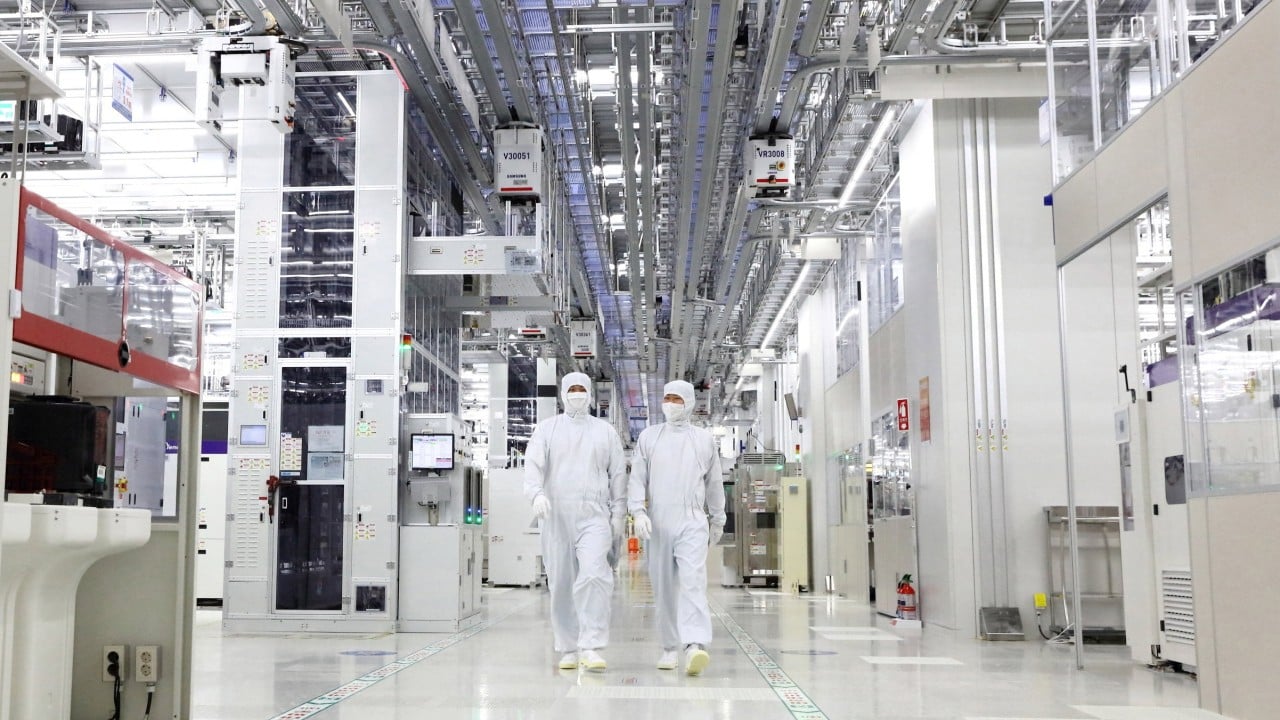
Building a semiconductor factory is fundamentally an exercise in securing reliable utility lines. A single advanced semiconductor fabrication facility consumes more electricity than entire mid-sized cities. While the southwestern region boasts an abundance of nominal power generation, mostly from localized green energy initiatives and older traditional plants, the transmission infrastructure required to move massive, high-load industrial currents smoothly to active production lines remains unbuilt.
Korea Electric Power Corp faces historic debt levels. The utility is ill-equipped to fund the massive sub-station networks and high-voltage direct current lines needed to stabilize a silicon cluster of this magnitude. If the power fluctuates for even a fraction of a second, entire production runs of high-bandwidth memory are instantly ruined.
The Water Supply Bottleneck
Electricity is only half the problem. Fabrication facilities require millions of gallons of ultra-pure water daily to clean silicon wafers between manufacturing steps. South Jeolla province has historically suffered from intense seasonal droughts, raising immediate questions about how Korea Water Resources Corp intends to guarantee an uninterrupted supply of water without sparking intense political pushback from local agricultural sectors. The administration insists that existing reservoirs can handle the load, but local environmental groups and farming cooperatives are already signaling resistance to industrial diversion.
Chasing the High Bandwidth Monopoly
The global hardware market remains utterly dependent on South Korean memory. Both Samsung and SK Hynix produce the high-bandwidth memory modules that power the world's leading artificial intelligence accelerators. Without these specific memory components, advanced computing clusters cannot operate.
The new $576 billion initiatives represent a preemptive defense mechanism. Competitors in the United States, Taiwan, and Japan are building their own heavily subsidized domestic supply chains. If South Korea fails to expand its physical footprint ahead of global demand, it risks losing its core leverage over the international hardware sector.
The risk of overcapacity looms large over this plan. Building multiple mega-clusters simultaneously assumes that the demand for physical artificial intelligence hardware will continue climbing exponentially for the next decade. If the enterprise software market fails to monetize software systems at scale, the underlying infrastructure market will contract sharply, leaving South Korea with hundreds of billions of dollars in specialized, empty concrete hulls.
Managing the Corporate Burden
While the state coordinates the zoning and infrastructure promises, the financial burden falls overwhelmingly on the private balance sheets of Samsung Electronics and SK Hynix. These corporations are being asked to bankroll the state's regional development goals at a time when global margins are tightening.
Company executives appeared alongside President Lee during the announcement, signaling alignment, but internal anxieties persist regarding worker relocation. Attracting elite engineering talent away from the cultural and educational hub of the Seoul metropolitan area to the southwestern provinces has historically proven nearly impossible for South Korean corporations. Elite software and hardware engineers routinely refuse placements outside Gyeonggi province. The state will have to offer unprecedented tax incentives and housing subsidies to prevent a severe brain drain within its own borders.
The success of the southwestern migration depends entirely on whether the government can deliver the promised utility infrastructure before the global hardware cycle peaks. Without immediate, heavy state funding for high-voltage transmission lines and dedicated industrial reservoirs, the $576 billion megaproject risks becoming an expensive monument to political ambition rather than a functional tech stronghold. South Korea has laid its chips on the table. Now it must build the grid to run them.