The dense canopy of the eastern Democratic Republic of Congo does not allow for silence. There is a constant, vibrating hum of cicadas, the sharp snap of distant branches, and the low rumble of trucks navigating roads that are more mud than asphalt. But to those who track killers for a living, the most terrifying sound in this vast forest is a single, wet cough.
When that cough belongs to someone hundreds of miles away from the known frontlines of an epidemic, the world changes in an instant.
Public health maps usually look neat. They feature bright red circles indicating the epicentre of an outbreak, fading into lighter shades of orange and yellow as the danger supposedly decreases. We comfort ourselves with these gradients. We look at the data and think we understand the boundaries of the threat. But viruses do not read maps, and they do not respect the lines drawn by cartographers or politicians.
Recently, a single case of Ebola was confirmed in a rebel-held territory of the Congo, far from where the medical teams had set up their primary grid. It was a statistical anomaly that shattered the comfortable illusion of containment. It proved, once again, that in the war against microscopic invaders, distance is a lie.
The Ghost in the Machine
To understand how a deadly pathogen slips through a war zone, look at a hypothetical merchant named Masika.
Masika does not care about geopolitical strategy. She cares about survival. She packs a woven basket with cassava root and charcoal, balances it on her head, and walks. She walks past government checkpoints where soldiers in mismatched fatigues demand a bribe. She walks across invisible borders into territory controlled by the Mai-Mai militia, or the Allied Democratic Forces, or any one of the dozens of rebel factions that carve up the eastern Congo like a spoils cake.
Movement is life for the people of the Kivus. If you stop moving, you do not eat.
Now, imagine Masika feels a sudden, crushing fatigue. Her joints ache. She attributes it to the weight of the charcoal. By the time she reaches a small, poorly equipped clinic in a clearing deep within rebel territory, she is burning with a fever. The nurse there has no electricity. He has no protective gear. He touches her brow with an unprotected hand.
This is how a localized crisis becomes a ghost in the machine of global health.
When the laboratory results finally trickled back from a distant facility, confirming Ebola, the realization set in like a sudden drop in barometric pressure. The patient was not near Beni or Butembo, the heavily monitored hubs of the response. They were out in the gray zone. The unreachable zone.
The challenge here is not scientific. We know how to fight Ebola. We have highly effective experimental vaccines and therapeutic treatments that can save lives if administered early. The real problem lies in the human geography of conflict.
Medicine at Gunpoint
It is easy to sit in a sterile office in Geneva or Washington and talk about rapid response deployment. It is an entirely different matter when the road to the patient is controlled by teenagers carrying rusty Kalashnikovs who view any outsider as a spy or an enemy combatant.
In rebel-held areas, distrust is the default setting. Decades of violence, exploitation, and broken promises have taught the local population that intervention usually comes with a body count. When white land cruisers arrive bearing workers in yellow biohazard suits that resemble space monsters, panic follows. Rumors spread faster than the virus itself. They are bringing the disease to kill us. They are harvesting our organs. The vaccine is a curse.
Consider what happens next when a medical team attempts a contact-tracing ring vaccination in this environment. They cannot just drive in. They must negotiate with local warlords. These negotiations take days, sometimes weeks. Every hour spent haggling over safe passage is an hour the virus uses to find another host.
Fear is a highly contagious emotion, and it paralyzes the very infrastructure needed to halt transmission. If a community hides its sick out of terror, the epidemic goes underground. It burns through families in the shadows of the jungle, invisible to the satellite dishes and data dashboards of the World Health Organization.
Outbreak Epicentre -----------------> Rebel-Held Territory (Far Field)
  [High Surveillance]                  [Zero Visibility]
  [Vaccine Hubs]                       [Active Conflict]
  [Controlled Area]                    [Suspicion & Rumors]
This is the hidden cost of geopolitical instability. A breakdown in governance is not just a political tragedy; it is a biological hazard. A virus thrives in chaos. It uses the cracks in human society to mutate, multiply, and migrate.
The Illusion of Elsewhere
There is a comforting psychological mechanism that allows the rest of the world to look at headlines from the Congo and turn the page. It is the concept of "elsewhere." We convince ourselves that what happens in a remote forest in Central Africa has no bearing on our modern, paved, air-conditioned lives.
That assumption is a luxury we can no longer afford.
The distance between that rebel-held clearing and a major international airport is not measured in thousands of miles. It is measured in the forty-eight hours it takes for a symptomatic traveler to board a motorbike, a bus, a domestic flight, and an international airliner. The global transportation network is an circulatory system, and a pathogen enters it like ink dropped into a glass of water.
[Remote Clinic] -> [Motorbike Taxi] -> [Regional Hub] -> [International Airport]
We often look at these health crises backward. We focus on the terminal point—the hospital isolation ward in London or New York—rather than the point of origin. We spend billions on defensive measures at our borders while underfunding the basic, everyday health systems in the places most vulnerable to emergence.
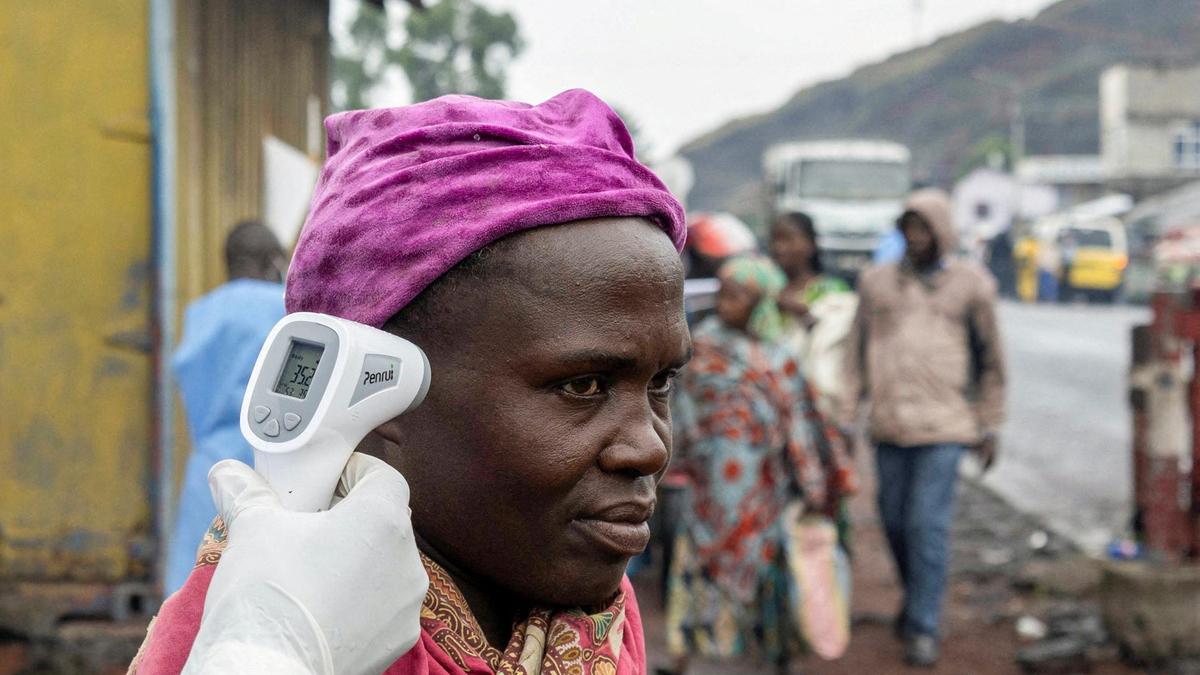
True security does not come from building higher walls; it comes from ensuring that the nurse in that remote, off-grid clinic has a pair of gloves, a reliable thermometer, and a way to communicate with the world before the fire spreads.
The Weight of the Unknown
The current situation in the Congo forces us to confront a terrifying vulnerability. We do not know how many other cases are currently incubating in villages where no Western journalist or health worker dares to travel. The confirmed case is a warning shot. It is a flare fired into the night sky, illuminating a landscape of vast, unmapped risk.
The response workers who lace up their boots every morning in the Congo face a dual threat. They are dodging bullets while tracking a virus. They are dealing with communities that are deeply traumatized by war, trying to convince them that a needle injection is an act of mercy rather than malice. It requires a level of courage that rarely makes it into the statistical briefs.
We are left waiting for the next data point, hoping the ring of vaccination holds, yet knowing the odds are stacked against us in the brush. The jungle is vast, the roads are broken, and the human networks that crisscross the conflict zones are too complex to ever fully police or predict.
Somewhere tonight, under a corrugated tin roof slick with tropical rain, someone is feeling the first sharp pangs of a fever. They are looking out into the dark, deciding whether to stay hidden or to seek help from a world they do not trust. The future of the outbreak hangs entirely on that choice.