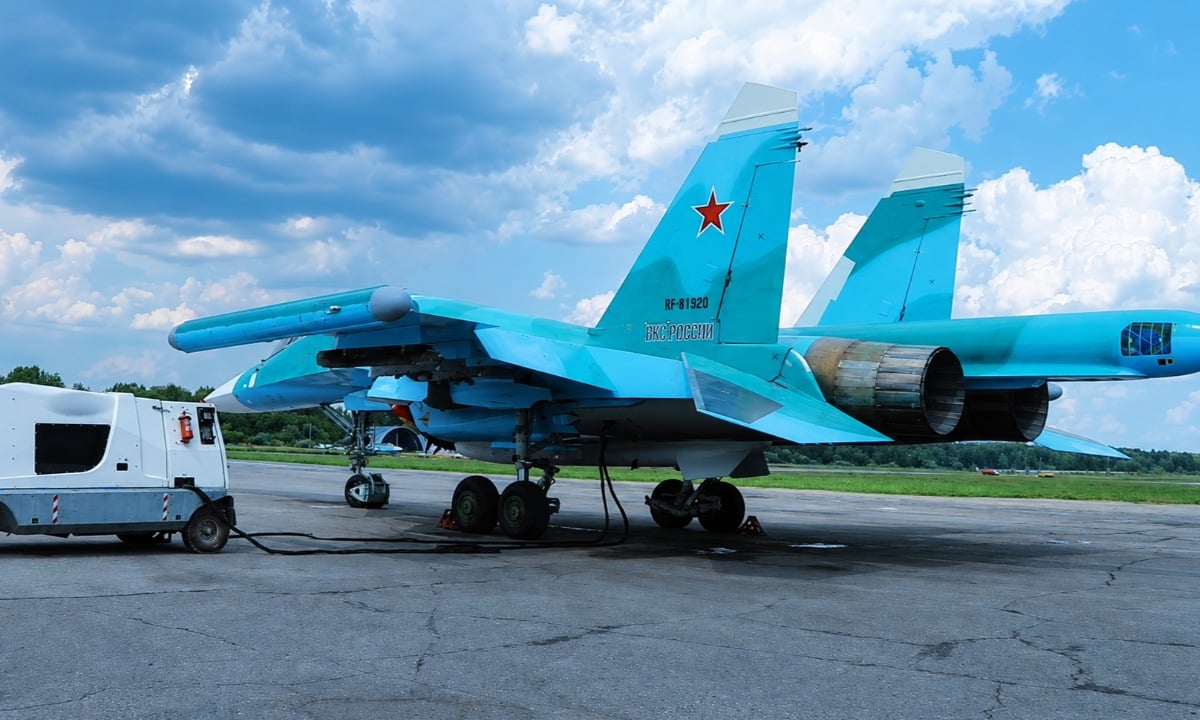
The floor of the aviation plant in Novosibirsk smells of coolant, ionized metal, and industrial lacquer. It is a sterile, echoing vastness where the state’s grandest ambitions are riveted together by hand. Workers in pristine blue coveralls move along the flanks of a freshly minted Sukhoi Su-34 fighter-bomber. Its zinc-chromate primer glows a ghostly, iridescent green before the final coat of dark gray paint is sprayed on. To the casual observer, or to the television cameras filming a carefully staged segment for state news, this looks like the absolute apex of industrial might.
It looks like victory.
But look closer at the hands holding the pneumatic riveting guns. Notice the slight tremor in the forearm of a twenty-four-year-old machinist named Kirill—a hypothetical composite of the young technical school graduates now working triple shifts under wartime mobilization laws. Kirill knows the math. He understands that the sleek, multi-million-dollar airframe he is polishing today is not an expansion of empire. It is a replacement. It is a bandage applied to a hemorrhaging artery.
Outside the high arched windows of the assembly bay, the bitter Siberian air blows across tarmac where another batch of combat aircraft is being prepped for flyaway delivery to the Russian Aerospace Forces. The official press releases from the United Aircraft Corporation will trumpet this delivery with grand nouns and soaring verbs. They will talk of modern capabilities and industrial resilience. What they will not mention are the columns of black smoke rising over the fields of the Donbas, or the empty lockers at airbases in Voronezh and Morozovsk.
The reality of modern air warfare is a brutal exercise in accounting, and right now, the ledger is written in red.
The Illusion of the Assembly Line
When a nation goes to war, its factories become a secular church. Workers are told that every bolt tightened is a blow against the enemy. For months, the Kremlin has pushed its defense industrial base into overdrive, running factories twenty-four hours a day, seven days a week. The recent delivery of new Su-34 and Su-35S jets is meant to project an image of an unstoppable machine, an economy that can swallow Western sanctions and still spit out advanced twin-engine warplanes.
It is a masterful illusion.
To understand why, we have to look past the shiny fuselages and look at the rates of attrition. Since the escalation of the conflict in Ukraine, Russia has lost a significant portion of its pre-war fleet of modern fighter-bombers. These are not old Soviet relics dragged out of deep storage in Siberia; these are the frontline workhorses of the air campaign. Every time an Su-34 drops a glide bomb from forty miles away, it risks venturing into the radar envelope of a Western-supplied air defense system. Sometimes, the sky lights up. Sometimes, the jet does not come back.
Consider the physical reality of replacing a shot-down jet. A modern fighter is not a T-90 tank. You cannot simply stamp out the steel hulls, drop in an engine, and send it to the front lines with a crew that received three weeks of training. A combat aircraft is an incredibly fragile ecosystem of components. It requires specialized titanium alloys, thousands of miles of wiring, and advanced radar arrays that depend on microelectronics.
When a factory delivers a batch of two or three new jets, state media celebrates as if an entire armada has been reborn. But if that same military lost four jets the previous month to surface-to-air missiles and friendly fire incidents, the math remains stubbornly negative. The assembly line is running as fast as it can, yet it is merely walking backward at a slightly slower pace.
The Invisible Attrition
The loss of metal is only half the crisis. The more terrifying deficit is measured in flesh, bone, and years of spent adrenaline.
Let us look at another perspective, that of an experienced pilot we will call Maxim. Maxim has spent fifteen years in the cockpit. He survived the gray zone operations in Syria, logged thousands of hours of flight time, and knows exactly how his aircraft will behave when pulling seven Gs while low on fuel. He possesses what pilots call "the feel"—that instinctive, muscle-memory understanding of the fine line between aerodynamic performance and catastrophe.
When Maxim’s jet is torn apart by an exploding warhead over an anonymous Ukrainian village, Russia does not just lose an airframe that cost thirty-five million dollars to build. It loses those fifteen years of irreplaceable intuition.
The Kremlin can build a new Su-35 in a matter of months if they cannibalize enough civilian airliners for parts and smuggle in enough microchips through third-party intermediaries. They cannot build a new Maxim in months. It takes a decade to forge a competent flight leader. It requires thousands of tons of expensive aviation fuel, access to sophisticated flight simulators, and years of peacetime training that a nation at war simply cannot afford to provide.
What happens instead? The replacement jets rolling off the Novosibirsk line are increasingly handed over to younger, less experienced crews. These are boys accelerated through the academy, their heads filled with theory but their hands unaccustomed to the terrifying chaos of active electronic warfare environments. They are flying advanced machines, but they lack the tactical wisdom to survive them.
This creates a vicious, self-reinforcing loop. Inexperienced pilots make mistakes. They fly into known air defense sectors, they fail to recognize radar warning receiver tones, and they mismanage their fuel. Consequently, more jets are lost. The factories must work harder. The training pipelines must be squeezed tighter. The quality of both the machine and the man deteriorates, hidden beneath the gloss of a fresh coat of military-grade paint.
The Ghost in the Silicon
The struggle to keep these aircraft flying exposes a profound vulnerability within the Russian industrial architecture. For decades, the global defense sector believed that Russian aviation was entirely self-reliant, a proud legacy of the Sukhoi and Mikoyan design bureaus. But the modern sky demands digital eyes and brains.
Every new jet delivered to the frontline forces contains an uncomfortable truth: it is haunted by Western technology.
Despite sweeping sanctions meant to choke off the supply of dual-use technology, components from American, European, and Taiwanese manufacturers continue to find their way into Russian military hardware. They arrive in cardboard boxes through a labyrinthine network of shell companies in Central Asia, the Middle East, and East Asia. A chip designed for an automated agricultural drone or a high-end medical imaging device is carefully extracted and soldered onto the circuit board of a Russian navigation system.
But this black-market supply chain is fragile, erratic, and ruinously expensive.
Imagine running a factory where you cannot guarantee that the microchips arriving next Tuesday will match the blueprints on your assembly floor. The engineers are forced to constantly improvise, adapting yesterday’s software to run on whatever smuggled silicon they managed to secure this week. This is not precision manufacturing. It is high-tech scavenging.
This introduces a terrifying element of unreliability into these new aircraft. A radar system might suffer from intermittent power surges because a voltage regulator had to be swapped for an unapproved commercial equivalent. A heads-up display might flicker when the cockpit temperature drops below freezing. On paper, the military has received a new combat jet. In reality, they have received a ticking logistical time bomb, an aircraft whose true reliability is entirely untested until it faces the ultimate stress of combat.
The Weight of the Glide Bomb
The desperation to get these new jets into the air is driven by a shift in Russian battlefield doctrine. The air force has abandoned the romantic, dangerous notions of deep-penetration air superiority. They no longer try to sweep the skies of enemy fighters in sweeping dogfights.
Instead, they have become an airborne artillery arm.
The primary mission of the Su-34 fleet now centers on the deployment of UMPK glide bomb kits. These are crude, heavy Soviet-era iron bombs fitted with pop-out wings and basic satellite guidance modules. They are cheap, devastatingly destructive, and can be launched from dozens of miles away, well outside the range of short-range Ukrainian air defenses. They smash through concrete bunkers, obliterate defensive trenches, and level entire city blocks ahead of infantry advances.
It is an effective tactic, but it places an immense, agonizing strain on the airframes.
An aircraft designed for high-altitude interception is instead being forced to haul massive, un-aerodynamic three-ton payloads at low altitudes to avoid long-range radar detection, before performing a steep climb to release the bombs. This violent cycle of low-altitude buffering and high-stress climbing rapidly fatigues the metal structure of the wings and fuselage. The lifespan of these aircraft is being consumed at three or four times the normal peacetime rate.
The new jets rolling off the line are not arriving to reinforce an existing fleet; they are arriving to replace aircraft that are literally shaking themselves to pieces from overuse. It is a race against structural failure, conducted in a sky where a single miscalculation means an encounter with a Patriot battery.
The state media broadcasts will continue to show the handshakes, the official handovers, and the pristine cockpits of the new Sukhois. The generals will smile, their chests heavy with medals, and speak of an industry that cannot be broken.
But back in Novosibirsk, as the shift changes and the factory doors open to let in the freezing night, the workers leave in silence. They look at the empty berths where the finished jets stood only hours before, knowing that those planes are already flying westward toward a horizon that swallows them whole. The factory fire burns bright, but it is burning the future to pay for the survival of the day.