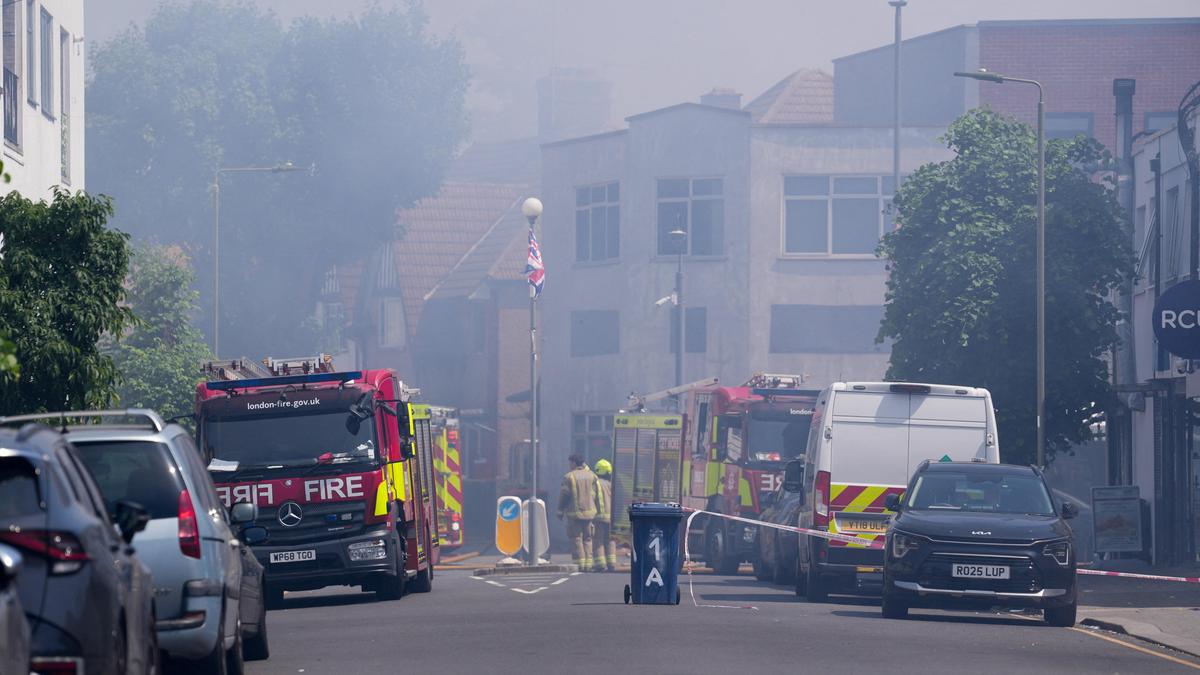
The smell of charred wood does not fade quickly. It hangs in the damp London air, clinging to bricks, weaving through the fabric of winter coats, and settling deep into the back of the throat. For the residents of Golders Green, that acrid scent became an unwanted neighbor on a quiet Tuesday morning.
Sirens are not uncommon in North London. But when four fire engines rushed toward Hamilton Road just after 6:00 AM, the sound carried a different weight. It felt heavy. It felt familiar.
By the time the London Fire Brigade arrived, flames were tearing through a ground-floor kosher bakery and grocery shop. A flat sits directly above the business. Firefighters, battling the blaze for nearly an hour, managed to rescue two people from the first floor using a ladder. They were treated at the scene for smoke inhalation. The shop itself was gutted. Its windows were shattered, and its interior turned to ash.
In any other part of the city, a standard news brief would sum it up: a structural fire, a swift emergency response, thankfully no fatalities. But context changes everything. Location changes everything.
The Weight of a Postcode
Golders Green is the beating heart of London’s Jewish community. It is a neighborhood built on tradition, where generations of families have walked the same pavements, bought their Friday night challah from the same bakeries, and built a sanctuary of culture and faith.
To understand why a broken window or a plume of smoke here causes a collective intake of breath, you have to understand the invisible tension that has blanketed the area for months. This isn't an isolated incident in the minds of the people who live here. It sits against a backdrop of anxiety.
Consider the geography of fear. Just months prior to this blaze, a kosher restaurant on the very same high street was vandalized. Its windows were smashed; its cash register stolen. Around the same time, nearby Jewish schools were forced to temporarily close their gates, advising parents that it was safer for children to stay home. Incidents of antisemitic hate speech and vandalism had spiked across the capital, leaving a community on high alert.
When a kosher shop goes up in flames in an area already bruising from targeted incidents, the mind does not naturally jump to an electrical fault. It jumps to the worst-case scenario.
The Mechanics of the Investigation
The London Fire Brigade and the Metropolitan Police launched a joint investigation before the embers were completely cool. For hours, speculation rippled through WhatsApp groups and local synagogues. Was this the escalation everyone had quietly dreaded?
Then came the official statement. The Metropolitan Police announced that, following initial assessments, the fire was not being treated as suspicious.
To the casual observer, that phrase—not treated as suspicious—is a relief. It means a sigh of relief. It means a faulty toaster, an overheated compressor, or a stray spark. It means the world is slightly less malicious than it appeared at dawn.
But for a community living under the shadow of persistent threats, that bureaucratic language can feel jarring. It creates a strange cognitive dissonance. How can an event not be suspicious when the very ground it occurred on feels vulnerable?
Fire investigators look at reality through a lens of cold physics. They trace the V-patterns of burn marks on walls. They analyze the point of origin. They look for accelerants like petrol or kerosene. They check electrical mains and appliance switches. If the science says the fire started inside a sealed unit without human intervention, the case transitions from a criminal inquiry to a commercial tragedy.
The police must rely strictly on that evidence. They cannot investigate based on atmosphere alone. Yet, the atmosphere remains.
The Human Cost of a False Alarm
Imagine standing on the pavement, watching the flashing blue lights reflect in the puddles of a grey London morning. You own a shop three doors down. You sell books, or clothes, or kosher meat. You see the melted plastic signage of your neighbor's store.
Even when the authorities tell you it was an accident, the adrenaline does not simply vanish. The heart rate does not instantly drop back to normal. The factual truth of a faulty wire does not erase the psychological reality of vulnerability.
This is the hidden tax of living in an arson-hit or high-tension area. Every accident is viewed through the lens of intent. A car backfiring sounds like something else. A late-night knock on the door carries a brief flash of dread. A fire is never just a fire.
The kosher bakery was more than a commercial enterprise. In neighborhoods like Golders Green, these shops are community hubs. They are places where neighbors exchange pleasantries, where the rhythm of the week is measured in grocery shopping for the Sabbath. When one disappears, even temporarily, it leaves a physical gap in the streetscape and a psychological dent in the community's sense of security.
Bridging the Divide
The emergency services did their job with textbook efficiency. Thirty firefighters prevented the blaze from consuming the entire block. The police communicated their findings swiftly to prevent panic from spiraling into false rumors. This is how a city functions at its best during a crisis.
But the healing of a neighborhood requires a different kind of work. It requires an acknowledgment that logic and emotion often run on parallel tracks.
The residents of Golders Green will continue to buy their bread, walk their children to school, and gather in their synagogues. Resilience is woven into the very fabric of this community. They have looked after one another through decades of shifting cultural tides and varying levels of threat. They will look after the owners of the ruined shop, too.
As the police tape is taken down and the charred debris is cleared into skips, the high street will slowly return to its usual bustle. The smell of smoke will eventually be replaced by the familiar scents of fresh baking and coffee.
But for a long time, as darkness falls over North London, shopkeepers will double-check their locks, look twice at unfamiliar cars, and look up at the sky, watching for the first sign of grey against the black.


