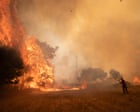
The air in the valley does not taste like air anymore. It tastes like old bone ash and charred resin, a heavy, metallic coat that clings to the back of your throat long after the sun has gone down.
For ten years, I have watched the Iberian frontier burn. Not on a screen, wrapped in the comforting blue light of a monitor, but through a kitchen window that rattles against a dry, scouring wind. Ten years of watching green turn to gray in a matter of hours. Ten years of listening to the frantic, rising pitch of water-bombers cutting low over the cork oak groves, their bellies heavy with the last defense of a dying landscape.
We used to call them seasons. Summer, autumn, winter, spring. A neat little wheel of predictability passed down through generations of farmers who knew precisely when to turn the soil and when to prune the vines. That wheel is broken. Now, there is only the waiting, and the burning, and the quiet, terrible realization that what we are witnessing is not a series of unfortunate anomalies. It is a new baseline.
Look closely at the soil beneath your boots. If you are standing anywhere near the Mediterranean basin, that dirt is baking. It is powder.
(Note: While this narrative reflects personal observation of the region, it aligns directly with data from the Copernicus Climate Change Service, which has recorded successive record-breaking temperature spikes across southern Europe over the past decade.)
The Anatomy of a Slow Disaster
Dryness is a thief. It steals the moisture from the topsoil first, then it reaches down into the roots of ancient olive trees that have stood for centuries, watching empires rise and fall, only to wither in a single brutal July.
Mateo knows the thief well. Mateo is not his real name, but he is every viticulturist whose hands I have shaken—hands cracked and stained purple by decades of harvest. I met him in August, when the shade temperature hovered stubbornly near forty-three degrees Celsius.
"The grapes are cooking on the vine," he told me, holding up a shriveled cluster that looked more like raisins than the promise of a robust vintage. "They aren't even fermenting properly anymore. The sugar content spikes before the acidity can catch up. We are harvesting a month earlier than my grandfather did. And every year, that month creeps backward."
He wasn't angry. That is the most haunting part of it. There is a profound, exhausted resignation that settles over people who live on the frontline of ecological collapse. Anger requires energy, and energy is conserved for hauling water tanks and clearing brush lines.
When people ask me what the climate emergency looks like, they expect dramatic movie scenes. Raging walls of fire consuming entire cities. Apocalyptic floods washing away highways. And yes, those happen. But the true face of the emergency is much quieter. It is the sound of a well running dry in the middle of spring. It is the sudden silence of a forest where the birds have fled or perished. It is the slow, agonizing contraction of a way of life that can no longer sustain the weight of the sky above it.
The Invisible Stakes
Why should anyone care about a dry valley in Spain or Portugal if they live thousands of miles away, tucked safely into a concrete high-rise or a temperate northern suburb?
Because borders are an illusion written on paper, and climate respects no jurisdiction.
Consider what happens next: when the olive harvest fails in Andalusia, the price of oil spikes in London, New York, and Tokyo. When the aquifers beneath the Iberian plains drop below the pumping threshold, agricultural export volumes plummet, rippling through global supply chains that feed millions. The food on your plate is tethered by an invisible thread to the health of the soil in southern Europe.
We live in an interconnected web of consequences. Pull one string in the Mediterranean, and the whole apparatus shivers.
For a long time, denial was easy. It was comforting to view these extreme weather events as statistical outliers. A bad summer. A dry spell. Nature clearing her throat. But when a decade becomes one continuous upward tick on the thermometer, denial ceases to be an opinion. It becomes a luxury no one can afford.
I remember the summer of 2017. The fires raced across the hills behind my house with a terrifying, locomotive roar. The sky turned the color of bruised plums at noon. Streetlights flickered on at midday because the smoke had blotted out the sun entirely. Evacuation orders came crackling over the radio in rapid, clipped Spanish.
Packing a life into a single suitcase in twenty minutes teaches you something vital about human vanity. You do not grab the television. You do not grab the heirlooms or the books. You grab your passport, a box of old photographs, and your dog. Everything else is just fuel for the beast.
We survived that fire. The house remained, miraculously spared by a sudden shift in the wind that felt less like luck and more like a stay of execution. But the hills behind us were transformed into a lunar landscape of black sticks and ash.
It took three years for the first stubborn shoots of green to punch through that charcoal crust. Three years of silence. No cicadas. No rustling leaves. Just the sound of rain washing naked topsoil down into choked gullies.
Confronting the Mirror
We are standing at a historic crossroads, though we prefer to look down at our phones rather than up at the horizon.
The science is no longer a matter of debate among those who study the mechanics of our atmosphere; it is an accounting ledger of loss. Every fraction of a degree in global temperature rise adds another layer of stress to ecosystems that are already operating at their absolute limits.
Yet, the conversation often gets bogged down in political posturing and abstract targets. We talk about net-zero deadlines decades away as if the atmosphere is reading a calendar and pacing itself. The atmosphere does not care about our political cycles. It responds only to physics. And the physics are unforgiving.
When you spend ten years watching the landscape unravel, you realize that the hardest thing to change is not our energy infrastructure, as monumental a task as that is. The hardest thing to change is our imagination. We are remarkably good at normalizing catastrophe. We adapt. We buy air conditioning units. We drill deeper wells. We build higher sea walls. We treat the symptoms while ignoring the sickness, normalizing the smell of smoke in July until it just becomes part of summer.
We must stop adapting to the destruction and start confronting the source.
The frontline is no longer an isolated geographic zone on the edge of Europe. The frontline is everywhere. It is in the water bill that doubles in a suburban home. It is in the insurance policies that are quietly canceled in fire-prone regions. It is in the quiet dread parents feel when they look at their children and wonder what kind of world will greet them in their middle age.
The wind is picking up again outside my window. The air has that familiar, dry edge to it. Down in the valley, the leaves on the olive trees are turning their silver undersides up to the merciless blue sky, trembling in anticipation of a storm that will likely never come.
The ash is still warm.


