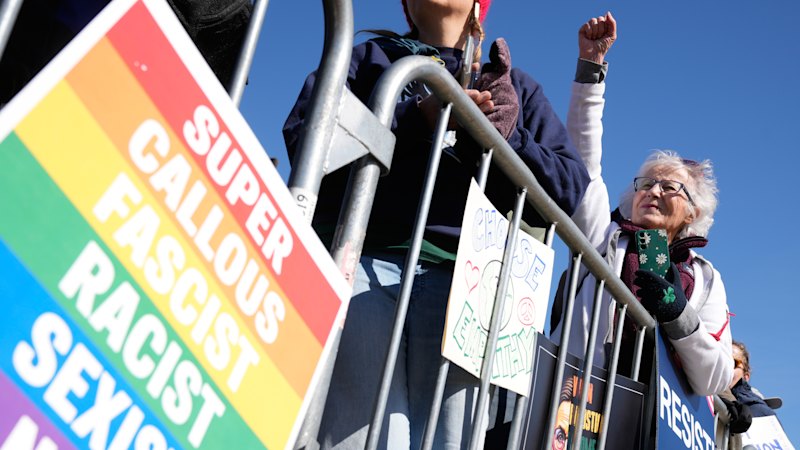
The national media loves a David and Goliath story. They especially love it when David is wearing a Carhartt jacket in a West Virginia hollow and Goliath is a populist president they despise. You’ve seen the headlines. They claim a "groundswell" of resistance is bubbling up in the Appalachian heartland. They point to twenty people holding cardboard signs outside a courthouse in a town of two thousand as proof that the political tectonic plates are shifting.
It is a lie. Not a malicious conspiracy, but a professional delusion.
The "resistance in the hills" trope is a product of urban journalists visiting a rural coffee shop, finding the one person with a Master’s degree who moved back from Brooklyn, and treating their opinion as a representative data point. I’ve sat in these editorial rooms. I’ve seen how the "rural resistance" pitch gets greenlit because it satisfies a desperate need for the coastal elite to believe their worldview is finally "trickling down" to the masses.
In reality, these rallies aren't a sign of Trump’s fading grip. They are a sign of his absolute dominance. When you look at the actual mechanics of political power in the American interior, these protests are the equivalent of throwing pebbles at a tank.
The Math of Performative Dissent
Let’s talk about the cold, hard numbers. In most of these "rallying" counties, the margin of victory in the last two cycles wasn't just wide; it was a chasm. We are talking about 70-30 or 80-20 splits. When a media outlet reports that "hundreds" gathered in a West Virginia town to protest, they are usually inflating the count by including the curious onlookers and the counter-protesters across the street.
Even if we take their numbers at face value, what does a rally of 300 people in a county of 40,000 actually signify?
It signifies a statistical outlier.
Politically, these events are high-fives for the converted. They don't flip votes. They don't change local council priorities. They certainly don't signal a "turning point." In the industry, we call this Confirmation Bias Journalism. The reporter has a thesis—"Trump is losing the working class"—and they will drive eight hours into the mountains to find the three people who support that thesis, ignoring the 5,000 people at the high school football game who think the protesters are performing for the cameras.
The Rural-Urban Feedback Loop
The mistake the "Resistance" makes is assuming that visibility equals influence. In a small town, visibility often equals social suicide.
I’ve interviewed local organizers who admit—off the record, always—that their "rallies" are less about political persuasion and more about personal therapy. They feel isolated. They want to know they aren't alone. That’s human. That’s valid. But it isn't a political movement. It’s a support group.
The media’s insistence on framing these small gatherings as "rallies against Trump" ignores the actual power structure of these regions. In West Virginia, the power isn't in the town square. It’s in the energy sector, the local chambers of commerce, and the church basements. None of those institutions are "rallying." They are doubling down on the status quo because, from their perspective, the populist movement hasn't failed them—the people criticizing it have.
The Myth of the "Converted" Voter
There is a recurring character in these articles: The Reformed Trump Voter.
This person is the Holy Grail for political journalists. They usually start the interview with, "I voted for him in 2016, but..."
Here’s the truth about the Reformed Voter: They are almost always a fiction of convenience. Quantitative data from firms like Echelon Insights or the Pew Research Center consistently shows that the "flip" rate is remarkably low. Most people who abandon a candidate don't switch to the opposition; they just stop showing up. They become "disengaged."
But "Man Stays Home and Watches Netflix" isn't a compelling headline. "West Virginia Coal Miner Joins the Resistance" is.
So the media elevates the 1% of the population that has changed their mind and ignores the 99% who have dug their heels in deeper. This creates a dangerous feedback loop where policymakers in D.C. start believing their own press releases. They think they are winning over the "moderate middle" in the Rust Belt, only to be blindsided on election night when the "silent majority" turns out to be exactly as loud and as loyal as they were four years ago.
Cultural Aesthetic vs. Political Reality
One of the most annoying aspects of this "small town rally" narrative is the focus on aesthetics. The articles always mention the setting: "Amidst the rusted skeletons of old mills" or "Under the shadow of the Appalachian peaks."
This is "poverty porn" mixed with political wish-fulfillment.
The media treats rural Americans like a lost tribe they are trying to communicate with. They think that if they find a few people who speak the "language" of the resistance while wearing flannel, it proves the message is universal.
It’s not.
Politics in 2026 isn't about policy; it’s about identity. A rally in a small town doesn't change the identity of that town. If anything, a vocal, media-hyped protest often triggers a "defensive crouch" reaction from the rest of the community. When a town sees itself portrayed in the New York Times as "finally waking up," the actual residents don't feel enlightened. They feel insulted. They see a circus that came to town for a weekend to make the locals look like they’ve finally learned their lesson.
The Logic of the Counter-Rally
If you want to know where the energy actually is, look at the counter-protests. They are rarely covered with the same "courageous" framing, but they are often larger, louder, and more representative of the local tax base.
In these small-town skirmishes, the "resistance" is often composed of retirees, transplants from other states, or the local academic fringe. The "opposition" is the working-age population, the small business owners, and the people who actually drive the local economy.
By prioritizing the "Resistance" narrative, the media misses the real story: the deepening of the trench. The two sides aren't talking to each other. They aren't even at the same rally. They are living in two different versions of West Virginia, and only one of those versions has the numbers to win an election.
Stop Looking for a "Shift" and Start Looking at the Floor
The baseline support for Trump in these areas is not a ceiling; it’s a floor.
It doesn't matter how many rallies the opposition holds. It doesn't matter how many "enlightened" op-eds are written by people who haven't spent a night in a trailer park. The political alignment of the American interior is a structural reality, not a temporary mood.
The "Resistance" narrative is a security blanket for people who can't handle the fact that a large portion of the country fundamentally disagrees with them on every level. They search for "cracks in the base" because the alternative—that the base is a solid, impenetrable block of granite—is too terrifying to contemplate.
I’ve watched campaigns blow tens of millions of dollars trying to "outreach" to these areas based on the false hope provided by these media stories. They hire "rural consultants" who tell them exactly what they want to hear: "If you just show up and talk about healthcare, the Trump voters will come over."
They don't. They won't.
Healthcare, infrastructure, and economics are secondary to the primary driver of modern politics: Social Spite. When you celebrate a small-town rally as a "victory," you are engaging in a form of cultural condescension that only strengthens the resolve of the people you are trying to defeat.
The Professional Dissent Class
We also need to address the "Professional Protester" element. In 2026, protesting is a hobby for the upper-middle class.
The people at these rallies in West Virginia often have the luxury of time. They are the ones who can afford to stand on a corner for four hours on a Tuesday. The people who actually decide the fate of the state are at work. They are in the mines, they are in the trucks, they are in the warehouses.
When the media focuses on the rally, they are focusing on the leisure class of the left. They are ignoring the labor class of the right. This is the ultimate irony of the "Small Town Resistance" story: it is a story about the working class, told by the elite, featuring the only three people in town who don't have to punch a clock.
The Danger of the False Positive
The reason this matters—the reason I’m being so "cynical," as my colleagues would say—is that false positives are more dangerous than no information at all.
If the opposition believes they are making inroads in West Virginia because of a few rallies, they will misallocate resources. They will skip the hard work of organizing in the suburbs where they actually have a chance, and instead chase the ghost of a "Rural Realignment" that isn't coming.
The "millions of Americans" rallying against Trump isn't a movement. It's a demographic footprint that hasn't moved an inch. If you want to change the country, stop reading feel-good stories about "Resistance in the Hills." Stop looking for signs of a "thaw" in the heartland.
The heartland isn't thawing. It’s freezing over.
Every time a national outlet shines a spotlight on a tiny protest in a sea of red, they aren't documenting a change; they are inciting a reaction. They are giving the local majority a reason to show up and vote even harder, just to prove the "outsiders" wrong.
The resistance in small-town West Virginia isn't the start of a revolution. It’s the final, fading signal of a political culture that has already been evicted from the premises.
If you're still waiting for the "Great Pivot," you aren't paying attention to the math. You're paying attention to the cardboard.
The cardboard is cheap. The votes are expensive. And right now, the opposition is bankrupt.
Stop looking for David. Goliath didn't just win; he bought the valley, the mountain, and the local newspaper that's currently telling you he's in trouble.