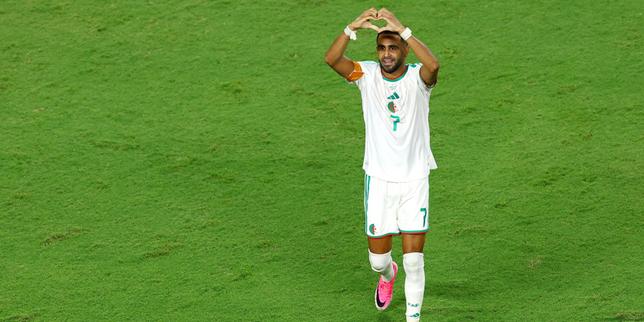
The wind in the northern suburbs of Paris does not care about your dreams. In Sarcelles, a commune defined by concrete blocks and grid-like public housing, the winter air bites through cheap tracksuits and numbs the ankles. On the asphalt pitches of the AAS Sarcelles sports complex, a frail boy with spindly legs and an oversized shirt used to stay out long after the streetlights flickered to life.
His name was Riyad Mahrez.
Every coach who watched him agreed on two things. First, the boy possessed a left foot that could make a football do impossible things. Second, he would never make it as a professional. He was simply too thin. In a footballing ecosystem increasingly obsessed with power, biological metrics, and muscular supremacy, Mahrez looked like a gust of wind could blow him into the next department. He was an anomaly. An afterthought.
But football scouting is a flawed science because it measures the muscle and misses the marrow. It looks at the chest expansion and completely overlooks the stubbornness of the human heart.
The Sound of the Train in the Distance
To understand the trajectory of a man who would eventually lift the Premier League trophy against 5,000-to-1 odds, you have to understand the specific weight of grief.
When Riyad was fifteen, his world fractured. His father, Ahmed, was his anchor. Ahmed was the one who accompanied him to every match, the one who gave him the quiet confidence to ignore the critics who called him too fragile. Then, suddenly, Ahmed’s heart failed.
Grief does strange things to a teenager. For some, it is a paralyzing weight. For Mahrez, it became a silent, obsessive engine. Think about the sheer psychological fortitude required to sit in a small bedroom in a Parisian suburb, looking at your own gaunt reflection, knowing your biggest supporter is gone, and deciding that failure is no longer an option.
He didn't get faster or heavier overnight. He just became entirely immune to the word "no."
Consider the reality of the French academy system. It is a well-oiled machine that selects elite athletes at age twelve or thirteen, placing them in state-of-the-art facilities like Clairefontaine. Mahrez never got that golden ticket. He was left behind in the amateur leagues, playing on rough surfaces where tackles were delivered with the explicit intent to hurt. He was nineteen and still playing in the seventh tier of French football for his hometown club. By that age, future superstars are already making their Champions League debuts.
He was running out of time.
Then came Quimper. It was a semi-professional club in the isolated, rain-swept region of Brittany. The contract offered almost nothing. The accommodation was a shared, cramped apartment with other triallists who were equally desperate. He lived on a diet of cheap pasta and raw ambition.
Mathias Pogba, who shared that tiny apartment with him, later recalled that Mahrez was convinced he was going to the top. Not hoping. Not wishing. Knowing. When you have nothing but a mattress and a bag of football boots, that kind of certainty looks like madness to the outside world. It looks like a defense mechanism.
But it was strategy.
The Geography of Disbelief
In 2010, the second-division French club Le Havre took a gamble on him. Even then, they placed him in their reserve team. They looked at his frame and hesitated. The technical staff wanted him to bulk up, to spend hours in the gym lifting iron. Mahrez resisted. He knew that his survival on the pitch depended on his agility, his ability to drop his shoulder and leave a defender tracking a ghost. If he gained ten kilograms of muscle, he would lose the very deception that made him dangerous.
It was a masterclass in self-knowledge.
The turning point came when a scout from England showed up at a rain-sodden stadium in Normandy. Steve Walsh, the man responsible for finding hidden gems for Leicester City, had actually gone to watch a different player. Instead, he kept seeing a skinny winger who didn't care that he was playing in front of a few hundred people.
When Leicester approached Mahrez in January 2014, his friends and family told him not to go.
The English Championship was notorious. It was a brutal, physical league where referees looked the other way during bone-crunching tackles. It was a place where giant defenders ate creative wingers for breakfast. Furthermore, Mahrez had no idea where Leicester even was. He honestly thought they were a rugby club.
He signed anyway.
The transition was not a fairy tale. It was an assault on the senses. Imagine stepping onto a pitch in the English Midlands on a Tuesday night in February, the rain driving sideways, facing a six-foot-four defender whose sole objective is to deposit you into the advertising hoardings.
Mahrez didn't shrink. He leaned into the chaos.
He developed a signature move that every defender in England knew was coming, yet none could stop. He would sprint down the right flank, slow down to a dead stop, look the defender in the eye, feint to go outside, and then suddenly chop the ball back inside onto his left foot. It was a dance step honed on the concrete of Sarcelles, transported to the immaculate grass of the King Power Stadium.
The Year the World Broke
What happened in the 2015-2016 season remains the most illogical event in modern sports history.
Leicester City, a team assembled for less money than their rivals spent on a single substitute, began to win. Then they kept winning. At the center of this sporting miracle was the boy who had been deemed too small for French football.
Mahrez was no longer just surviving the physicality of the Premier League; he was dictating its terms. He scored seventeen goals. He provided eleven assists. He won the PFA Players' Player of the Year award, becoming the first African footballer to ever receive the honor.
But the statistics do not capture the actual feeling of watching him that year. It was the sheer audacity of his play. In a multi-billion-dollar industry governed by fear and rigid tactical systems, Mahrez played with the joy of a kid who had just sneaked onto a pitch after hours. He played with a swagger that bordered on arrogance, but it was an arrogance earned through years of isolation and rejection.
When he moved to Manchester City in 2018 for a then-club-record fee, the skeptics returned. They said he would be a luxury player in Pep Guardiola’s hyper-regimented system. They said he would spend his prime years sitting on a luxurious bench.
They forgot that Mahrez had already spent his youth on much worse benches.
He adapted. He learned to track back. He learned the complex geometry of Guardiola’s positional play. He became a vital cog in a machine that won four Premier League titles, culminating in a historic treble. He didn't lose his identity; he merely refined it.
The Weight of the Green Shirt
Yet, for all his success in England, the true measure of Mahrez’s emotional core lies across the Mediterranean.
Born in France, he chose to represent Algeria, the homeland of his parents. It was a choice of the heart, made long before he was a global superstar. To play for Algeria is to carry the intense, sometimes suffocating passions of forty-five million people. It is an environment where football is not entertainment; it is national identity.
In 2019, Mahrez captained the desert foxes at the Africa Cup of Nations in Egypt. They reached the semi-final against Nigeria. The match was locked at 1-1. The clock showed ninety-four minutes. A free kick was awarded just outside the penalty box.
The entire nation held its breath.
Mahrez stood over the ball. He looked calm, almost detached. It was the same expression he wore on the concrete pitches of Sarcelles when the bigger boys tried to intimidate him. He took a short run-up and struck the ball with his left foot. It bypassed the wall and flew into the top corner of the net.
The stadium erupted. Back in Algiers, the streets turned into a sea of green and white flares. In Paris, the sub-divisions celebrated. It was the definitive moment of his career, a strike that propelled Algeria to their first continental title in twenty-nine years.
He had gone from the skinny kid nobody wanted to the captain who delivered an entire nation’s joy.
The Lesson of the Unseen Mile
Today, the journey of Riyad Mahrez is often sanitized into a clean, motivational narrative. People look at the trophies, the millions of euros, the Champions League medals, and they assume it was an inevitable ascent of a gifted prodigy.
It wasn't.
His career was a series of closed doors that he had to kick open with a fractured shin and a light frame. His story is a warning to every coach, every talent scout, and every manager who relies too heavily on spreadsheets and physical measurements. Talent is not a physical dimension. It cannot be measured with a tape or a scale.
Sometimes, the most valuable asset an athlete can possess is the complete inability to accept reality as it is presented to them.
Mahrez never looked like a modern footballer, and that was his greatest strength. He remained an artist in an era of athletes, a reminder that the game still belongs to those who can make a ball talk, regardless of how much they weigh.
The lights of the grandest stadiums in Europe have faded for him now as his career moves into its autumn chapters in Saudi Arabia. But if you visit Sarcelles on a freezing evening, you will still see kids on the concrete, wearing oversized shirts, dropping their shoulders, and trying to chop the ball back onto their left foot. They look toward the horizon, ignoring the cold, completely convinced that the world will one day have no choice but to listen.