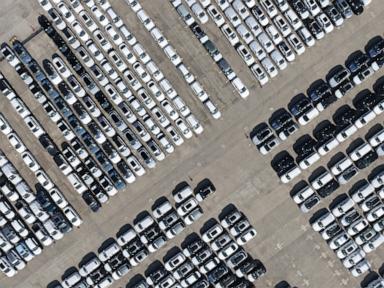
On a humid Tuesday afternoon at the Port of Shanghai, the air smells of salt, diesel, and fresh paint. If you stand near the pier, the sheer scale of the operation is enough to make you feel microscopic. Towering gantry cranes move with mechanical rhythm, lifting massive steel shipping containers and dropping them into the bellies of oceanic vessels. But recently, the cargo has changed. It is no longer just electronics in cardboard boxes or textiles wrapped in plastic.
It is cars. Thousands of them.
Rows upon rows of pristine, freshly minted vehicles bake under the summer sun, stretching as far as the eye can see. Most of them share a quiet characteristic: they do not rumble, they do not idle, and they do not emit a single puff of exhaust. They are electric.
While Western analysts debate policy and legacy automakers scramble to retro-fit century-old factories, an economic tidal wave has already crested. In June alone, China’s passenger car exports surged by a staggering 80%. This is not a gradual shift. It is an explosion. And behind that mathematical leap lies a human story of ambition, desperate reinvention, and a global tug-of-war that is reshaping town squares from Munich to Sydney.
The Ghost in the Assembly Line
To understand how we arrived at an 80% spike in a single month, you have to leave the coastal ports and travel inland to places like Hefei or Shenzhen. Think of a hypothetical engineer named Zhou. He is thirty-two, drinks too much instant coffee, and hasn't left his factory floor before 9:00 PM in six months.
Zhou grew up in a rural province where his family didn't own a car. Today, he manages a fleet of robotic arms that weld ultra-high-strength steel chassis for battery-electric SUVs.
For decades, the global automotive industry had a strict hierarchy. Detroit had muscle. Germany had precision engineering. Japan had reliability. China was where you sent cheap plastics to be stamped out by the millions. If you told a European executive twenty years ago that a Chinese sedan would soon rival their finest engineering, they would have laughed you out of the boardroom.
They aren't laughing anymore.
Zhou’s reality is one of relentless efficiency. In Western factories, changing a vehicle platform can take years of bureaucratic negotiations and union debates. In Zhou’s world, a design tweak based on real-time user data is implemented in weeks. The Chinese domestic market became a brutal, hyper-competitive Darwinian ecosystem. Hundreds of local EV brands fought to the death over the last decade. The ones left standing didn't just survive; they became apex predators.
Now, the Chinese market is saturated. Growth at home is cooling. The predators are hungry, and they are looking across the ocean.
The Arithmetic of Ambition
Numbers can be numbing, but let us look closely at what an 80% jump actually means. We are talking about hundreds of thousands of vehicles in a thirty-day window. This is not a statistical anomaly caused by a backlog of shipping orders. It is the result of a deliberate, multi-decade bet on electrification.
While the West viewed electric vehicles as a luxury niche or an environmental obligation, Beijing viewed them as a geopolitical escape hatch. China lacked the oil reserves of the Middle East and the combustion-engine legacy of Europe. But it possessed lithium, cobalt, and a massive supply chain for electronics. By skipping the internal combustion engine entirely—a process known as technological leapfrogging—they turned their weakness into a clean slate.
Consider the economics of a modern EV. The battery is the heart of the machine, accounting for roughly 40% of its total cost. China controls the vast majority of the world’s battery refining and manufacturing capacity. When a European automaker builds an EV, they often buy Chinese batteries. When a Chinese automaker builds an EV, they buy from the factory down the street.
The math is brutal. It allows a level of pricing power that traditional brands simply cannot match without taking massive losses.
But a car is not just a collection of steel and lithium. It is an emotional purchase. It is the second most expensive thing most families will ever buy. And that is where the real battle is being fought: not in the spreadsheets of economists, but in the minds of everyday drivers.
The Suburban Crossroads
Let us shift our gaze to a quiet suburb outside Brisbane, Australia. Meet Sarah. She is a working mother of two, hyper-aware of her monthly budget, and her ten-year-old gasoline hatchback is on its last legs.
Sarah wants to do the right thing for the planet, but she also needs to pay her mortgage. She walks into a local dealership expecting to look at traditional hybrids. Instead, she is confronted with a sleek, futuristic electric vehicle from a brand name she can barely pronounce. It has a glass roof, an infotainment screen larger than her living room television, and a price tag thousands of dollars lower than any Western or Japanese competitor.
She hesitates. There is a deeply ingrained skepticism about foreign manufacturing. Is it safe? Will the software glitch? Where do you get it serviced if something goes wrong?
This anxiety is the last line of defense for legacy automakers. Brands like Volkswagen, Ford, and Toyota survive on generations of trust. Your grandfather drove a Ford; your mother drove a Toyota; you buy a Volkswagen. That emotional inertia is incredibly powerful.
Yet, as Sarah sits in the driver's seat, feeling the premium synthetic leather and watching the seamless navigation system map out her route, the weight of tradition begins to erode. Financial reality is a powerful solvent for brand loyalty. When the price difference amounts to several months of groceries, history loses its grip.
Sarah’s dilemma is being repeated across Southeast Asia, Europe, and Latin America. In June, thousands of buyers chose the unknown brand over the legacy nameplate. Every one of those choices is a brick pulled from the foundation of Western industrial dominance.
The Invisible Walls
The sudden flood of vehicles has not gone unnoticed by global capitals. In Washington and Brussels, the 80% export surge looks less like a triumph of green technology and more like an existential threat to domestic jobs.
Tariffs are rising. Political rhetoric is sharpening. The argument from Western leaders is that Chinese automakers benefit from unfair state subsidies, allowing them to flood markets and crush local competition.
It is a messy, complicated argument. To a degree, it is true; the Chinese government heavily funded the early days of its EV sector. But it also ignores the sheer scale of innovation that happened along the way. You cannot subsidize your way into making a vehicle that consumers genuinely want to buy. The quality, the software integration, and the battery range of these exported cars are a result of genuine, cutthroat engineering competition.
The imposition of tariffs creates a fascinating paradox. By blocking or taxing these affordable electric vehicles, Western governments protect their domestic automotive workers, but they simultaneously slow down their own climate goals. If the average citizen cannot afford an electric vehicle made at home, and the cheap imported ones are locked behind a tariff wall, the transition away from fossil fuels stalls.
It is a high-stakes game of chicken. Chinese manufacturers are already adapting. Blocked by direct shipping routes, they are investing heavily in factories within Europe and South America, effectively bypassing the trade barriers by becoming local employers.
The Quiet Harbor
The sun is setting over the Port of Shanghai now, casting long shadows across the thousands of metallic roofs waiting for the evening tide. The cranes have not stopped moving.
This export surge is not a temporary trend or a seasonal spike. It is the sound of the world’s economic center of gravity shifting a few inches to the East. It is the culmination of millions of hours of labor from engineers like Zhou, and the beginning of a profound transformation for consumers like Sarah.
The legacy automakers of the world are waking up to a reality where their history is no longer a shield. The global market does not care about nostalgia. It cares about value, technology, and execution. As the massive transport ships slip away from the Chinese coast and head out into the open ocean, they carry more than just cars. They carry the blueprint of a new industrial era, silently traveling toward a driveway near you.