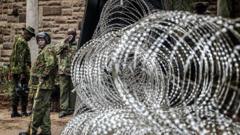
The metal barriers went up before the sun could fully burn through the morning fog of Nairobi. Heavy, rusted, and unyielding, they clamped down on the asphalt arteries that feed the heart of the city. Officers in deep blue utilities stood in clusters, their boots snapping against the pavement, tear gas canisters glinting against their vests.
By mid-morning, Uhuru Highway was a ghost of itself. No roaring matatus spitting black exhaust. No street vendors weaving through gridlocked sedans with handfuls of plastic-wrapped maps or sweet bananas. Just an eerie, enforced quiet.
To a casual observer, or a distant news editor skimming a wire service feed, the scene could be filed away as standard state choreography. A government protecting its infrastructure. A security apparatus managing a crowd. But if you stand on the cracked pavement of CBD long enough, you realize the barricades are not just stopping traffic. They are trying to stop a memory.
Consider what happens when a city is forced to look at its own reflection in the shield of a riot officer.
For weeks, the youth of this country did something unprecedented. They did not gather under the banners of traditional political dynasties. They did not march for a tribal kingpin. They walked out of their offices, their universities, and their small market stalls because the math of survival had simply stopped working. A proposed finance bill, heavy with taxes on basic necessities, became the breaking point. But when the dust settled from those initial confrontations, the conversation shifted from ledger lines to human lives.
Today was supposed to be a walk of remembrance. A quiet procession to honor those who fell during the chaotic weeks of confrontation. Yet, the response was a city locked down, transformed into a maze of checkpoints and diverted paths.
To understand why a state fears a memorial march, you have to look past the political speeches and focus on the quiet reality of a single household in the settlements bordering the city center. Let us look at a mother—we can call her Mary, a name shared by so many who watched their children walk out the door with nothing but a phone and a bottle of water.
Mary does not understand macroeconomics. She does not read the policy briefs floating around the parliament buildings. What she understands is that her son, a twenty-two-year-old computer science student who spent his nights freelance coding on a cracked screen, never came home. He was not throwing stones. He was recording a video, trying to show the world what was happening on the streets of his city.
When the news reports state that "key roads were sealed off to maintain order," it completely misses the point. The order they are maintaining is built on a foundation of unacknowledged grief.
Grief is heavy. It does not disappear just because an intersection is blocked. Instead, it pools at the edges of the barricades.
As the morning progressed, small groups began to gather near the edges of the police lines. There were no megaphones today. No chants. The energy was different—sober, tense, and deeply personal. Young men and women stood in pairs, holding white flowers, their eyes fixed on the line of officers who stood mere yards away.
The standoff was entirely digital and entirely physical all at once. Even as the physical paths were blocked, phones were raised. Streams of live video bypassed the metal blockades, broadcasting the empty streets to millions of screens across the continent. The state could control the asphalt, but they had entirely lost control of the airwaves.
An older man, his coat worn thin at the elbows, tried to cross the street toward a pharmacy behind the police line. An officer waved him back with a short, sharp motion of his baton. The old man did not argue. He simply turned around, his shoulders slumping. That small interaction tells the entire story of the day. The measures meant to contain a protest end up paralyzing the ordinary life of the very citizens the state claims to protect.
The real problem lies elsewhere, far beneath the immediate tension of blocked highways. It is the widening chasm of trust. When a population believes that its grief is viewed by the state merely as a logistical threat to be managed, the contract between the governor and the governed is broken. You cannot police a people into forgetting their dead.
Every barricade erected on Uhuru Highway is a physical manifestation of fear. Not the citizens' fear of the police, but the authorities' fear of what happens when a community collectively remembers its losses. A crowd demanding economic reform is a political problem. A crowd mourning its children is a moral one.
As midday approached, the sun broke through the cloud cover, baking the empty tarmac. A single young woman walked up to the front of the barricade. She did not shout. She did not throw anything. She carefully placed a single red rose at the base of the metal barrier, right at the feet of an officer whose face remained masked behind a plastic visor.
For a second, nobody moved. The officer looked down at the flower, then back up at the crowd. In that brief, agonizing silence, the entire weight of the country's struggle hung in the balance. The flower remained on the asphalt, a small splash of color against the grey metal and the blue uniforms.
The streets will eventually reopen. The matatus will return, their horns blaring, filling the air with the familiar chaos of Nairobi life. The barriers will be loaded back onto the flatbeds and stored away in police depots until the next flashpoint. But the memory of what happened on these streets cannot be cleared away by a sweep of a broom or a command from a superintendent.
The silence enforced on the highway today did not stifle the message. It only made the echoes louder.