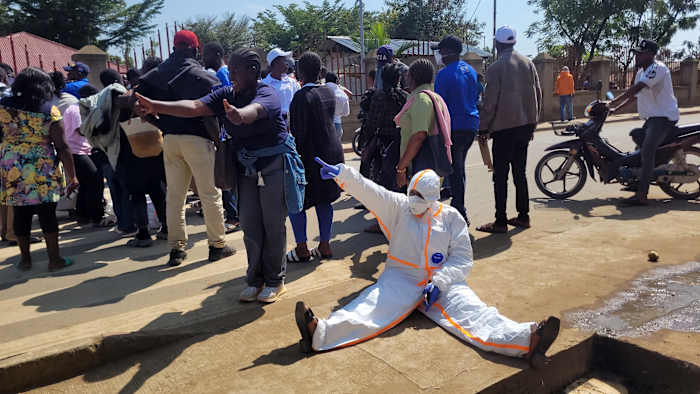
The air inside the clinic smelled of bleach, warm sweat, and the unmistakable, metallic tang of fear.
It was three in the morning. Dr. Aruna Mansaray sat on an upturned plastic bucket, her forehead pressed against the cool concrete wall of an isolation ward. Her fingers, stripped of sensation by hours inside thick latex gloves, throbbed. Outside, the generator hummed its steady, deafening lullaby, keeping the lights burning over rows of cots that were filling faster than the medical supplies could arrive.
She listened. Not to the monitors, but to the silence outside the corrugated iron gates.
That silence was dangerous. It was the sound of a strike.
Across the region, the outbreak was accelerating. Numbers climbed on government dashboards like rising floodwaters, neat little rows of data points representing lives unraveling in real time. But spreadsheets do not capture the sound of a mother whispering a final blessing to a child she cannot touch. Spreadsheets do not bleed. They do not walk off the job because their last paycheck bounced three months ago, leaving them unable to buy rice, let alone the chlorine needed to sanitize their own doorhandles.
We talk about outbreaks as if they are weather events. A storm rolls in from the forest. A virus leaps a species barrier. We track the transmission chains with clinical detachment, plotting R-naught values and incubation periods on glowing screens miles away from the dust and the heat.
This is a profound mistake.
An epidemic is not merely a biological phenomenon. It is a social mirror. And right now, that mirror reflects a system built on the quiet exploitation of the people holding the line.
Consider what happens when the frontline breaks.
Three days prior, at the regional hospital, the nurses laid down their clipboards. They did not do it out of malice. They did it because exhaustion has a breaking point. When you are asked to walk into a hot zone day after day without adequate personal protective equipment, without hazard pay, and without the basic dignity of timely wages, survival takes on a different meaning. You cannot pay for your children's school fees with applause. You cannot feed your family with moral victories.
The strike was inevitable. The government called it reckless. The international agencies called it a logistical crisis. Aruna called it Tuesday.
"If I go home, my children eat," a senior nurse named Mariama had told her the night before she walked out. Her eyes were rimmed with pink from lack of sleep. "If I stay here, I might save a stranger's child, but mine will starve in the courtyard. Tell me, Doctor. Which choice makes me a monster?"
Aruna had no answer. Because in the calculus of crisis management, human beings are routinely treated as infinite resources until they shatter.
Epidemiology has a vocabulary for this. We speak of healthcare worker attrition, operational bottlenecks, and supply chain fractures. These are sanitized terms designed to make catastrophe palatable to committee rooms. Strip away the jargon, and you find a terrifyingly simple reality: disease exploits our systemic failures with mathematical precision.
When nurses strike, triage tents empty. When triage tents empty, patients panic. When patients panic, they flee into the community, carrying the fever with them into crowded markets, onto packed buses, and into homes where elder relatives wait unprotected.
The virus does not negotiate. It does not care about budgetary impasses or bureaucratic delays. It only requires a host, and a system too fractured to mount a defense.
History warned us this would happen. In past outbreaks across West Africa and beyond, the pattern repeated with the cruel predictability of a metronome. First comes the pathogen. Then comes the heroic mobilization of local clinicians. Then come the broken promises of financial support from distant capitals. Then comes the walkout. And finally, the exponential surge that everyone pretended to see coming too late.
We romanticize resilience until it becomes an excuse for neglect. We praise the courage of doctors sleeping on floors while quietly ignoring the fact that the floor shouldn't have been their bed in the first place.
Back in the ward, a monitor beeped. A sharp, rhythmic plea for attention.
Aruna lifted her head from the wall. Her joints popped. Her back screamed in protest. She pulled on a fresh pair of gloves—recycled, carefully inspected for microscopic tears—and walked back into the light.
The patients were waiting. The fever was waiting.
And somewhere out there in the dark, the strike held firm, a silent testament to the cost of taking the irreplaceable for granted.