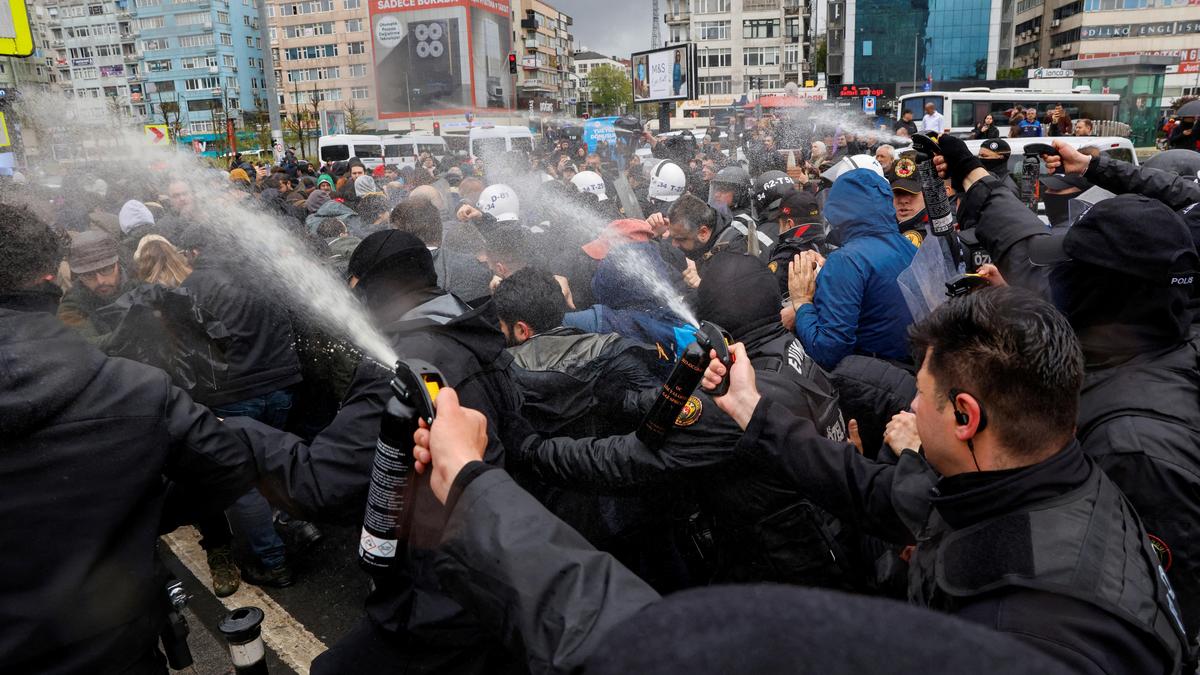
The checkpoints began miles before the square. By dawn on May 1, 2026, Istanbul had been surgically bifurcated. Public transport ground to a halt, ferry lines across the Bosphorus were severed, and over 40,000 police officers formed a human ring around the city's historical heart. The official justification was security, but the reality was a choreographed display of state dominance intended to ensure that not a single labor union banner touched the stones of Taksim Square. This was not a standard policing operation. It was a total urban blockade.
For the Turkish government, Taksim is not a plaza. It is a ghost. Since the Gezi Park protests of 2013, the square has been treated as a radioactive site of potential dissent. While the media often frames these May Day clashes as a simple dispute over parade routes, the conflict runs much deeper. It is a battle over the right to exist in the physical world without state permission. When the tear gas canisters began arching over the barricaded streets of Beşiktaş and Saraçhane this morning, they weren't just dispersing crowds. They were enforcing a decade-long policy of geographic erasure.
The Infrastructure of Exclusion
Istanbul’s transformation into a city of internal borders did not happen overnight. The strategy is built on a sophisticated blend of legal maneuvers and physical barriers. Under the current administration, the Governor’s office has turned "administrative bans" into a permanent feature of the metropolitan landscape. By designating Taksim as off-limits for demonstrations, the state creates a legal vacuum where any citizen standing in the street becomes a criminal by default.
The logistics of the 2026 crackdown reveal an escalation in technical precision. Police used mobile facial recognition towers at major transit hubs and deployed high-altitude drones to track small clusters of marchers long before they reached the primary barricades. This is proactive policing—a method designed to break the momentum of a crowd before it can even form. By the time the first 200 arrests were recorded, most of the detainees hadn't even reached a picket line. They were intercepted in side alleys or pulled off buses.
The Geography of Fear
Why is the state so afraid of a square? To understand the violence, one must look at the topography of Istanbul. Taksim sits at the top of a hill, overlooking the city's commercial and cultural arteries. In the logic of Turkish political history, whoever holds the square holds the narrative of the nation.
- Symbolic Weight: The 1977 May Day massacre, where dozens were killed, turned Taksim into a site of martyrdom for the left.
- Visibility: Unlike the designated "meeting areas" provided by the government—often remote, wind-swept reclaimed land on the outskirts of the city—Taksim is visible. It is unavoidable.
- The Gezi Trauma: The 2013 protests proved that a small spark in this specific location can ignite a national firestorm. The current security posture is a direct response to that lingering anxiety.
The government offers "Yenikapı" as an alternative—a massive, sterile concrete pad on the coast. It is a space designed for controlled speeches and state-sanctioned rallies. It has no history. It has no neighbors. To the unions, accepting Yenikapı is an admission of defeat. It is an agreement to be loud in a place where no one can hear you.
The Economic Engine of Dissent
While the headlines focus on the smoke and the plastic shields, the fuel for this year’s fervor is purely economic. Turkey’s inflation has remained stubbornly high, eroding the purchasing power of the middle and working classes to a degree not seen in a generation. The "labor" in May Day is no longer just a socialist abstraction. It is a cry of desperation from people who can no longer afford rent in the very city they are being banned from protesting in.
The police officers firing the tear gas and the protesters breathing it in often come from the same economic bracket. This is the great irony of the Istanbul barricades. The state relies on a massive security apparatus composed of young men from rural provinces who are equally squeezed by the skyrocketing cost of living. Yet, the hierarchy holds. The state ensures loyalty through a mix of nationalist rhetoric and the basic necessity of a government paycheck.
A Breakdown of the Numbers
The scale of the 2026 mobilization is staggering when compared to previous years.
| Metric | 2022 Stats | 2026 Stats |
|---|---|---|
| Personnel Deployed | 15,000 | 42,000+ |
| Road Closures | 24 major routes | 68 major routes |
| Detentions (by noon) | 160 | 210 |
| Drone Surveillance | Limited | Constant/Multi-tier |
These figures suggest that the state no longer views May Day as a seasonal nuisance. It treats it as a high-stakes counter-insurgency operation. This shift signifies a loss of confidence in "soft" political control. When a government can no longer win the argument through the economy or the ballot box, it resorts to the physical occupation of its own streets.
The Legal Shell Game
The international community often views these arrests through the lens of human rights violations. While accurate, this perspective misses the cleverness of the Turkish legal strategy. The authorities rarely ban "labor rights" as a concept. Instead, they ban "the location" due to "intelligence of a terror threat" or "disruption of public order."
This creates a circular legal logic. The protest is banned to prevent disruption; the protest happens anyway because the ban is seen as unconstitutional; the resulting police intervention causes the very disruption that was cited as the reason for the ban. The blame is then shifted onto the "unruly" participants who refused to go to the designated concrete pads on the city's edge.
Lawyers for the unions argue that the European Court of Human Rights has repeatedly ruled in favor of Taksim as a legitimate site for assembly. The Turkish Constitutional Court has echoed this. Yet, on the morning of May 1, the word of a government-appointed governor carries more weight than the highest courts in the land. The rule of law has been replaced by the rule of the barrier.
The Role of Independent Media
The crackdown also targeted the witnesses. Journalists attempting to film the arrests near Barbaros Boulevard were pushed back with shields, their press cards scrutinized with a hostility usually reserved for combatants. In an era where everyone has a smartphone, the state’s goal is not to hide the violence—it is to control the angle. They want the footage to show the power of the state, not the faces of the arrested.
The strategy is working. Most mainstream Turkish outlets carried sanitized versions of the day, focusing on the "opening of roads" and the "efficiency of the security forces." The reality of the gas-choked side streets of Cihangir and the bruised students being dragged into unmarked vans was relegated to social media feeds, which were intermittently throttled throughout the afternoon.
The Long Shadow of Authoritarian Urbanism
This isn't just about May Day. It is about the future of the city. Istanbul is being redesigned to be "protest-proof." The removal of benches from public squares, the narrowing of certain sidewalks, and the massive increase in CCTV coverage are all part of a larger project of authoritarian urbanism.
A city that cannot be walked is a city that cannot organize. By breaking the physical connectivity of Istanbul, the government breaks the social connectivity of the opposition. The "hundreds" arrested today are a symptom. The cause is a systematic effort to turn the public into a collection of isolated commuters rather than a collective of citizens.
The standoff at the Saraçhane aqueduct today was particularly telling. Protesters stood beneath the Roman arches, blocked by a wall of riot shields. Behind them lay the history of a city that has seen empires fall. In front of them was the modern machinery of a state that refuses to let the past repeat itself.
The water cannons were used with a frequency that suggests the state has moved past the point of negotiation. There is no middle ground when the very presence of a citizen in a square is interpreted as an existential threat to the regime. The government won the day in a tactical sense. Taksim remained empty, save for the pigeons and the police. But this is a pyrrhic victory. You can clear a square with gas, but you cannot clear the resentment that settles in the lungs of everyone who was there.
The siege of Taksim is not a sign of strength. It is the ultimate admission of fragility. A confident state does not need 40,000 men to guard a patch of pavement from its own people.
Identify the trend. The next time the barricades go up, they will be higher, and the desperation of those on the other side will be deeper. The state has mastered the art of clearing the streets, but it has completely forgotten how to listen to them.