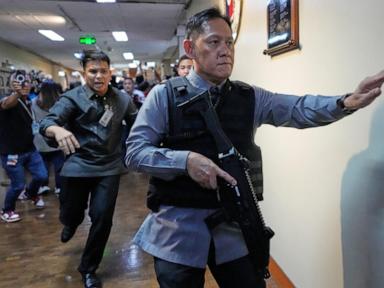
The sound of gunfire echoing through the halls of the Philippine Senate marks more than a botched arrest or a standard political skirmish. It represents a total collapse of the unspoken treaty between the branches of government. When tactical units breached the legislative compound to apprehend a sitting senator, they didn’t just bring handcuffs; they brought a physical manifestation of an executive branch that no longer views the Senate as a co-equal power. This is the brutal reality of a shifting political order where the traditional shield of parliamentary immunity has been traded for the blunt instrument of police intervention.
The incident centers on the attempted detention of a lawmaker under circumstances that bypass conventional protocols. In the Philippines, the Senate has historically been treated as a sanctuary, a place where even the most controversial figures are afforded a degree of protection to prevent the executive from silencing dissent through arbitrary arrest. That sanctuary is now gone. The breach signifies that the guardrails intended to protect the legislative process are being systematically dismantled, replaced by a doctrine of "enforcement at any cost."
The Myth of Parliamentary Protection
For decades, the concept of parliamentary immunity served as a cornerstone of the Philippine Republic. It was designed to ensure that senators could speak truth to power without the immediate threat of being dragged away in the middle of a session. However, the legal definition of this immunity is surprisingly narrow. Under the 1987 Constitution, a legislator is only immune from arrest for offenses punishable by not more than six years of imprisonment while the Congress is in session.
The authorities used this specific legal loophole as a battering ram. By framing the charges as "non-bailable" or carrying heavy sentences, the executive branch has found a way to weaponize the judicial system against its rivals. This isn't just about one man. It is about a blueprint for how to decapitate the opposition without needing to declare martial law. When the police entered the Senate premises, they weren't just looking for an individual; they were testing the structural integrity of the building’s legal status.
The Mechanics of the Breach
The operation was not a spontaneous escalation. Investigative tracks show a coordinated effort involving specialized units that operated outside the normal chain of command for Senate security. Typically, the Sergeant-at-Arms is the final authority on who enters the chamber with a weapon. In this instance, that authority was ignored.
Witnesses describe a scene of calculated chaos. The deployment of tactical gear and long firearms within a civilian administrative building was a deliberate choice meant to intimidate. It served as a visual message to the public: no one is out of reach. The gunfire, whether accidental or intended as a warning, broke a decades-long streak of relative peace within the GSIS building that houses the Senate.
A History of Legislative Harassment
This crisis didn't emerge from a vacuum. It is the culmination of years of escalating tension between the executive and legislative branches. We have seen this play out before in smaller, quieter ways—frozen budgets, delayed appointments, and the selective prosecution of mid-level staffers. But the physical invasion of the Senate marks a point of no return.
In the past, political disputes were settled in the Supreme Court or through the ballot box. Now, they are being settled in the hallways with flashbangs and sidearms. This shift suggests that the administration has lost patience with the slow grind of democratic procedures. When the law becomes an obstacle to the executive's will, the executive simply changes the environment in which the law is applied.
The Failure of Senate Leadership
One cannot analyze this event without looking at the internal fractures within the Senate itself. A chamber that was once fiercely protective of its independence has become a house divided. The leadership’s inability—or unwillingness—to prevent the police from entering the premises suggests a deep-seated fear of reprisal.
If the Senate President cannot guarantee the safety of the members within their own house, the institution loses its legitimacy. The silence from certain factions within the chamber speaks louder than the gunfire. It indicates a level of complicity or, at the very least, a resignation to the new status quo. The "August Body" is beginning to look like a mere department of the executive office.
The Economic Fallout of Political Instability
While the headlines focus on the drama of the arrest, the business community is watching with a different kind of dread. Capital is cowardly. It flees at the first sign of institutional instability. When the highest legislative body in the land is subjected to armed raids, it sends a signal to international investors that the rule of law in the Philippines is secondary to political whim.
The peso’s performance and the flight of foreign direct investment are closely tied to the perceived stability of democratic institutions. If a senator can be hunted down in the halls of power, what protections does a foreign corporation have? The erosion of the Senate’s sanctity is a direct threat to the country’s credit rating and its standing in the global market. This isn't just a local news story; it’s a warning to the World Bank and every multinational firm operating in Manila.
Corruption and the Convenience of Arrest
Often, these high-profile arrests are shielded by the rhetoric of anti-corruption. The public is told that the "law is the law" and that no one is above it. While the charges against the targeted senator may or may not have merit, the timing and the method of the arrest suggest that the motive is less about justice and more about optics.
True justice doesn't require a midnight raid with masked gunmen. It requires a transparent trial and a respect for due process. When the state chooses the most violent path to enforce a warrant, it admits that it is more interested in the spectacle of power than the substance of the law. This is a classic strongman tactic: use the tools of justice to perform an act of political theater.
The Role of Modern Surveillance
The investigative trail leads to the increased use of advanced surveillance technology in the lead-up to the raid. Reports suggest that the senator's movements were tracked using a combination of digital footprints and physical tailing that exceeds the standard requirements for a criminal investigation.
The integration of state-sponsored spyware and traditional policing has created a dragnet that makes it nearly impossible for political targets to find refuge. The Senate, once thought to be a "dead zone" for such operations, has proven to be as porous as any other building. The technology used to coordinate this raid reveals a level of technical sophistication that is being turned inward, against the state's own citizens and representatives.
The Precedent of Violence
By normalizing gunfire in the Senate, the current administration has lowered the bar for future conflict. Once a line is crossed, it stays crossed. Future administrations will look back at this day as a justification for their own use of force. The dangerous precedent here is that political problems now have military solutions.
We are moving toward a system where the winning side of an election gets to use the police as a personal security detail and the losing side ends up in a cell or worse. This "winner-takes-all" mentality is the death knell for a functioning republic. It turns every election into a high-stakes battle for survival rather than a debate over policy.
The International Response and Its Limits
Expect a flurry of "concerned" statements from Washington, Tokyo, and Brussels. They will speak of "democratic norms" and "human rights." But these statements are largely hollow. The Philippine government knows that as long as it remains a strategic partner in the Pacific, it can get away with a significant amount of domestic repression.
Geopolitics often trumps internal human rights concerns. The administration is betting that the world will look the other way in exchange for continued access to military bases and trade routes. This cynical calculation is what allows such blatant violations of legislative independence to occur. The international community might wag its finger, but the police will keep their boots on the Senate floor.
The Fracturing of the Police Force
Not every officer involved in the operation was comfortable with the task. Information from internal sources suggests a rift within the Philippine National Police (PNP) regarding the legality of the raid. Younger officers, trained in modern human rights protocols, found themselves at odds with a command structure that demanded immediate, violent results.
This internal friction is a ticking time bomb. When the police force is used as a political weapon, it loses its professional identity. It becomes a paramilitary wing of the ruling party. This degradation of the police force is one of the most long-lasting and damaging effects of the Senate siege. It will take generations to rebuild the trust that was shattered in a single afternoon of gunfire.
The End of the Gentlemen's Agreement
The Senate was built on "gentlemen's agreements"—informal rules that kept the peace between rival political families. Those agreements are now dead. The current political climate favors the ruthless and the loud. The quiet negotiations that used to happen behind closed doors have been replaced by public executions of character and physical intimidation.
The legislative branch is now in a state of permanent defensive crouch. Senators who were once outspoken critics of the executive have suddenly gone quiet. They have seen the gunmen in the halls. They know that the walls of the Senate are made of glass, not stone. The chilling effect of this operation cannot be overstated; it has silenced the only body capable of providing a check on executive power.
Accountability and the Long Memory of the People
The public’s reaction has been a mix of shock and weary indifference. In a country where extrajudicial killings have become common, gunfire in the Senate is just another Tuesday for some. But for those who remember the struggles for democracy in the 1980s, this is a haunting echo of the past.
The people are watching, and while they may seem quiet now, history shows that the Filipino public has a low tolerance for the blatant abuse of power. The administration may have won the day, but they have seeded a deep resentment that will eventually find its way to the surface. Power that relies on a gun is power that is fundamentally fragile.
The Next Phase of the Crackdown
With the Senate breach successful, the focus will likely shift to the judiciary. The courts are the last remaining hurdle for an executive seeking total control. We can expect to see a similar pattern: the use of technicalities to disqualify judges, the deployment of "volunteer" groups to harass legal officials, and the continued use of high-profile arrests to send a message of fear.
The goal is not just to arrest one senator. The goal is to reshape the entire Philippine state into a top-down hierarchy where the president’s word is the only law that matters. The gunfire in the Senate was the starting gun for this new era. The traditional mechanisms of democracy are being replaced by a system of "enforced compliance" that leaves no room for debate or dissent.
The state has demonstrated that it is willing to use lethal force within the heart of its own government. This is no longer a theoretical debate about the separation of powers. It is a physical reality. The Senate is no longer a sanctuary; it is a crime scene. When the smoke clears and the glass is swept away, the question won't be who was arrested, but what—if anything—remains of the republic. The silence that follows a gunshot is often more telling than the noise itself. It is the sound of an institution holding its breath, waiting for the next door to be kicked in. This is not a drill. It is the end of an era. The only remaining question is how much further the state is willing to go to prove it is the only power that matters. We are about to find out.
Seek legal counsel immediately if you are a public official targeted by these shifting enforcement tactics; the old rules of immunity no longer apply.