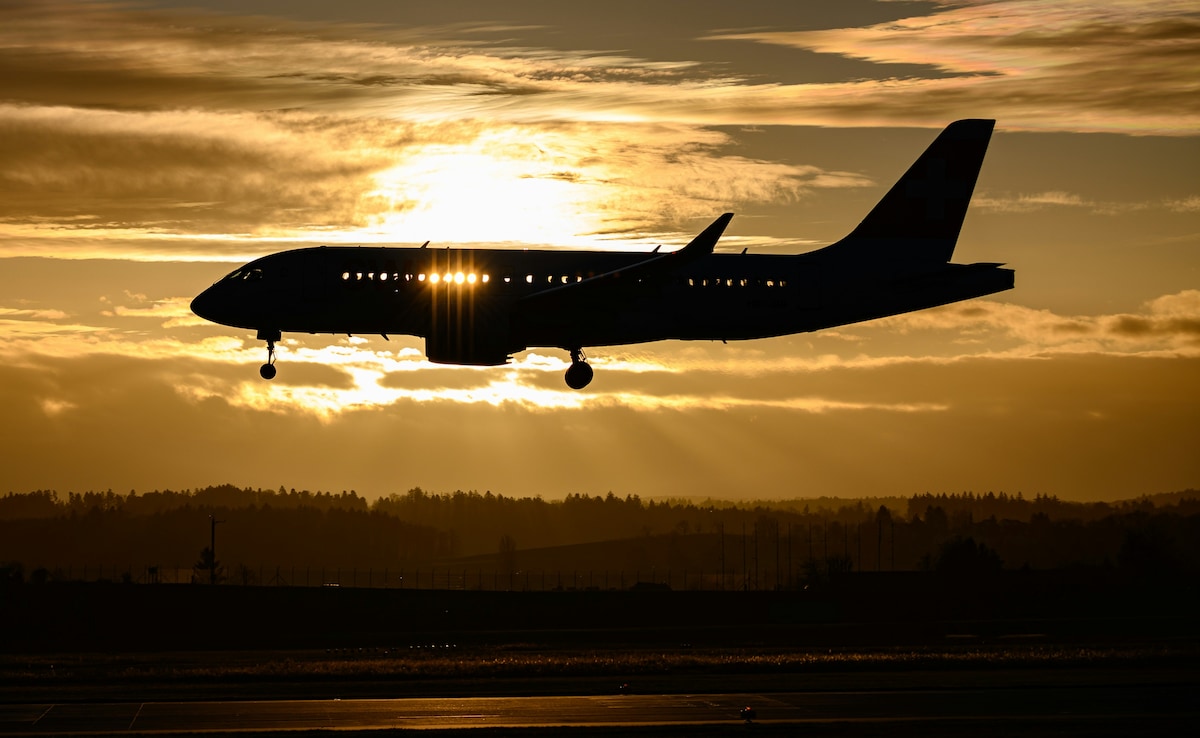
The cockpit of a Boeing 737 is a cathedral of controlled logic. It is a space where every sound has a meaning and every vibration is accounted for. Captain Miller—let’s call him that to protect a career built on decades of uneventful landings—was descending toward a major U.S. metropolitan airport, his mind synced with the rhythmic pulse of the flight deck. The landing gear was down. The flaps were set. The runway was a gray ribbon growing larger against the urban sprawl. Then came the sound that should not exist at four thousand feet.
Thud.
It wasn't the metallic screech of an engine failure or the hollow pop of a bird strike. It was something denser. A dull, heavy impact against the fuselage that vibrated through the floorboards and into Miller’s boots. In that split second, the air in the cockpit changed. The logic broke.
The Toy That Became a Tomahawk
For decades, the sky was a tiered cake. Commercial liners owned the high altitudes, general aviation claimed the middle, and the birds kept the rest. It was a predictable, regulated ecosystem. But we have entered an era where the cake has been smashed. The democratization of the sky, brought to you by the local electronics store, has introduced a wild card that the aviation industry is only beginning to grasp.
A standard consumer drone weighs about as much as a large book. To a person standing in a park, it is a miracle of stability and photography. To a turbofan engine spinning at twelve thousand revolutions per minute, it is a grenade.
When a bird hits a plane, it is a tragedy of biology. Soft tissue, feathers, and hollow bones are designed by nature to be light; when they meet a jet engine, they usually disintegrate. Engines are tested to withstand these "ingestion events." But a drone is not soft. It is comprised of lithium-polymer batteries, carbon fiber frames, and hardened plastic rotors.
Consider the physics of the encounter. A drone hovering at two pounds becomes a kinetic hammer when struck by an aircraft traveling at two hundred miles per hour. This isn't a theory. It is a matter of $F = ma$. The force exerted on the aluminum skin of a commercial jet during such a collision can exceed several tons of pressure concentrated into a space no larger than a smartphone.
A Ghost in the Radar
Miller scanned his instruments. No warning lights. No loss of hydraulic pressure. But the "what if" began to crawl up his spine. If that object had been ingested by the engine, the blades could have shattered, sending shrapnel through the wing and into the fuel tanks. If it had struck the windshield, the reinforced glass might have held, but the sudden obscured vision during the most critical phase of flight—the landing—could have turned a routine arrival into a mass casualty event.
The terrifying reality of modern aviation is that these objects are nearly invisible to traditional Air Traffic Control (ATC). Primary radar is designed to pick up large metallic structures. Secondary radar relies on transponders. A plastic drone, barely larger than a dinner plate, exists in the "clutter." It is a ghost.
Pilots are now reporting these encounters with staggering frequency. These aren't just mistakes; they are symptoms of a profound disconnect between technology and responsibility. We have given the average person the power to enter restricted airspace with zero training and even less understanding of the stakes involved.
The Invisible Boundary
There is a legal line in the sky, usually a five-mile radius around airports, where drones are strictly prohibited. These "No Fly Zones" are hardcoded into the software of many high-end drones. But software is a fence made of sand. It can be bypassed. It can be "jailbroken." Or, more commonly, it can be ignored by those using home-built kits that lack these digital guardrails.
Why does someone fly a drone near an airport? Usually, it's for the "ultimate shot." They want to capture the belly of a leviathan as it passes overhead, seeking a viral moment for a social media feed. They are chasing a digital thumb-up while risking the lives of three hundred people who are currently worrying about their connecting flights or whether they left the oven on at home.
The stakes are invisible until they aren't.
The pilot’s perspective is one of extreme vulnerability. At four thousand feet, they are committed. They are on a tether of physics and momentum. They cannot swerve. They cannot "pull over." They are flying a massive, pressurized tube through a narrow corridor of space, and they are doing it with the assumption that the corridor is clear. When that assumption is shattered by a hobbyist's toy, the contract of safety that allows global travel to function begins to fray.
The Cost of a Second
We often talk about the "human element" in accidents as a mistake made by the professional. We analyze pilot fatigue, maintenance errors, and ATC miscommunications. But the new human element is the stranger on the ground.
Security experts are scrambling to catch up. They are testing "drone jammers," which use radio frequency interference to drop drones out of the sky, and even trained hawks to intercept them. But these are reactive measures. They are Band-Aids on a wound that is widening.
The real problem lies in the lag between innovation and regulation. We have built a world where a fifty-dollar motor can reach altitudes that were once the exclusive province of multimillion-dollar machines. We have bypassed the gatekeepers of the sky.
The Walk-Around
After Miller landed safely—miraculously, without a catastrophic failure—he performed his post-flight walk-around. He carried a flashlight, tracing the smooth lines of the aircraft he had lived in for half his life. Near the nose gear, he found it.
A smudge of black plastic. A deep, jagged dent in the fairing.
He touched the cold metal, feeling the raw power of the impact. He thought about the passengers who had just walked off the plane, grumbling about the weather or the price of airport coffee. They had no idea. They had been separated from a disaster by a few inches of reinforced aluminum and a stroke of sheer, unadulterated luck.
Luck is not a safety protocol.
As the sun set over the tarmac, Miller looked up into the darkening sky. Somewhere out there, beyond the perimeter fence, another light was blinking. It wasn't a star, and it wasn't a plane. It was a small, hovering silhouette, waiting for the next giant to pass.
The sky used to be a sanctuary of order. Now, it is a place where a thousand-mile-per-hour machine can be brought down by a battery and a bit of reckless curiosity. We are flying in a crowded room with our eyes closed, hoping we don't hit the furniture we didn't know was there.